Friday, October 29, 2010

Profits Down? Raise Your Rates

When sales are down, the first instinct for many business owners is to lower their prices.

You, too? The temptation is strong.

Yet, you ought to resist that temptation. Or, even, do the opposite -- raise your rates when sales are slow.

That's been my experience since 1998. And it's the subject of a recent article in The Wall Street Journal. Here's the key excerpt:

But some research indicates that racing to lower prices—even if it lures more customers—doesn't usually put a company ahead. Even in down economies, raising prices just slightly can have a greater bottom-line impact than lowering them, according to a study in the McKinsey Quarterly, published by the business management advisory firm McKinsey & Co.

A price rise of 1% at an average company in the S&P 1500 index, which includes large-, mid- and small-cap companies, would generate an 8% increase in operating profit if sales volume stays steady, the study found. By contrast, a price discount of 1% reduces profit by 8%. Typically, in order to offset the impact of a 5% price cut, volume would have to rise by about 19%.

Small firms, especially, are likely to feel the impact of a price cut because—unlike big-box stores—each product represents a much larger portion of their profitability ...

It's an eye-opening article, with at least four takeaways you can profit from today ...

1) Raise your level of service along with your prices, for maximum effect (that's what Allen Ackerman did when he added the social networking tool and raised his fees):

 ... business owners walk a fine line between increasing revenue and alienating customers. A-List Placement's Mr. Ackerman says prices at his firm went up in tandem with extra services he offered.

A-List Placement claims a percentage of each new hire's salary, historically about 20%. But when hiring dried up a few years ago and his clients wanted to pay less, Mr. Ackerman decided to created an online social-networking tool, called the Hire Syndicate, that allows recruiters to share information about candidates and job openings. The 500 recruiters now using the site can more quickly find the perfect match for clients.

He says that enhanced service allows him to charge as much as 25% of the employee's salary today, though he makes an exception for long-time clients who say they can't afford the new rates.

2) Go after those clients who can pay more (that's what Brett Klasko does in targeting high net-worth investors with his newsletter service):

... His New York-based firm, Investors Alley Corp., sends stock-market newsletters via email to subscribers.

The company, which generates most of its revenue from advertisers, invested in a better email delivery system last year to insure the newsletters were delivered more quickly and didn't get caught in spam filters. That move boosted his circulation—from 75,000 readers in 2008 to 125,000 today—and allowed him to target more-active and higher net-worth traders. Not one advertiser left when Mr. Klasko raised prices 7% earlier this year, he says. 

3) Bundle products/services together when charging more (that's what Shel Horowitz did when he switched from charging by the hour to charging by the project):

... Horowitz, who owns Accurate Writing & More in Hadley, Mass., offers marketing services such as writing book jackets and press releases. After business dropped 25% in the recession, he decided to change his pricing model from $175 an hour to a set amount for each assignment. The new prices deliver an about 25% to 30% pay increase from his prior model, he says.

"A lot of clients are more comfortable with a flat-fee per service," he explains, adding that returning customers haven't been fazed by the change.

4) Test small, to avoid big disasters (that's what Manny Apolonio did when upping his rates to $40-60 for a few clients, who didn't flinch):

He had set up his company, a concierge service that runs errands for clients, a year ago with rates of between $20 and $40 an hour. As he became inundated by referrals, Mr. Apolonio realized that there was opportunity to raise prices to between $40 and $60 an hour.

"I tested the waters with a few clients and they were totally receptive. We became profitable in June and I'm still incredibly busy," he says.

In most of the cases I've seen over the years, higher prices are more of a barrier in the business owner's mind than in the customer's. But, as with all new ideas, test small before rolling out big.

This is another example of "Inside Marketing" -- improving your marketing from the inside, by making a few changes to what you're already doing.

(For more ideas like these, download Guaranteed Marketing for Service Business Owners.)

Thursday, October 28, 2010

Thank You = Power Marketing

You know I'm a fan of mailing handwritten thank-you notes to clients. A. Big. Fan.

Thank-you notes pay big dividends, in my experience.

As William James wrote: "The deepest principle in human nature is the craving to be appreciated." A thank-you note mailed to clients shows how much you appreciate them. You satisfy a craving when you do this. And your clients will always -- always -- reward you for this.

In his excellent book, You, Inc., Harry Beckwith writes: "Handwritten thank-you notes feel like gifts because you took the time to find the paper and envelope, write the note, affix the stamp, and gift-wrap your note in its package."

Finally, to drive this point home, here are two mini-case studies from the book, Thank You Power, by Deborah Norville:

1) According to a 1995 study by Bruce Rind and Prashant Bordia, restaurant servers who wrote "Thank you" on the check before handing it to their customers got tips averaging 11 percent more than servers who didn't.

The takeaway here is simple: A written "Thank you" can pay you back.

2) In her book, "Thank You Power," Deborah Norville describes another thank-you experiment, in which jewelry store customers were called to thank them for their business -- they "spent more during return visits the following month than customers who didn't get a thank you call."

But they also spent more than customers who got the thank you call and were told at the same time of an upcoming 20 percent-off sale. Word of the sale, which could be perceived as a pitch for more business, made the thank you ring hollow.

The takeaway here is a bit more complex: Your "Thank you" may hinder future sales if you do it wrong. While I've personally received -- and used -- discount coupons that came with thank-you notes, they may rub some customers the wrong way, as they did in the jewelry store experiment.

So, as in all cases where you're offered a new marketing tactic, you should test it out. You may be just one thank-you note away from a major breakthrough with your clients.

Seriously. What would an 11-percent bump in revenue mean for you, like the restaurant servers enjoyed?

You'll never know until you test the idea for yourself.

No matter how you choose to say "thank you" to clients, though, it's an easy, proven way to increase their satisfaction and long-term profitability. And it's entirely under your control -- all you have to do is decide, then start thanking them.

This is another example of "Inside Marketing" -- improving your marketing from the inside, by making a few changes to what you're already doing.

(More ideas like these in the Free Report, Guaranteed Marketing for Service Business Owners.)

Wednesday, October 27, 2010

Marketing + Physics = Google

"What has been will be again, what has been done will be done again; there is nothing new under the sun," wrote King Solomon in Ecclesiastes 1:9

But ... if there's nothing new under the sun, how do you account for creativity?

Like this: Creativity is simply new combination of old ideas.

Reese's Peanut Butter Cups are ... chocolate and peanut butter, combined.

The Velvet Underground was ... art and rock & roll, combined.

You get the idea. Old ideas combined in new ways produce creative breakthroughs.

So, what would happen if you combined marketing and physics?

You'd get the creative insights that Dan Cobley, a marketing director at Google, offers in this short video from TED, which is well worth watching ...


(Kevin M. Donlin is author of the Special Report, Guaranteed Marketing for Service Business Owners.)

Tuesday, October 26, 2010

What Do The Texas Rangers Know About Success That You Don't?

The Texas Rangers are in The World Series this year for the first time in team history.

How did they do it?

There's no one reason. You need superior coaching, pitching, fielding, running, and hitting to make it this far.

But I found something the Rangers are doing that not only helped them reach The Series, but can help improve your business, too.

It's this: They defined a key success metric and try to achieve it every game.

What does this have to do with your business?

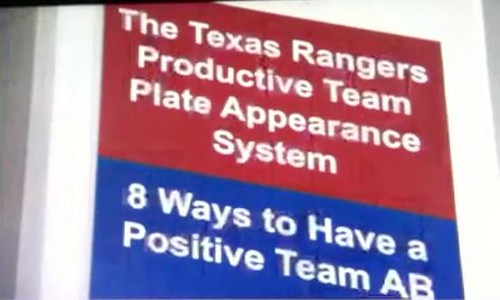
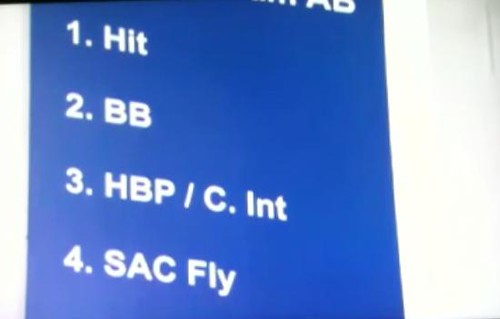
First, take a look at the photos below, which I had smuggled out of the Rangers' clubhouse last week (don't ask how :-)


The Texas Rangers figure -- rightly -- that you can't improve what you don't measure. So they devised 8 ways to measure what a "Positive Team At Bat" is, including a hit, base-on-balls (BB), hit-by-pitch or catcher's interference (HBP / C. Int) and so on ...


... and their goal is to have 17 "Positive Team At Bats" every game. They figure that reaching this threshold gives them a chance to win every game. So far this season, their system has worked out well.

Now, two things for you:

1) What is the key success metric for your marketing efforts?

Ideally, it's something you have total control over, such as what you do at the plate in baseball. Examples:
  • Calls made to clients and/or prospects
  • Handwritten thank-you notes mailed to clients
  • Pay-per-click ads created or tested in Google Adwords

Whatever it is, you must find at least one way to measure success in your marketing. Otherwise, you're flying blind.

2) What is your daily goal or quota?

Again, you can't improve what you don't measure, so be sure to pick a number -- any number is better than none -- and aim for it.

Analyze your results every day and every week. Do more of what's working, less of what's not. And, sooner than you expect, you may find your business is in the Big Leagues.

This is another example of "Inside Marketing" -- improving your marketing from the inside, by making a few changes to what you're already doing.

(Kevin M. Donlin is author of the Special Report, Guaranteed Marketing for Service Business Owners.)
Monday, October 25, 2010

3 Keys to Inside Marketing: List, Offer, Copy

It's been said that the three most-important parts of any marketing promotion are, in order: List, Offer, Copy.

Think about it: When your child has to sell magazine subscriptions for school, whom do they turn to first? You, Grandma, and Uncle Bob -- the List.

Get the right list of prospects and you won't get a lot of push-back on your price or sales pitch. The selling is relatively easy.

Or, what do you do on the last day of a garage sale, when you've got a box of Harlequin Romance novels and 3 old hockey sticks that haven't sold yet? You lower the price or even give them away -- that's the Offer.

With the right offer, again, the selling is relatively easy.

Yet, most business owners spend days and weeks agonizing over the last of these three keys: the Copy -- they words they use to sell their products or services, whether on paper, by phone, or in person.

They spend precious little time choosing the right audience for their promotion (the List) or structuring the price, payment terms, guarantee, and other elements of what they're selling (the Offer).

Not only can you, as a business owner, improve your sales by spending more time on list selection and offer creation, but these elements are 100% under your control.

You get to decide whom to sell to (List) and what to sell (Offer), before worrying about how to sell it (Copy).

That line of thinking is part of what I call "Inside Marketing" -- improving your business from the inside.

(Kevin M. Donlin is author of the Special Report, Guaranteed Marketing for Service Business Owners.)
Friday, October 22, 2010

Vonage Customer Service Fail - The Joseph Jaffe Trainwreck; UPDATE: Resolved

You know the Golden Rule: "Treat others the way you would want them to treat you."

We've heard it since childhood and it still makes sense.

Especially if you deal with customers -- you know, those people who your salary?

In fact, since the advent of digital technology, which lets us record nightmarish calls with customer service or take videos of sleeping repairmen ... you would think every business that wants to stay in business would have taken notice.

Every smart business in 2010 should have a sentence in their Employee Handbook that reads: Every conversation you have with a customer may be recorded for defaming purposes.

But somebody forgot to tell Vonage.

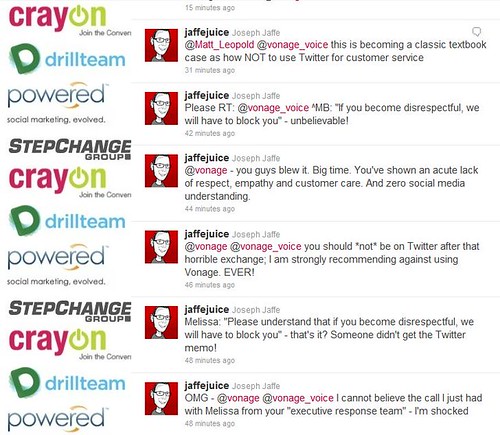
Take a look at the following Tweetstream from Joseph Jaffe (@jaffejuice), which I've been following for the past hour or so ...


It's the latest textbook example of customer service gone wrong, thanks to dual-use technology in the hands of customers. By dual use I mean that, like sickles or hammers, Twitter can be used for peaceful purposes or as a weapon of war.

And Joseph Jaffe, as you can see above, is on the warpath. Very publicly.

Look. It is never a best practice to threaten a customer ("We will have to block you") as Melissa, the soon-to-be-former customer service agent, is quoted as saying above.

But it's a worst practice to treat customers rudely now, when that conversation is instantly made public to millions of people, as it is on Twitter.

So here's a new Golden Rule of Customer Service, submitted for your approval (and Vonage's education):

"Treat others the way you would want them to treat you ... so that you won't mind if they share it with the planet."

UPDATE: There is a happy ending to this story. Within the hour, Vonage called Jaffe to fix things. Good catch by Vonage! I hope Melissa gets to keep her job ...

(Kevin M. Donlin is author of Guaranteed Marketing for Service Business Owners.)

Thursday, October 21, 2010

Mediocre Advertising Won't Drive Sales

Some new ads from Subaru are making the rounds.

Here's one ...


Yes, it gets attention, which is the first rule in advertising.

But does it make me more interested in owning this thing? Or desirous?

My opinion: This is way too clever for its own good.

Does anyone remember when Subaru tried the opposite approach? In 1992, Subaru was like Punk Rock –


... and that didn’t work out so well.

I predict the same fate for the Mediocrity campaign.

This is what happens when funny people who hate to sell are given lots of money and no supervision. Funny people should stick to being funny. Because, when it comes to advertising, humor is a minefield.

Very, very few ads use humor in a way that also sells.

Below is one example. Can you think of any others?


This commercial was produced by Doyle Dane Bernbach (DDB) in 1969.

Here's the script, which uses words, images and, yes, humor, to actually sell ...
I, Maxwell E Snavely, being of sound mind and body, do hereby bequeath the following:

To my wife Rose, who spent money like there was no tomorrow ... I leave 100 dollars and a calendar.

To my sons Rodney and Victor, who spent every dime I ever gave them on fancy cars and fast women ... I leave 50 dollars, in dimes.

To my business partner Jules, whose only motto was spend, spend, spend ... I leave nothing, nothing, nothing.

And to my other friends and relatives who also never learnt the value of a dollar ... I leave a dollar.

Finally, to my nephew Harold, who oft-times said, “a penny saved is a penny earned”, and who also oft-times said, “Gee Uncle Max, it sure pays to own a Volkswagen” ... I leave my entire fortune of one hundred billion dollars.

(Kevin M. Donlin is author of the Special Report, Guaranteed Marketing for Service Business Owners.)