It's been said that the three most-important parts of any marketing promotion are, in order: List, Offer, Copy.
Think about it: When your child has to sell magazine subscriptions for school, whom do they turn to first? You, Grandma, and Uncle Bob -- the List.
Get the right list of prospects and you won't get a lot of push-back on your price or sales pitch. The selling is relatively easy.
Or, what do you do on the last day of a garage sale, when you've got a box of Harlequin Romance novels and 3 old hockey sticks that haven't sold yet? You lower the price or even give them away -- that's the Offer.
With the right offer, again, the selling is relatively easy.
Yet, most business owners spend days and weeks agonizing over the last of these three keys: the Copy -- they words they use to sell their products or services, whether on paper, by phone, or in person.
They spend precious little time choosing the right audience for their promotion (the List) or structuring the price, payment terms, guarantee, and other elements of what they're selling (the Offer).
Not only can you, as a business owner, improve your sales by spending more time on list selection and offer creation, but these elements are 100% under your control.
You get to decide whom to sell to (List) and what to sell (Offer), before worrying about how to sell it (Copy).
That line of thinking is part of what I call "Inside Marketing" -- improving your business from the inside.
(Kevin M. Donlin is author of the Special Report, Guaranteed Marketing for Service Business Owners.)
Monday, October 25, 2010


Friday, October 22, 2010
Vonage Customer Service Fail - The Joseph Jaffe Trainwreck; UPDATE: Resolved
You know the Golden Rule: "Treat others the way you would want them to treat you."
We've heard it since childhood and it still makes sense.
Especially if you deal with customers -- you know, those people who your salary?
In fact, since the advent of digital technology, which lets us record nightmarish calls with customer service or take videos of sleeping repairmen ... you would think every business that wants to stay in business would have taken notice.
Every smart business in 2010 should have a sentence in their Employee Handbook that reads: Every conversation you have with a customer may be recorded for defaming purposes.
But somebody forgot to tell Vonage.
Take a look at the following Tweetstream from Joseph Jaffe (@jaffejuice), which I've been following for the past hour or so ...
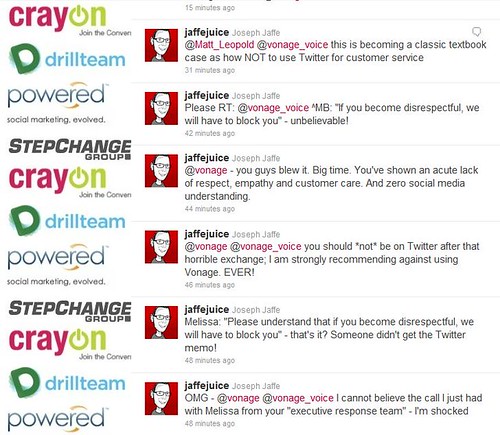
It's the latest textbook example of customer service gone wrong, thanks to dual-use technology in the hands of customers. By dual use I mean that, like sickles or hammers, Twitter can be used for peaceful purposes or as a weapon of war.
And Joseph Jaffe, as you can see above, is on the warpath. Very publicly.
Look. It is never a best practice to threaten a customer ("We will have to block you") as Melissa, the soon-to-be-former customer service agent, is quoted as saying above.
But it's a worst practice to treat customers rudely now, when that conversation is instantly made public to millions of people, as it is on Twitter.
So here's a new Golden Rule of Customer Service, submitted for your approval (and Vonage's education):
"Treat others the way you would want them to treat you ... so that you won't mind if they share it with the planet."
UPDATE: There is a happy ending to this story. Within the hour, Vonage called Jaffe to fix things. Good catch by Vonage! I hope Melissa gets to keep her job ...
 (Kevin M. Donlin is author of Guaranteed Marketing for Service Business Owners.)
We've heard it since childhood and it still makes sense.
Especially if you deal with customers -- you know, those people who your salary?
In fact, since the advent of digital technology, which lets us record nightmarish calls with customer service or take videos of sleeping repairmen ... you would think every business that wants to stay in business would have taken notice.
Every smart business in 2010 should have a sentence in their Employee Handbook that reads: Every conversation you have with a customer may be recorded for defaming purposes.
But somebody forgot to tell Vonage.
Take a look at the following Tweetstream from Joseph Jaffe (@jaffejuice), which I've been following for the past hour or so ...
It's the latest textbook example of customer service gone wrong, thanks to dual-use technology in the hands of customers. By dual use I mean that, like sickles or hammers, Twitter can be used for peaceful purposes or as a weapon of war.
And Joseph Jaffe, as you can see above, is on the warpath. Very publicly.
Look. It is never a best practice to threaten a customer ("We will have to block you") as Melissa, the soon-to-be-former customer service agent, is quoted as saying above.
But it's a worst practice to treat customers rudely now, when that conversation is instantly made public to millions of people, as it is on Twitter.
So here's a new Golden Rule of Customer Service, submitted for your approval (and Vonage's education):
"Treat others the way you would want them to treat you ... so that you won't mind if they share it with the planet."
UPDATE: There is a happy ending to this story. Within the hour, Vonage called Jaffe to fix things. Good catch by Vonage! I hope Melissa gets to keep her job ...
Thursday, October 21, 2010
Mediocre Advertising Won't Drive Sales
Some new ads from Subaru are making the rounds.
Here's one ...
Yes, it gets attention, which is the first rule in advertising.
But does it make me more interested in owning this thing? Or desirous?
My opinion: This is way too clever for its own good.
Does anyone remember when Subaru tried the opposite approach? In 1992, Subaru was like Punk Rock –
... and that didn’t work out so well.
I predict the same fate for the Mediocrity campaign.
This is what happens when funny people who hate to sell are given lots of money and no supervision. Funny people should stick to being funny. Because, when it comes to advertising, humor is a minefield.
Very, very few ads use humor in a way that also sells.
Below is one example. Can you think of any others?
This commercial was produced by Doyle Dane Bernbach (DDB) in 1969.
Here's the script, which uses words, images and, yes, humor, to actually sell ...
(Kevin M. Donlin is author of the Special Report, Guaranteed Marketing for Service Business Owners.)
Here's one ...
Yes, it gets attention, which is the first rule in advertising.
But does it make me more interested in owning this thing? Or desirous?
My opinion: This is way too clever for its own good.
Does anyone remember when Subaru tried the opposite approach? In 1992, Subaru was like Punk Rock –
... and that didn’t work out so well.
I predict the same fate for the Mediocrity campaign.
This is what happens when funny people who hate to sell are given lots of money and no supervision. Funny people should stick to being funny. Because, when it comes to advertising, humor is a minefield.
Very, very few ads use humor in a way that also sells.
Below is one example. Can you think of any others?
This commercial was produced by Doyle Dane Bernbach (DDB) in 1969.
Here's the script, which uses words, images and, yes, humor, to actually sell ...
I, Maxwell E Snavely, being of sound mind and body, do hereby bequeath the following:
To my wife Rose, who spent money like there was no tomorrow ... I leave 100 dollars and a calendar.
To my sons Rodney and Victor, who spent every dime I ever gave them on fancy cars and fast women ... I leave 50 dollars, in dimes.
To my business partner Jules, whose only motto was spend, spend, spend ... I leave nothing, nothing, nothing.
And to my other friends and relatives who also never learnt the value of a dollar ... I leave a dollar.
Finally, to my nephew Harold, who oft-times said, “a penny saved is a penny earned”, and who also oft-times said, “Gee Uncle Max, it sure pays to own a Volkswagen” ... I leave my entire fortune of one hundred billion dollars.
(Kevin M. Donlin is author of the Special Report, Guaranteed Marketing for Service Business Owners.)
Wednesday, October 20, 2010
Your Customers Are Questioning You
Of his time in a Nazi death camp, Viktor Frankl wrote: "What was really needed was a fundamental change in our attitude toward life."
He continued:
After revolutionizing his world from the inside, he was able to endure unspeakable hardship on the outside.
Now. No matter how tough times may be for you, seen in this context, they aren't that tough.
But you may be facing uncertainty, even despair, in your business. You may have days (weeks?) when you ask yourself: Why am I doing this?
Well. How about switching the questions around, as Frankl did?
Instead of asking about the meaning of your business life, think of yourself as being questioned by your business. Specifically, you are being questioned by your customers:
This kind of thinking helped Frankl survive nearly three years in a concentration camp, along with the loss of his family and his profession.
So, try turning your business problems around. The next time you get stuck, ask yourself: What do my customers want?
If you're not 100% sure, go ask them. Or call them on the phone. Then start giving them what they want.
It just might help your business survive -- and thrive -- in an economy far less hostile than a death camp.
(Kevin M. Donlin is author of the Special Report, Guaranteed Marketing for Service Business Owners.)
He continued:
We needed to stop asking about the meaning of life, and instead to think of ourselves as those who were being questioned by life -- daily and hourly. Our answer must consist, not in talk or meditation, but in right action and in right conduct.This unconventional thinking helped Frankl survive the same conditions that killed 6 million other people.
After revolutionizing his world from the inside, he was able to endure unspeakable hardship on the outside.
Now. No matter how tough times may be for you, seen in this context, they aren't that tough.
But you may be facing uncertainty, even despair, in your business. You may have days (weeks?) when you ask yourself: Why am I doing this?
Well. How about switching the questions around, as Frankl did?
Instead of asking about the meaning of your business life, think of yourself as being questioned by your business. Specifically, you are being questioned by your customers:
- What are they telling you?
- What do they want?
- Will you give it to them?
- Why not start tomorrow?
This kind of thinking helped Frankl survive nearly three years in a concentration camp, along with the loss of his family and his profession.
So, try turning your business problems around. The next time you get stuck, ask yourself: What do my customers want?
If you're not 100% sure, go ask them. Or call them on the phone. Then start giving them what they want.
It just might help your business survive -- and thrive -- in an economy far less hostile than a death camp.
(Kevin M. Donlin is author of the Special Report, Guaranteed Marketing for Service Business Owners.)
Tuesday, October 19, 2010
Nimble Marketing from a Big Company - GotoWebinar Thank You

Answer: Good news.
Usually, it's a party invitation or a thank-you note.
Either way, good news.
Never a subpoena, a bill, or a letter from your ex-wife's attorney. Those come in #10 business envelopes.
Sending thank-you notes to your clients may be the best use of a first-class stamp I can think of.
That's why it's always puzzled me ... why don't more small businesses send more thank-you notes?
Think about it: If you know there's something your clients want, and you can give it to them at a very low cost ... why don't you?
Now. Want to know something more puzzling?
A very big company just sent me a thank-you note (pictured above). It's from Gotowebinar, signed by my account rep, Kristen.
Hey, Kristen -- way to go. You've added a personal element to an otherwise big, impersonal company. I will return the favor by remaining your client, giving you thousands of dollars in business in the coming months.
That's a nice ROI on a 44-cent stamp.
But this is the puzzling part -- if a business giant like Gotowebinar can mail out handwritten thank-you notes, why can't you?
(For more ideas like these, download Guaranteed Marketing for Service Business Owners.)
Thursday, October 14, 2010
Your Marketing Message: Something, or Nothing?

After you've seen it for more than one day, the word "Today" means nothing.
Because it can't be today every day.
What words have your prospects and customers been exposed to over time that now mean nothing?
"Value!" "Quality!" "Service!" "Selection!"
... you can add your own.
Don't use those words. They mean nothing.
Think: How can you say what you want to say, in language that actually means something to your market? Language that doesn't insult our intelligence, like "Today" every day.
No huge marketing budget needed. Just think.
(Kevin M. Donlin is author of the Special Report, Guaranteed Marketing for Service Business Owners.)
Wednesday, October 13, 2010
Your Brain, Your Business, Your Life
I like my brain.
It's been very good to me, despite those four-and-a-half years of intensive neuron slaughter, otherwise known as college.
So I really liked the book, Brain Rules: 12 Principles for Surviving and Thriving at Work, Home, and School .
Author John Medina, a molecular biologist with a gift for clear writing, shares the latest science and its implications for your brain, your business, your marketing, your family, and your life.
Here are three takeaways from the book, which can help you improve your business from the inside ...
1) Exercise boosts brain power
Your brain evolved to survive in jungles and prairies, after our early ancestors routinely walked an average of 12 miles a day in search of (and in avoidance of becoming) food. As a result, your brain is NOT meant to sit in a cubicle or a classroom for 8 hours a day.
Think about it: The smartest senior citizens you know are probably the most active. And most of history's greatest thinkers were physically active: Aristotle, Immanuel Kant, Napoleon Bonaparte, Albert Einstein, and Douglas MacArthur all had a habit of pacing as they thought or taught, for example.
If you do nothing more than aerobic exercise, 30 minutes at time, two or three times a week, your brain will benefit. But don't stop there. Break up your workday with physical activity, such as walking, biking, or stretching.
2) Sleep well, think well
A lack of sleep retards your ability to pay attention, remember, reason logically, solve problems, or do any other thinking. For best results, your work schedule should match your productive times, whether it be morning, evening, or someplace in between.
And -- here's the fun part -- your businesses should encourage a nap in mid-afternoon, when productivity sags for almost everyone. So, instead of a Red Bull at 3:00, try a 20-minute siesta.
3) Vision trumps all other senses
Our brains see and think in pictures. Visual processing dominates how we interpret the world, with about half your brain power devoted to vision. As a result, pictures are easier to remember than words.
This has vast implications for your marketing and presentation efforts. Here are two:


Oh, and in the spirit of including pictures, here's one of the book ...
It's been very good to me, despite those four-and-a-half years of intensive neuron slaughter, otherwise known as college.
So I really liked the book, Brain Rules: 12 Principles for Surviving and Thriving at Work, Home, and School
.Author John Medina, a molecular biologist with a gift for clear writing, shares the latest science and its implications for your brain, your business, your marketing, your family, and your life.
Here are three takeaways from the book, which can help you improve your business from the inside ...
1) Exercise boosts brain power
Your brain evolved to survive in jungles and prairies, after our early ancestors routinely walked an average of 12 miles a day in search of (and in avoidance of becoming) food. As a result, your brain is NOT meant to sit in a cubicle or a classroom for 8 hours a day.
Think about it: The smartest senior citizens you know are probably the most active. And most of history's greatest thinkers were physically active: Aristotle, Immanuel Kant, Napoleon Bonaparte, Albert Einstein, and Douglas MacArthur all had a habit of pacing as they thought or taught, for example.
If you do nothing more than aerobic exercise, 30 minutes at time, two or three times a week, your brain will benefit. But don't stop there. Break up your workday with physical activity, such as walking, biking, or stretching.
2) Sleep well, think well
A lack of sleep retards your ability to pay attention, remember, reason logically, solve problems, or do any other thinking. For best results, your work schedule should match your productive times, whether it be morning, evening, or someplace in between.
And -- here's the fun part -- your businesses should encourage a nap in mid-afternoon, when productivity sags for almost everyone. So, instead of a Red Bull at 3:00, try a 20-minute siesta.
3) Vision trumps all other senses
Our brains see and think in pictures. Visual processing dominates how we interpret the world, with about half your brain power devoted to vision. As a result, pictures are easier to remember than words.
This has vast implications for your marketing and presentation efforts. Here are two:
- Include pictures in your ads. Research shows that the eye is always drawn to pictures and remembers them better than words alone. (A tough pill to swallow for a copywriter like me who loves words!)
- Delete your presentations and start over. The typical PowerPoint business presentation has almost 40 words per slide. More pictures and fewer words would capture and hold an audience's attention far better.
Oh, and in the spirit of including pictures, here's one of the book ...
Subscribe to:
Posts (Atom)