Wednesday, November 3, 2010

Marketing for Busy People

Yesterday, I wrote about marketing as a systematic process.

If I had had more time, I would have included this quote:

"If you can’t describe what you are doing as a process then you don’t know what you’re doing." – W. Edwards Deming

To recap, I suggested that your marketing system is everything you do with a person who comes into contact with your business, from their first email or phone call until the day exit the marketplace forever.

The essential elements of any marketing system include the following:

1) Lead capture. You record the name, email address, and other needed information from prospects in a database -- with your prospects' permission, of course.

2) Follow-up. You contact prospects who do not buy the first time, answering their questions and offering them information to move them along in the buying process.

3) Sales scripts. You deliver the same sales pitch to every prospect, tailored to their unique questions and objections, but as uniform as possible, to eliminate variation from tested "selling words" that have worked before.

4) Customer care. You have policies and procedures in place to maximize client satisfaction while minimizing frustration.

5) Referrals. You take the same steps with every customer to encourage and reward referrals.

Now. Here's the problem you probably face, in the words of one of my readers who owns a computer repair service:
I want VERY much to try and do something with these other resources of yours ... but I have to try and find the time.

I've had your earlier email flagged and on my "to-do" list for what seems months now (I'm sure it's only been a month, but it's been too long all the same) and there are just too many other things that are taking priority.
And there it is. We know that we need to work on our marketing. But we don't have the time. Other things "take priority."

What's the marketing solution for busy people? Here's one possibility: "The secret of getting ahead is getting started. The secret of getting started is breaking your complex overwhelming tasks into small manageable tasks, and then starting on the first one." - Mark Twain

And here's another way to attack a big problem like your marketing:
When I face the desolate impossibility of writing five hundred pages, a sick sense of failure falls on me, and I know I can never do it. Then gradually, I write one page and then another. One day's work is all I can permit myself to contemplate. - John Steinbeck
That's the business solution to being too busy to market: Just get started.

Don't worry about overhauling your entire marketing system or trying to make 21 improvements this week.

Just ask yourself small, non-threatening questions, like: What one thing could I do to improve my marketing in the next 30 minutes?

You'd be surprised at how much good you can do today, in only 30 minutes. You can:
  • add a Unique Selling Proposition (USP) or a special "coupon code" to your voicemail greeting
  • write and mail one thank-you note to a recent client
  • add one email to your follow-up autoresponder series (I use and recommend Aweber)
  • pick up the phone and call one potential joint-venture partner
  • email one happy client and ask if you can use their comments as a testimonial on your web site
Do these steps seem trivial? Too small to make a difference?

Heh. Keep reading ...

Let's pick just one item from the list above. Let's say that, by mailing one thank-you note per day to 30 clients this month, it produces just $1 per day in new profit -- $365 more profit per year.

Yes, that's trivial.

But what if, tomorrow, you add just one email to the follow-up emails that go out to prospects who opt into your autoresponder series. That one email produces another "trivial" $1/day in profit -- $365 more per year.

What if you keep finding one more way to add $1 a day in profit to your business. And you do it for just 30 working days. What is the cumulative result?

It's $10,950 over 12 months.

Again, that figure may seem trivial. But $10,950 is enough to:
  • fully fund your IRA;
  • take your family to the ocean for 5 days; and
  • buy a Stratocaster on Ebay
You can make big leaps in small steps, in only 30 minutes a day for 30 days.

Try it and see.

Note: Here's a resource I created on the power of systematic follow-up marketing.

Tuesday, November 2, 2010

What's Your Marketing System?

Being from the Detroit area, I'm a big fan of statistician and management guru W. Edwards Deming, who basically shamed the Big 3 automakers into improving the quality of their products by first helping the Japanese to do so after World War II.

His philosophy has been summarized as follows, by Wikipedia:

Dr. W. Edwards Deming taught that by adopting appropriate principles of management, organizations can increase quality and simultaneously reduce costs (by reducing waste, rework, staff attrition and litigation while increasing customer loyalty). The key is to practice continual improvement and think of manufacturing as a system, not as bits and pieces.

So ... what's your system for marketing?

Your marketing system can be defined as everything you do with a person who comes into contact with your business, from their first email or phone call until the day exit the marketplace forever.

Here are essential elements of marketing system:

1) Lead capture. You record the name, email address, and other needed information from prospects in a database -- with your prospects' permission, of course.

2) Follow-up. You contact prospects who do not buy the first time, answering their questions and offering them information to move them along in the buying process.

3) Sales scripts. You deliver the same sales pitch to every prospect, tailored to their unique questions and objections, but as uniform as possible, to eliminate variation from tested "selling words" that have worked before.

4) Customer care. You have policies and procedures in place to maximize client satisfaction while minimizing frustration.

5) Referrals. You take the same steps with every customer to encourage and reward referrals.

Get the idea?

Unless you have a marketing system, you don't have a business. You have a hobby.

If you're unhappy with the results your marketing is producing so far this year, it may be tempting to blame the economy. Or Washington. Or penny-pinching customers who don't appreciate your brilliance.

But blaming outside forces leaves you powerless to make improvements where it counts, on the inside of your business.

Instead, the cause of low sales and miniscule profits more likely lies in your marketing system.

So blame the system. But only for about 10 seconds, because beating yourself up won't bring your sales up.

Instead, get busy improving your system, one small step at a time. That's how systematic, continual improvement in your profits happens.

(For more ideas like these, download Guaranteed Marketing for Service Business Owners.)

Monday, November 1, 2010

New Way to Solve Problems: Get Physical

Got a problem? Want new insights on how to solve it?

Then keep reading ...

In April of this year, I spoke at a career seminar in Saskatoon, Saskatchewan. Among the presenters was Dr. Norman E. Amundson, a professor of Counseling Psychology at the University of British Columbia, who gave an outstanding talk on problem solving.

I took a lot of notes while he spoke; one page is pictured below.

We've all been stuck on a problem before. You rack your brains for a solution. You turn it over in your mind. You sit and stew. And all you get is a headache.

Why not try a physical approach instead? Dr. Amundson referred to it as "walking the problem."

He asked the audience to picture a problem we were trying to solve as located on the other side of the room. Then, he said ...

"Instead of walking toward the solution from the problem as a starting point, we should walk toward the problem from the solution.

"How did we get there? Thinking this way creates new patterns and gets you unstuck.

"Looking back at your problem while standing 'in the solution,' you might 1) not see a problem at all; and 2) take a different route to the problem or move at a different rate -- there are many ways to solve a problem.

"By starting from the position of 'problem solved,' you start from a position of strength, with a broader perspective. As a result, you will work with more energy and excitement."

Try this physical method for solving problems today. I've used it before with remarkable results.

Example: I don't get writer's block. Ever. Why? Because, any time I get stuck for more than 5 minutes on what to write, I get up from the keyboard and walk away. I imagine the ideal sentence will be sitting on my chair, waiting for me, when I get back. It may take 30 seconds of walking before I find the sentence sitting there ... or 20 minutes. But I always get a solution of some sort after I finish walking.

Kooky? Quirky? Who cares. It works.

Now. Would you like even more expert ideas to solve problems and grow your business?

If so, I'd like to give you my speaker notes from a three-day, $5,000 marketing seminar, put on by Jay Abraham in Los Angeles.

The speakers were phenomenal: Seth Godin, Stephen R. Covey, Stephen M.R. Covey, Marshall Thurber, John Assaraf, Donald Moine, Andy Miller, and others. If you can't find at least a dozen money-making ideas from these 25 pages of notes, you ought to move to Cuba ...

You can download my $5,000 seminar notes here.

Friday, October 29, 2010

Profits Down? Raise Your Rates

When sales are down, the first instinct for many business owners is to lower their prices.

You, too? The temptation is strong.

Yet, you ought to resist that temptation. Or, even, do the opposite -- raise your rates when sales are slow.

That's been my experience since 1998. And it's the subject of a recent article in The Wall Street Journal. Here's the key excerpt:

But some research indicates that racing to lower prices—even if it lures more customers—doesn't usually put a company ahead. Even in down economies, raising prices just slightly can have a greater bottom-line impact than lowering them, according to a study in the McKinsey Quarterly, published by the business management advisory firm McKinsey & Co.

A price rise of 1% at an average company in the S&P 1500 index, which includes large-, mid- and small-cap companies, would generate an 8% increase in operating profit if sales volume stays steady, the study found. By contrast, a price discount of 1% reduces profit by 8%. Typically, in order to offset the impact of a 5% price cut, volume would have to rise by about 19%.

Small firms, especially, are likely to feel the impact of a price cut because—unlike big-box stores—each product represents a much larger portion of their profitability ...

It's an eye-opening article, with at least four takeaways you can profit from today ...

1) Raise your level of service along with your prices, for maximum effect (that's what Allen Ackerman did when he added the social networking tool and raised his fees):

 ... business owners walk a fine line between increasing revenue and alienating customers. A-List Placement's Mr. Ackerman says prices at his firm went up in tandem with extra services he offered.

A-List Placement claims a percentage of each new hire's salary, historically about 20%. But when hiring dried up a few years ago and his clients wanted to pay less, Mr. Ackerman decided to created an online social-networking tool, called the Hire Syndicate, that allows recruiters to share information about candidates and job openings. The 500 recruiters now using the site can more quickly find the perfect match for clients.

He says that enhanced service allows him to charge as much as 25% of the employee's salary today, though he makes an exception for long-time clients who say they can't afford the new rates.

2) Go after those clients who can pay more (that's what Brett Klasko does in targeting high net-worth investors with his newsletter service):

... His New York-based firm, Investors Alley Corp., sends stock-market newsletters via email to subscribers.

The company, which generates most of its revenue from advertisers, invested in a better email delivery system last year to insure the newsletters were delivered more quickly and didn't get caught in spam filters. That move boosted his circulation—from 75,000 readers in 2008 to 125,000 today—and allowed him to target more-active and higher net-worth traders. Not one advertiser left when Mr. Klasko raised prices 7% earlier this year, he says. 

3) Bundle products/services together when charging more (that's what Shel Horowitz did when he switched from charging by the hour to charging by the project):

... Horowitz, who owns Accurate Writing & More in Hadley, Mass., offers marketing services such as writing book jackets and press releases. After business dropped 25% in the recession, he decided to change his pricing model from $175 an hour to a set amount for each assignment. The new prices deliver an about 25% to 30% pay increase from his prior model, he says.

"A lot of clients are more comfortable with a flat-fee per service," he explains, adding that returning customers haven't been fazed by the change.

4) Test small, to avoid big disasters (that's what Manny Apolonio did when upping his rates to $40-60 for a few clients, who didn't flinch):

He had set up his company, a concierge service that runs errands for clients, a year ago with rates of between $20 and $40 an hour. As he became inundated by referrals, Mr. Apolonio realized that there was opportunity to raise prices to between $40 and $60 an hour.

"I tested the waters with a few clients and they were totally receptive. We became profitable in June and I'm still incredibly busy," he says.

In most of the cases I've seen over the years, higher prices are more of a barrier in the business owner's mind than in the customer's. But, as with all new ideas, test small before rolling out big.

This is another example of "Inside Marketing" -- improving your marketing from the inside, by making a few changes to what you're already doing.

(For more ideas like these, download Guaranteed Marketing for Service Business Owners.)

Thursday, October 28, 2010

Thank You = Power Marketing

You know I'm a fan of mailing handwritten thank-you notes to clients. A. Big. Fan.

Thank-you notes pay big dividends, in my experience.

As William James wrote: "The deepest principle in human nature is the craving to be appreciated." A thank-you note mailed to clients shows how much you appreciate them. You satisfy a craving when you do this. And your clients will always -- always -- reward you for this.

In his excellent book, You, Inc., Harry Beckwith writes: "Handwritten thank-you notes feel like gifts because you took the time to find the paper and envelope, write the note, affix the stamp, and gift-wrap your note in its package."

Finally, to drive this point home, here are two mini-case studies from the book, Thank You Power, by Deborah Norville:

1) According to a 1995 study by Bruce Rind and Prashant Bordia, restaurant servers who wrote "Thank you" on the check before handing it to their customers got tips averaging 11 percent more than servers who didn't.

The takeaway here is simple: A written "Thank you" can pay you back.

2) In her book, "Thank You Power," Deborah Norville describes another thank-you experiment, in which jewelry store customers were called to thank them for their business -- they "spent more during return visits the following month than customers who didn't get a thank you call."

But they also spent more than customers who got the thank you call and were told at the same time of an upcoming 20 percent-off sale. Word of the sale, which could be perceived as a pitch for more business, made the thank you ring hollow.

The takeaway here is a bit more complex: Your "Thank you" may hinder future sales if you do it wrong. While I've personally received -- and used -- discount coupons that came with thank-you notes, they may rub some customers the wrong way, as they did in the jewelry store experiment.

So, as in all cases where you're offered a new marketing tactic, you should test it out. You may be just one thank-you note away from a major breakthrough with your clients.

Seriously. What would an 11-percent bump in revenue mean for you, like the restaurant servers enjoyed?

You'll never know until you test the idea for yourself.

No matter how you choose to say "thank you" to clients, though, it's an easy, proven way to increase their satisfaction and long-term profitability. And it's entirely under your control -- all you have to do is decide, then start thanking them.

This is another example of "Inside Marketing" -- improving your marketing from the inside, by making a few changes to what you're already doing.

(More ideas like these in the Free Report, Guaranteed Marketing for Service Business Owners.)

Wednesday, October 27, 2010

Marketing + Physics = Google

"What has been will be again, what has been done will be done again; there is nothing new under the sun," wrote King Solomon in Ecclesiastes 1:9

But ... if there's nothing new under the sun, how do you account for creativity?

Like this: Creativity is simply new combination of old ideas.

Reese's Peanut Butter Cups are ... chocolate and peanut butter, combined.

The Velvet Underground was ... art and rock & roll, combined.

You get the idea. Old ideas combined in new ways produce creative breakthroughs.

So, what would happen if you combined marketing and physics?

You'd get the creative insights that Dan Cobley, a marketing director at Google, offers in this short video from TED, which is well worth watching ...


(Kevin M. Donlin is author of the Special Report, Guaranteed Marketing for Service Business Owners.)

Tuesday, October 26, 2010

What Do The Texas Rangers Know About Success That You Don't?

The Texas Rangers are in The World Series this year for the first time in team history.

How did they do it?

There's no one reason. You need superior coaching, pitching, fielding, running, and hitting to make it this far.

But I found something the Rangers are doing that not only helped them reach The Series, but can help improve your business, too.

It's this: They defined a key success metric and try to achieve it every game.

What does this have to do with your business?

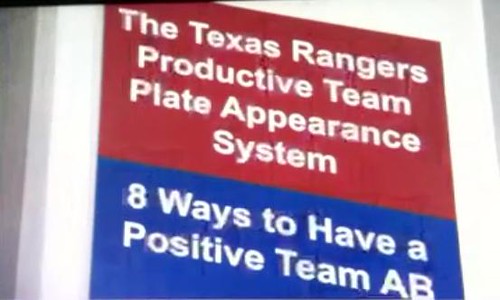
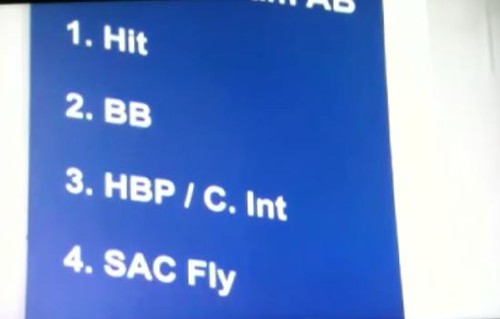
First, take a look at the photos below, which I had smuggled out of the Rangers' clubhouse last week (don't ask how :-)


The Texas Rangers figure -- rightly -- that you can't improve what you don't measure. So they devised 8 ways to measure what a "Positive Team At Bat" is, including a hit, base-on-balls (BB), hit-by-pitch or catcher's interference (HBP / C. Int) and so on ...


... and their goal is to have 17 "Positive Team At Bats" every game. They figure that reaching this threshold gives them a chance to win every game. So far this season, their system has worked out well.

Now, two things for you:

1) What is the key success metric for your marketing efforts?

Ideally, it's something you have total control over, such as what you do at the plate in baseball. Examples:
  • Calls made to clients and/or prospects
  • Handwritten thank-you notes mailed to clients
  • Pay-per-click ads created or tested in Google Adwords

Whatever it is, you must find at least one way to measure success in your marketing. Otherwise, you're flying blind.

2) What is your daily goal or quota?

Again, you can't improve what you don't measure, so be sure to pick a number -- any number is better than none -- and aim for it.

Analyze your results every day and every week. Do more of what's working, less of what's not. And, sooner than you expect, you may find your business is in the Big Leagues.

This is another example of "Inside Marketing" -- improving your marketing from the inside, by making a few changes to what you're already doing.

(Kevin M. Donlin is author of the Special Report, Guaranteed Marketing for Service Business Owners.)