Want more good ideas for your business?
Here's how to get an endless supply, by "reading" an extra 10-30 books every year --
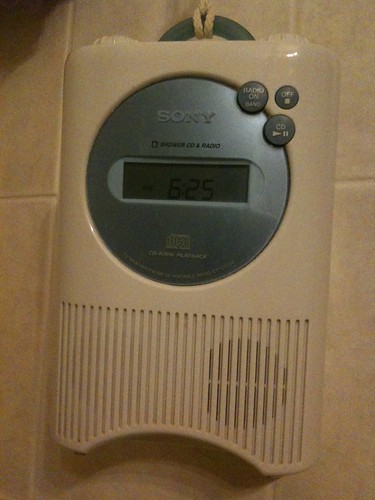
-- just listen to audiobooks in the shower. That's my trusty (waterproof) Sony CD Player above.
This morning, I "studied" 3 tracks from the audiobook, "One Small Step Can Change Your Life: The Kaizen Way to Success," by Dr. Robert Maurer.
Brian Tracy says that, if you listen to audiobooks while driving, you can create a "university on wheels" by learning new information during the hundreds of hours you spend in the car each year.
And if you believe, as I do, that we often make poor use of the 168 hours in every week, your shower is another place to turn down time into learning time.
Yes, of course, you do need some down time that's really down time -- no deep thinking about business or marketing. But that's what sleep, family meals, and weekends are for.
Now. If you think listening to audiobooks in the shower is a tad bit eccentric, you are wrong. Eccentric is writing notes to yourself in the shower.
(For more ideas like these, download Guaranteed Marketing for Service Business Owners.)
Tuesday, November 9, 2010
Never Shower Alone
Monday, November 8, 2010
Pareto's 80/20 Principle in Marketing
I'm a huge fan of the Pareto principle, aka the 80/20 Rule.
Briefly defined, it's this: a minority of causes usually leads to a majority of results.
There are exceptions, of course, which is why I inserted "usually" into the definition.
Still, the 80/20 Rule works often enough that you can achieve huge breakthroughs by applying it to your business.
Example: I used the 80/20 Rule to build an entire business on one Google Adwords ad and one keyword. Let me explain ...
A few years back, I was running a range of pay-per-click ads on Google, driving traffic to merchant's web sites and earning a commission on each lead that I provided them.
Each week, I analyzed my profits. One Saturday morning, I found that one ad and one keyword, part of hundreds I was running Google, was especially profitable.
So, I focused my efforts on testing and improving that ad and keyword. Profits went up.
Then, I replicated that winning ad, using other keywords. Profits went up again.
Then, I restructured my working days, dropping almost everything to focus on that one money-making activity -- improving my Google Adwords in that one area. Profits skyrocketed.
Within 6 months, I was bringing in more than $450,000 a year in net profits. And this went on for nearly three years.
Success came for me, as it can come for you, when I took three steps in my marketing:
1) identify the small number of activities producing a large percentage of profits;
2) spend more time on those high-profit activities;
3) spend less time on other low-value activities.
That's it.
The book to read on this subject is The 80/20 Principle
, by Richard Koch.
It's so good, I've read it three times.
And, yes, there's a lesson in that, too: Probably 80% of the books in your library are so-so. It's far better to read a few excellent books several times, than to read many crappy books once, IMHO.
To finish this rant, here are excerpts I wrote out by hand after my second reading of The 80/20 Principle ...
Briefly defined, it's this: a minority of causes usually leads to a majority of results.
There are exceptions, of course, which is why I inserted "usually" into the definition.
Still, the 80/20 Rule works often enough that you can achieve huge breakthroughs by applying it to your business.
Example: I used the 80/20 Rule to build an entire business on one Google Adwords ad and one keyword. Let me explain ...
A few years back, I was running a range of pay-per-click ads on Google, driving traffic to merchant's web sites and earning a commission on each lead that I provided them.
Each week, I analyzed my profits. One Saturday morning, I found that one ad and one keyword, part of hundreds I was running Google, was especially profitable.
So, I focused my efforts on testing and improving that ad and keyword. Profits went up.
Then, I replicated that winning ad, using other keywords. Profits went up again.
Then, I restructured my working days, dropping almost everything to focus on that one money-making activity -- improving my Google Adwords in that one area. Profits skyrocketed.
Within 6 months, I was bringing in more than $450,000 a year in net profits. And this went on for nearly three years.
Success came for me, as it can come for you, when I took three steps in my marketing:
1) identify the small number of activities producing a large percentage of profits;
2) spend more time on those high-profit activities;
3) spend less time on other low-value activities.
That's it.
The book to read on this subject is The 80/20 Principle
It's so good, I've read it three times.
And, yes, there's a lesson in that, too: Probably 80% of the books in your library are so-so. It's far better to read a few excellent books several times, than to read many crappy books once, IMHO.
To finish this rant, here are excerpts I wrote out by hand after my second reading of The 80/20 Principle ...
- To engage in 80/20 Thinking, continually ask: What is the 20% that is leading to the 80%?
- Whatever you're doing 80% of the time is probably a waste of time. If you make most of your money from a small part of your activity, you should turn your business upside down and concentrate your efforts on multiplying that small part.
- If an activity succeeds beyond expectations, it's likely a 20% activity.
- The vital few give success to you. A few things are always much more important than most things.
- The biggest wins all start small. Something big always comes from something that was small to start with. Look for the "invisible" 20% of small, key causes. They are there -- find them. Unexpected successes are one clue.
- Exploit 80/20 arbitrage. Ruthlessly prune 80% activities, such as checking email, to free up time and money for 20% activities. The profit is enormous because it is highly leveraged arbitrage.
Friday, November 5, 2010
Seth Godin and Tom Peters Want You to Blog
Should you start a blog? Or blog more often?
Watch Seth Godin and Tom Peters, then decide for yourself ...
People over-think blogging to the point that they never start. That's sad.
If your goal is to create the world's #1 blog, like Seth Godin's, you won't. So don't try.
But if your goal is to clarify your thinking about your business, while attracting new clients and helping existing ones, a blog can do that for you.
I've been a published writer/copywriter since 1994. And here's the best advice on overcoming writer's block I ever got: The best way to write, is to start.
By that I mean, don't sit down and try to write the perfect blog post. Just sit down and start writing. Write anything.
Set a small goal that's not scary, like writing for 10 minutes. If you find that 10 minutes is enough for a killer blog post, yay. More likely, you will have to come back later for another 10 minutes. Or you will find yourself so energized that you power through for 30 minutes and write something worthy of posting.
Either way, by starting to write, you are write. By agonizing over topics in your head, you write nothing.
Here are 3 more ways to overcome writer's block, and either start blogging or do it more often ...
1) Do you send emails to clients or prospects? Collect 2-3 of them and you have a blog post.
2) Do you write comments on other blogs? Collect 2-3 of them and you have another blog post.
3) Have you ever written a white paper, how-to article, or letter to the editor? That's enough material for still another blog post.
Tip: Don't blog to earn $1 million when you're acquired by VCs or because it might get you on page one of Google's search results. Those outcomes are beyond your control.
Instead, blog because every time you think for 10-30 minutes while writing, it changes you for the better.
Blogging is a form of mental kaizen. The posts you write are often small, trivial. You won't see results today, next week, or even 3 months from now.
But you will see positive results. Always.
And blogging can lead to unexpected breakthroughs, like ...
(For more ideas like these, download Guaranteed Marketing for Service Business Owners.)
Watch Seth Godin and Tom Peters, then decide for yourself ...
People over-think blogging to the point that they never start. That's sad.
If your goal is to create the world's #1 blog, like Seth Godin's, you won't. So don't try.
But if your goal is to clarify your thinking about your business, while attracting new clients and helping existing ones, a blog can do that for you.
I've been a published writer/copywriter since 1994. And here's the best advice on overcoming writer's block I ever got: The best way to write, is to start.
By that I mean, don't sit down and try to write the perfect blog post. Just sit down and start writing. Write anything.
Set a small goal that's not scary, like writing for 10 minutes. If you find that 10 minutes is enough for a killer blog post, yay. More likely, you will have to come back later for another 10 minutes. Or you will find yourself so energized that you power through for 30 minutes and write something worthy of posting.
Either way, by starting to write, you are write. By agonizing over topics in your head, you write nothing.
Here are 3 more ways to overcome writer's block, and either start blogging or do it more often ...
1) Do you send emails to clients or prospects? Collect 2-3 of them and you have a blog post.
2) Do you write comments on other blogs? Collect 2-3 of them and you have another blog post.
3) Have you ever written a white paper, how-to article, or letter to the editor? That's enough material for still another blog post.
Tip: Don't blog to earn $1 million when you're acquired by VCs or because it might get you on page one of Google's search results. Those outcomes are beyond your control.
Instead, blog because every time you think for 10-30 minutes while writing, it changes you for the better.
Blogging is a form of mental kaizen. The posts you write are often small, trivial. You won't see results today, next week, or even 3 months from now.
But you will see positive results. Always.
And blogging can lead to unexpected breakthroughs, like ...
- ranking on page one of Google's search results;
- landing a new client; or
- getting a call from a reporter at U.S. News & World Report
(For more ideas like these, download Guaranteed Marketing for Service Business Owners.)
Thursday, November 4, 2010
Irresistible Sales Letters from David Ogilvy and Perry Marshall
David Ogilvy, founder of Ogilvy & Mather, was a pioneer in direct-response advertising. And direct mail was his secret weapon.
He was so good, he even sold jets by mail.
Jets? Yes.
Here's how, from his book, Ogilvy on Advertising ...
Prospects for a new Cessna Citation business jet were sent carrier pigeons with an invitation to take a free ride in the jet. The recipients were asked to release the birds with their address tied to its leg. Some of the recipients ate the pigeons, but several returned alive, and at least one Citation was sold -- for $600,000.
Ogilvy's "homing pigeon sales letter" succeeded for several reasons.
Here are two: The recipients were qualified prospects (wealthy industrialists) and the letters (small boxes, actually, with birds inside) were too intriguing to ignore.
You can use these same two principles to improve any sales letter you send for your business.
Like Perry Marshall did ...
I just got the letter above -- with a clock included -- in the mail from Perry.
In addition to an excellent set of headlines, Perry did exactly what David Ogilvy did: he targeted his prospects carefully (I'm a former client) and his letter is too intriguing to ignore.
What? You can't afford to mail clocks?
Sure you can. If your offer and audience are a match, as Perry's are.
This letter sells a coaching program for $3,888. I'd wager the clock and sales letter costs about $4 to mail, including postage. (You can buy clocks and other attention grabbers in bulk for pennies.)
List rental? $0 -- he's mailing to his house list of current/past clients and, probably, qualified prospects.
At $4 per letter, Perry needs only 1 sale per 972 letters to break even -- a conversions rate of less than .1%. Judging from the strength of his sales copy, however, he will likely convert at least 2% -- about 20 times his break-even amount, for a very nice return on investment.
How can you emulate Ogilvy and Marshall in your business?
Start by carefully selecting who gets your sales message -- current and past clients are best. Then mail a letter too intriguing to ignore.
(For more ideas like these, download Guaranteed Marketing for Service Business Owners.)
Labels:
copywriting,
direct mail,
direct-response marketing
Wednesday, November 3, 2010
Marketing for Busy People
Yesterday, I wrote about marketing as a systematic process.
If I had had more time, I would have included this quote:
"If you can’t describe what you are doing as a process then you don’t know what you’re doing." – W. Edwards Deming
To recap, I suggested that your marketing system is everything you do with a person who comes into contact with your business, from their first email or phone call until the day exit the marketplace forever.
The essential elements of any marketing system include the following:
1) Lead capture. You record the name, email address, and other needed information from prospects in a database -- with your prospects' permission, of course.
2) Follow-up. You contact prospects who do not buy the first time, answering their questions and offering them information to move them along in the buying process.
3) Sales scripts. You deliver the same sales pitch to every prospect, tailored to their unique questions and objections, but as uniform as possible, to eliminate variation from tested "selling words" that have worked before.
4) Customer care. You have policies and procedures in place to maximize client satisfaction while minimizing frustration.
5) Referrals. You take the same steps with every customer to encourage and reward referrals.
Now. Here's the problem you probably face, in the words of one of my readers who owns a computer repair service:
What's the marketing solution for busy people? Here's one possibility: "The secret of getting ahead is getting started. The secret of getting started is breaking your complex overwhelming tasks into small manageable tasks, and then starting on the first one." - Mark Twain
And here's another way to attack a big problem like your marketing:
Don't worry about overhauling your entire marketing system or trying to make 21 improvements this week.
Just ask yourself small, non-threatening questions, like: What one thing could I do to improve my marketing in the next 30 minutes?
You'd be surprised at how much good you can do today, in only 30 minutes. You can:
Heh. Keep reading ...
Let's pick just one item from the list above. Let's say that, by mailing one thank-you note per day to 30 clients this month, it produces just $1 per day in new profit -- $365 more profit per year.
Yes, that's trivial.
But what if, tomorrow, you add just one email to the follow-up emails that go out to prospects who opt into your autoresponder series. That one email produces another "trivial" $1/day in profit -- $365 more per year.
What if you keep finding one more way to add $1 a day in profit to your business. And you do it for just 30 working days. What is the cumulative result?
It's $10,950 over 12 months.
Again, that figure may seem trivial. But $10,950 is enough to:
Try it and see.
Note: Here's a resource I created on the power of systematic follow-up marketing.
If I had had more time, I would have included this quote:
"If you can’t describe what you are doing as a process then you don’t know what you’re doing." – W. Edwards Deming
To recap, I suggested that your marketing system is everything you do with a person who comes into contact with your business, from their first email or phone call until the day exit the marketplace forever.
The essential elements of any marketing system include the following:
1) Lead capture. You record the name, email address, and other needed information from prospects in a database -- with your prospects' permission, of course.
2) Follow-up. You contact prospects who do not buy the first time, answering their questions and offering them information to move them along in the buying process.
3) Sales scripts. You deliver the same sales pitch to every prospect, tailored to their unique questions and objections, but as uniform as possible, to eliminate variation from tested "selling words" that have worked before.
4) Customer care. You have policies and procedures in place to maximize client satisfaction while minimizing frustration.
5) Referrals. You take the same steps with every customer to encourage and reward referrals.
Now. Here's the problem you probably face, in the words of one of my readers who owns a computer repair service:
I want VERY much to try and do something with these other resources of yours ... but I have to try and find the time.And there it is. We know that we need to work on our marketing. But we don't have the time. Other things "take priority."
I've had your earlier email flagged and on my "to-do" list for what seems months now (I'm sure it's only been a month, but it's been too long all the same) and there are just too many other things that are taking priority.
What's the marketing solution for busy people? Here's one possibility: "The secret of getting ahead is getting started. The secret of getting started is breaking your complex overwhelming tasks into small manageable tasks, and then starting on the first one." - Mark Twain
And here's another way to attack a big problem like your marketing:
When I face the desolate impossibility of writing five hundred pages, a sick sense of failure falls on me, and I know I can never do it. Then gradually, I write one page and then another. One day's work is all I can permit myself to contemplate. - John SteinbeckThat's the business solution to being too busy to market: Just get started.
Don't worry about overhauling your entire marketing system or trying to make 21 improvements this week.
Just ask yourself small, non-threatening questions, like: What one thing could I do to improve my marketing in the next 30 minutes?
You'd be surprised at how much good you can do today, in only 30 minutes. You can:
- add a Unique Selling Proposition (USP) or a special "coupon code" to your voicemail greeting
- write and mail one thank-you note to a recent client
- add one email to your follow-up autoresponder series (I use and recommend Aweber)
- pick up the phone and call one potential joint-venture partner
- email one happy client and ask if you can use their comments as a testimonial on your web site
Heh. Keep reading ...
Let's pick just one item from the list above. Let's say that, by mailing one thank-you note per day to 30 clients this month, it produces just $1 per day in new profit -- $365 more profit per year.
Yes, that's trivial.
But what if, tomorrow, you add just one email to the follow-up emails that go out to prospects who opt into your autoresponder series. That one email produces another "trivial" $1/day in profit -- $365 more per year.
What if you keep finding one more way to add $1 a day in profit to your business. And you do it for just 30 working days. What is the cumulative result?
It's $10,950 over 12 months.
Again, that figure may seem trivial. But $10,950 is enough to:
- fully fund your IRA;
- take your family to the ocean for 5 days; and
- buy a Stratocaster on Ebay
Try it and see.
Note: Here's a resource I created on the power of systematic follow-up marketing.
Tuesday, November 2, 2010
What's Your Marketing System?
Being from the Detroit area, I'm a big fan of statistician and management guru W. Edwards Deming, who basically shamed the Big 3 automakers into improving the quality of their products by first helping the Japanese to do so after World War II.
His philosophy has been summarized as follows, by Wikipedia:
So ... what's your system for marketing?
Your marketing system can be defined as everything you do with a person who comes into contact with your business, from their first email or phone call until the day exit the marketplace forever.
Here are essential elements of marketing system:
1) Lead capture. You record the name, email address, and other needed information from prospects in a database -- with your prospects' permission, of course.
2) Follow-up. You contact prospects who do not buy the first time, answering their questions and offering them information to move them along in the buying process.
3) Sales scripts. You deliver the same sales pitch to every prospect, tailored to their unique questions and objections, but as uniform as possible, to eliminate variation from tested "selling words" that have worked before.
4) Customer care. You have policies and procedures in place to maximize client satisfaction while minimizing frustration.
5) Referrals. You take the same steps with every customer to encourage and reward referrals.
Get the idea?
Unless you have a marketing system, you don't have a business. You have a hobby.
If you're unhappy with the results your marketing is producing so far this year, it may be tempting to blame the economy. Or Washington. Or penny-pinching customers who don't appreciate your brilliance.
But blaming outside forces leaves you powerless to make improvements where it counts, on the inside of your business.
Instead, the cause of low sales and miniscule profits more likely lies in your marketing system.
So blame the system. But only for about 10 seconds, because beating yourself up won't bring your sales up.
Instead, get busy improving your system, one small step at a time. That's how systematic, continual improvement in your profits happens.
(For more ideas like these, download Guaranteed Marketing for Service Business Owners.)
His philosophy has been summarized as follows, by Wikipedia:
Dr. W. Edwards Deming taught that by adopting appropriate principles of management, organizations can increase quality and simultaneously reduce costs (by reducing waste, rework, staff attrition and litigation while increasing customer loyalty). The key is to practice continual improvement and think of manufacturing as a system, not as bits and pieces.
So ... what's your system for marketing?
Your marketing system can be defined as everything you do with a person who comes into contact with your business, from their first email or phone call until the day exit the marketplace forever.
Here are essential elements of marketing system:
1) Lead capture. You record the name, email address, and other needed information from prospects in a database -- with your prospects' permission, of course.
2) Follow-up. You contact prospects who do not buy the first time, answering their questions and offering them information to move them along in the buying process.
3) Sales scripts. You deliver the same sales pitch to every prospect, tailored to their unique questions and objections, but as uniform as possible, to eliminate variation from tested "selling words" that have worked before.
4) Customer care. You have policies and procedures in place to maximize client satisfaction while minimizing frustration.
5) Referrals. You take the same steps with every customer to encourage and reward referrals.
Get the idea?
Unless you have a marketing system, you don't have a business. You have a hobby.
If you're unhappy with the results your marketing is producing so far this year, it may be tempting to blame the economy. Or Washington. Or penny-pinching customers who don't appreciate your brilliance.
But blaming outside forces leaves you powerless to make improvements where it counts, on the inside of your business.
Instead, the cause of low sales and miniscule profits more likely lies in your marketing system.
So blame the system. But only for about 10 seconds, because beating yourself up won't bring your sales up.
Instead, get busy improving your system, one small step at a time. That's how systematic, continual improvement in your profits happens.
(For more ideas like these, download Guaranteed Marketing for Service Business Owners.)
Monday, November 1, 2010
New Way to Solve Problems: Get Physical
Got a problem? Want new insights on how to solve it?
Then keep reading ...
In April of this year, I spoke at a career seminar in Saskatoon, Saskatchewan. Among the presenters was Dr. Norman E. Amundson, a professor of Counseling Psychology at the University of British Columbia, who gave an outstanding talk on problem solving.
I took a lot of notes while he spoke; one page is pictured below.
We've all been stuck on a problem before. You rack your brains for a solution. You turn it over in your mind. You sit and stew. And all you get is a headache.
Why not try a physical approach instead? Dr. Amundson referred to it as "walking the problem."
He asked the audience to picture a problem we were trying to solve as located on the other side of the room. Then, he said ...
"Instead of walking toward the solution from the problem as a starting point, we should walk toward the problem from the solution.
"How did we get there? Thinking this way creates new patterns and gets you unstuck.
"Looking back at your problem while standing 'in the solution,' you might 1) not see a problem at all; and 2) take a different route to the problem or move at a different rate -- there are many ways to solve a problem.
"By starting from the position of 'problem solved,' you start from a position of strength, with a broader perspective. As a result, you will work with more energy and excitement."
Try this physical method for solving problems today. I've used it before with remarkable results.
Example: I don't get writer's block. Ever. Why? Because, any time I get stuck for more than 5 minutes on what to write, I get up from the keyboard and walk away. I imagine the ideal sentence will be sitting on my chair, waiting for me, when I get back. It may take 30 seconds of walking before I find the sentence sitting there ... or 20 minutes. But I always get a solution of some sort after I finish walking.
Kooky? Quirky? Who cares. It works.
Now. Would you like even more expert ideas to solve problems and grow your business?
If so, I'd like to give you my speaker notes from a three-day, $5,000 marketing seminar, put on by Jay Abraham in Los Angeles.
The speakers were phenomenal: Seth Godin, Stephen R. Covey, Stephen M.R. Covey, Marshall Thurber, John Assaraf, Donald Moine, Andy Miller, and others. If you can't find at least a dozen money-making ideas from these 25 pages of notes, you ought to move to Cuba ...
You can download my $5,000 seminar notes here.
Then keep reading ...
In April of this year, I spoke at a career seminar in Saskatoon, Saskatchewan. Among the presenters was Dr. Norman E. Amundson, a professor of Counseling Psychology at the University of British Columbia, who gave an outstanding talk on problem solving.
I took a lot of notes while he spoke; one page is pictured below.
We've all been stuck on a problem before. You rack your brains for a solution. You turn it over in your mind. You sit and stew. And all you get is a headache.
Why not try a physical approach instead? Dr. Amundson referred to it as "walking the problem."
He asked the audience to picture a problem we were trying to solve as located on the other side of the room. Then, he said ...
![]() |
"How did we get there? Thinking this way creates new patterns and gets you unstuck.
"Looking back at your problem while standing 'in the solution,' you might 1) not see a problem at all; and 2) take a different route to the problem or move at a different rate -- there are many ways to solve a problem.
"By starting from the position of 'problem solved,' you start from a position of strength, with a broader perspective. As a result, you will work with more energy and excitement."
Try this physical method for solving problems today. I've used it before with remarkable results.
Example: I don't get writer's block. Ever. Why? Because, any time I get stuck for more than 5 minutes on what to write, I get up from the keyboard and walk away. I imagine the ideal sentence will be sitting on my chair, waiting for me, when I get back. It may take 30 seconds of walking before I find the sentence sitting there ... or 20 minutes. But I always get a solution of some sort after I finish walking.
Kooky? Quirky? Who cares. It works.
Now. Would you like even more expert ideas to solve problems and grow your business?
If so, I'd like to give you my speaker notes from a three-day, $5,000 marketing seminar, put on by Jay Abraham in Los Angeles.
The speakers were phenomenal: Seth Godin, Stephen R. Covey, Stephen M.R. Covey, Marshall Thurber, John Assaraf, Donald Moine, Andy Miller, and others. If you can't find at least a dozen money-making ideas from these 25 pages of notes, you ought to move to Cuba ...
You can download my $5,000 seminar notes here.
Subscribe to:
Posts (Atom)


