Ask any pro painter what the most important part of the job is and they'll answer with one word: preparation.
Do it right and the job goes smoothly. Do it wrong and you're looking at a disaster.
Which is counter-intuitive, right? After all, when you think of painting, you think of the results -- the color, shine, texture, etc. You don't see the preparation. Yet, it's the foundation of all great painting.
It's the same with your marketing.
When you think of marketing, you think of the results -- leads in your pipeline, emails or calls from hungry prospects, dollars in the bank, etc. You don't see the preparation. Yet, it's the foundation of all great marketing.
So, what makes for great marketing preparation?
Three things, at least. Here they are ...
1) Create a product or service that's better than your competitors'
This is NOT a sexy idea for most marketers. At. All.
It's way more fun to get "creative" with ideas to find and get new clients than it is to ensure you're offering them an outstanding value for their dollar.
But: If your marketing is brilliant and your product/service is crap, you'll only implode faster as more people find out you're no good. Which is not what you want.
Take heart. You don't have to sell the BEST product or service in the world. Just be better than the other guys. Like the hiker putting on running shoes as a bear approaches him and his buddy, you don't have to outrun the bear -- you only have to outrun the other guy.
2) Choose a clear target
Joe Polish warns against what he calls "blind archery" -- shooting arrows randomly without knowing the target, hoping you will eventually hit something.
But most marketers don't have a clear target of their ideal prospects. As a result, they're a danger to themselves and their bank accounts.
You must choose your target before you fire your marketing arrows. And that entails preparatory thinking.
3) Set up a follow-up system
This is also NOT sexy. But essential.
By follow-up system, I mean what will you do to systematically touch all prospects until they buy or die?
Don't launch any marketing effort that doesn't have follow-up built into it. If you fail to follow up, you leave at least 50% of your cash on the table.
As I explain in the guide I created on Followup Marketing,
I have never seen a follow-up system fail to pay for itself since 1996. In fact, I doubled sales -- twice -- for my first business by doing nothing more than using GoldMine to literally mine the gold from inbound emails and phone calls.
Bottom line: Doing the necessary prep work before you launch a marketing promotion is not always fun or exciting. Neither is flossing your teeth or wearing your seat belt. You can skip it. But don't complain about the outcome if you do.
Resource: If you want to put an end to "feast-or-famine" syndrome in your business, the free Client Cloning Kit can help. Grab your copy here.
Showing posts sorted by relevance for query follow up. Sort by date Show all posts
Showing posts sorted by relevance for query follow up. Sort by date Show all posts
Friday, August 24, 2012


Friday, January 28, 2011
How to Double Sales for Your Service Business
If you operate a service business, pay attention ...
You can double your sales simply by following up systematically with your prospects and clients. I've seen it happen over and over.
For a good perspective on this, here's an excerpt from an article by EyeonSales.com:
Bad news: You will never improve if you don't know what you're doing. And, when it comes to sales, most service business owners really don't know what they're doing.
Good news: You can double your sales if you do nothing more than follow up with all qualified prospects at least 3 times.
How?
Get a good CRM like SalesForce or GoldMine. Then use it to organize your communications with prospects and clients. It can pay you back in about 2-3 days ... but only if you use it.
I have never seen this fail since 1996. Heck, I quickly doubled sales twice for my first business by doing nothing more than using GoldMine to literally mine the gold from inbound emails and phone calls.
For more information, check out the little ebook I wrote on the followup marketing.
You can double your sales simply by following up systematically with your prospects and clients. I've seen it happen over and over.
For a good perspective on this, here's an excerpt from an article by EyeonSales.com:
Keep Efforts OrganizedIt's baffling how many service business owners don't track their conversations with prospects or clients, or follow up with them systematically.
Sales can be a daunting task when you do not keep all of your contacts, leads, and activities in a central place. To make your sacred selling time most effective, use a CRM tool to keep track of your sales conversations. I use and recommend Salesforce.com, though there are many other tools out there that you can use.
Take good notes, and at the end of each conversation, set a solid next step for yourself and record this in your CRM. This will help you stay organized as well as prioritize your follow-up and sales efforts.
Stop stressing out about your long to-do list. Follow these tips, and your days could look something like this:
It’s Friday morning, and you have blocked off three hours for uninterrupted sales time. You sit down at your computer, and an alarm goes off instructing you to call back Jessica Smith of Smith & Jones Manufacturing, whom you met at an industry event two weeks ago.
You open up your contact management system, peruse your notes, and see that Jessica is a Boston Celtics fan. You pick up the phone and call her, making a point to congratulate her on her team’s recent win over San Antonio.
The conversation continues, and you mention how you read a Harvard Business Review article that relates to the manufacturing industry. When the conversation ends you set a task in your calendar to follow up with Jessica next month. There is no immediate need, but you realize you can help Jessica’s business be more successful in the long term. Using your CRM tool, you add her to your enewsletter list and send a quick email to one of your associates, asking him to retrieve the article from HBR and send it to Jessica.
You move on to the next person on your list. By the time noon rolls around, you have moved four leads forward and left messages for five others.
This afternoon, you are off to deliver that big consulting project you’ve been working on all month.
The result: Your sales efforts are consistent and organized. You are developing relationships and moving prospects to the next stage of the pipeline. And it’s all because you made the time and added selling to your priority list.
Bad news: You will never improve if you don't know what you're doing. And, when it comes to sales, most service business owners really don't know what they're doing.
Good news: You can double your sales if you do nothing more than follow up with all qualified prospects at least 3 times.
How?
Get a good CRM like SalesForce or GoldMine. Then use it to organize your communications with prospects and clients. It can pay you back in about 2-3 days ... but only if you use it.
I have never seen this fail since 1996. Heck, I quickly doubled sales twice for my first business by doing nothing more than using GoldMine to literally mine the gold from inbound emails and phone calls.
For more information, check out the little ebook I wrote on the followup marketing.
Monday, March 7, 2011
How Many Contacts Does it Take to Make a Sale?
If you handle the marketing for a small business, here's a sales tip: It takes 5.
Specifically, 80% of sales come after 5 or more contacts with prospects, according to most of what I've read and experienced in business since 1996.
So, if you contact a prospect 4 times or less, you are leaving 80% of your revenue on the table.
Yikes.
Now, here some numbers ...
According to Tony Rubleski:
Rubleski offers several excellent ideas about how to follow up, including:
Specifically, 80% of sales come after 5 or more contacts with prospects, according to most of what I've read and experienced in business since 1996.
So, if you contact a prospect 4 times or less, you are leaving 80% of your revenue on the table.
Yikes.
Now, here some numbers ...
According to Tony Rubleski:
48% of sales people never follow up with a prospect
25% of sales people make a second contact and stop
12% of sales people only make three contacts and stop
Only 10% of sales people make more than three contacts
Now here’s the case for following up with prospects:
2% of sales are made on the first contact
3% of sales are made on the second contact
5% of sales are made on the third contact
10% of sales are made on the fourth contact
80% of sales are made on the fifth to twelfth contact
Rubleski offers several excellent ideas about how to follow up, including:
Use an eletter.I've written before about how to follow up with prospects:
One of the simplest, cost effective and smartest ways to stay in touch with customers, key prospects, and referral partners is to create and use an eletter in your marketing efforts. If it’s done consistently, you’ll have an incredibly powerful database built up that you can communicate with on a regular basis. We use ConstantContact for simplicity and cost and it has been wonderful. We shoot to get an eletter our every two-weeks and it always generates interest, business and comments each time we send it out.
Special Events.
A special client appreciation event is a very smart marketing strategy to engage, educate, update and thank top customers, referral partners and key prospects. People love to network, have fun and learn more. It’s also a great way to meet prospects in a fun, relaxed setting where your best customers are speaking highly of what you’ve done to help or improve their life.
To get you thinking and jog your creativity into action, here are a few events I’ve seen businesses use with great effectiveness:
*A local law office hosts an annual barbecue party by invitation only with hundreds of people showing up year after year
*Two mortgage brokers partner with a local nursery, send out postcards to their database for a free flower in the spring and a free pumpkin giveaway in October and have hundreds of people show up at each event
*A local financial advisor hosts a client appreciation luncheon with a guest speaker on a timely topic and fills a room with his best clients and several prospects invited as special guests
*A local restaurant has a one-week, “roll-back the menu” promotion by using 1976 prices for select dinners to celebrate their anniversary and every one of their locations is packed to the rafters with existing and new customers taking advantage of the deal
Get a good CRM like SalesForce or GoldMine. Then use it to organize your communications with prospects and clients. It can pay you back in about 2-3 days ... but only if you use it.To learn more, check out the guide I created on followup marketing.
I have never seen this fail since 1996. Heck, I quickly doubled sales twice for my first business by doing nothing more than using GoldMine to literally mine the gold from inbound emails and phone calls.
Friday, July 29, 2011
Email Marketing Success Story
Claude is a client of mine who owns a successful tutoring service in Eden Prairie, MN.
He's building his business using a series of 5 emails I created for him to send out to prospects.
Here's a sample of Claude's results:
There are two Big Lessons here:
1) You must follow up systematically with prospects by email.
For Claude, I wrote a series of emails that he sends out, in order, to every prospect. It's the same sales message every time. He doesn't have to wing it or wonder what to write. It's done for him.
As you can see above, these emails are paying him back -- big time -- in sales he otherwise might have lost.
When it comes to send your follow-up emails, there are two ways to do it ...
Now, here's a second Big Lesson from Claude's success story ...
2) Use the phone.
Because the best email in the world won't help you if it ends up in your prospect's spam folder.
So, if you charge more than, say, $20 for what you do, and you have the prospect's phone number, call them at least once during your follow-up process.
You'll find more ideas like these in my Free Report, Guaranteed Marketing.
He's building his business using a series of 5 emails I created for him to send out to prospects.
Here's a sample of Claude's results:
I signed up one customer last week for 25 hours after sending the first two emails in the series. It is a good thing that I followed up with a phone call as the emails had gone into the customer’s junk email. He was embarrassed but grateful that I took the time to call. He was a an easy acquisition. The emails did play a part in the process.
Another lady has promised to give me an answer about transferring her two daughters from a competitor. She called back two days after the first email. She is looking at 100 hours. If she signs up that is a home run.
The email templates definitely played a role in acquiring these two customers. It is so much easier to respond on a timely basis using the templates. Being a slow typist it would take me an hour to draft an equivalent email. And of course I do not have the outstanding writing skills that you do.
There are two Big Lessons here:
1) You must follow up systematically with prospects by email.
For Claude, I wrote a series of emails that he sends out, in order, to every prospect. It's the same sales message every time. He doesn't have to wing it or wonder what to write. It's done for him.
As you can see above, these emails are paying him back -- big time -- in sales he otherwise might have lost.
When it comes to send your follow-up emails, there are two ways to do it ...
- Manually, as Claude does. This can work with your average sale is pretty high and it's worth the 20-30 minutes a day it takes to systematically send out emails to all prospects in your funnel.
- Automatically, using an autoresponder service like Aweber (which I use and recommend). This is more technically involved, but it's the same principle: Once a prospect gives you permission to contact them, they should get a series of automatic emails to educate and convert them into clients.
Now, here's a second Big Lesson from Claude's success story ...
2) Use the phone.
Because the best email in the world won't help you if it ends up in your prospect's spam folder.
So, if you charge more than, say, $20 for what you do, and you have the prospect's phone number, call them at least once during your follow-up process.
You'll find more ideas like these in my Free Report, Guaranteed Marketing.
Wednesday, November 3, 2010
Marketing for Busy People

If I had had more time, I would have included this quote:
"If you can’t describe what you are doing as a process then you don’t know what you’re doing." – W. Edwards Deming
To recap, I suggested that your marketing system is everything you do with a person who comes into contact with your business, from their first email or phone call until the day exit the marketplace forever.
The essential elements of any marketing system include the following:
1) Lead capture. You record the name, email address, and other needed information from prospects in a database -- with your prospects' permission, of course.
2) Follow-up. You contact prospects who do not buy the first time, answering their questions and offering them information to move them along in the buying process.
3) Sales scripts. You deliver the same sales pitch to every prospect, tailored to their unique questions and objections, but as uniform as possible, to eliminate variation from tested "selling words" that have worked before.
4) Customer care. You have policies and procedures in place to maximize client satisfaction while minimizing frustration.
5) Referrals. You take the same steps with every customer to encourage and reward referrals.
Now. Here's the problem you probably face, in the words of one of my readers who owns a computer repair service:
I want VERY much to try and do something with these other resources of yours ... but I have to try and find the time.And there it is. We know that we need to work on our marketing. But we don't have the time. Other things "take priority."
I've had your earlier email flagged and on my "to-do" list for what seems months now (I'm sure it's only been a month, but it's been too long all the same) and there are just too many other things that are taking priority.
What's the marketing solution for busy people? Here's one possibility: "The secret of getting ahead is getting started. The secret of getting started is breaking your complex overwhelming tasks into small manageable tasks, and then starting on the first one." - Mark Twain
And here's another way to attack a big problem like your marketing:
When I face the desolate impossibility of writing five hundred pages, a sick sense of failure falls on me, and I know I can never do it. Then gradually, I write one page and then another. One day's work is all I can permit myself to contemplate. - John SteinbeckThat's the business solution to being too busy to market: Just get started.
Don't worry about overhauling your entire marketing system or trying to make 21 improvements this week.
Just ask yourself small, non-threatening questions, like: What one thing could I do to improve my marketing in the next 30 minutes?
You'd be surprised at how much good you can do today, in only 30 minutes. You can:
- add a Unique Selling Proposition (USP) or a special "coupon code" to your voicemail greeting
- write and mail one thank-you note to a recent client
- add one email to your follow-up autoresponder series (I use and recommend Aweber)
- pick up the phone and call one potential joint-venture partner
- email one happy client and ask if you can use their comments as a testimonial on your web site
Heh. Keep reading ...
Let's pick just one item from the list above. Let's say that, by mailing one thank-you note per day to 30 clients this month, it produces just $1 per day in new profit -- $365 more profit per year.
Yes, that's trivial.
But what if, tomorrow, you add just one email to the follow-up emails that go out to prospects who opt into your autoresponder series. That one email produces another "trivial" $1/day in profit -- $365 more per year.
What if you keep finding one more way to add $1 a day in profit to your business. And you do it for just 30 working days. What is the cumulative result?
It's $10,950 over 12 months.
Again, that figure may seem trivial. But $10,950 is enough to:
- fully fund your IRA;
- take your family to the ocean for 5 days; and
- buy a Stratocaster on Ebay
Try it and see.
Note: Here's a resource I created on the power of systematic follow-up marketing.
Wednesday, March 16, 2011
Don't Market Anything Without This
Sales Obermeister Tom Hopkins has said that, if someone is a client or prospect of his, they will hear from him at least 6 times a year (in person, by mail, or by phone) with information that they find valuable.
How often do you follow up with prospects and, more importantly, with clients?
If your answer is "0" or "I don't know," here's an exercise -- write down last year's revenue for your small business.
Now double it.
That's about how much you could have earned if you had followed up at least 3 times with prospects (before the sale) and clients (after the sale), based on my experience doing it since 1998.
Lesson: Don't launch any marketing effort that doesn't have follow-up communications built into it.
Don't run an ad -- online or in print -- if you can't commit to following up at least 3 times with prospects who call your office, for example. If you fail to follow up, you leave at least 50% of your cash on the table.
So, in a nutshell, the bad news: If you ignore your prospects, they will ignore you.
The good news? If you pay attention to your prospects, they will pay you.
To learn more, check out the guide I created on Followup Marketing.
has said that, if someone is a client or prospect of his, they will hear from him at least 6 times a year (in person, by mail, or by phone) with information that they find valuable.How often do you follow up with prospects and, more importantly, with clients?
If your answer is "0" or "I don't know," here's an exercise -- write down last year's revenue for your small business.
Now double it.
That's about how much you could have earned if you had followed up at least 3 times with prospects (before the sale) and clients (after the sale), based on my experience doing it since 1998.
Lesson: Don't launch any marketing effort that doesn't have follow-up communications built into it.
Don't run an ad -- online or in print -- if you can't commit to following up at least 3 times with prospects who call your office, for example. If you fail to follow up, you leave at least 50% of your cash on the table.
So, in a nutshell, the bad news: If you ignore your prospects, they will ignore you.
The good news? If you pay attention to your prospects, they will pay you.
To learn more, check out the guide I created on Followup Marketing.
Monday, June 11, 2012
The Fortune is in the Follow Up

Look closely -- that's my business card on the left side. It got 100% of my attention, very fast :-)
This was mailed to me by Gary Leonard, a designer and advertising copywriter, from Leonard Creative. He sent it after he and I sat down for coffee to discuss how to send each other leads and cooperate on projects.
Gary used Send Out Cards to create and mail this thank-you card. On the cover is a photo he took of both our business cards; inside is a nice message from him.
Now. Anybody can say they're creative. But words without actions mean nothing.
Gary, however, proved he's creative by building and mailing me this card. That's something.
Beyond creativity, Gary proved he has the people skills to take care of any prospects or vendors I refer to him. That's important.
And beyond that, Gary is leveraging 80/20 Marketing principles by following up with the leads and potential joint-venture partners he already has.
Think about it: How often do you talk to or meet a prospect ... then fail to do anything strategic after the fact? More often than you'd care to admit, probably.
Smart people, like Gary, know that the fortune is in the follow up.
By putting your prospects through a structured system of follow-up marketing and nurturing -- which should include thank-you notes -- you can turn more leads into sales, automagically.
UPDATE: I later got these comments from Gary:
"I sent the thank you card to an attorney. She thought it was cool enough to give to the firm's marketing manager, who now wants an appointment with me. Not only is it a small sample of my creative work. It also has all of my contact information right on the front of it."
Bio: Kevin Donlin can help you grow your business and enjoy the breakthrough results your hard work deserves. If you're interested in boosting your revenues and profits, please click here.
Monday, January 2, 2012
Win, Profit, Repeat
Think of a day when you made a lot of money in your business.
What did you do?
Did you:
If your last big payday was a seminar, for example, schedule your next seminar today -- even if you're not ready. Deadlines have a wonderful way of forcing you to take action ... especially if you're paying to rent the room for your seminar.
If your last big sale came after making a follow-up phone call, pick up the phone and make a follow-up call today. Better: make 5 calls.
If your last big payday came when you sold 2 of 3 prospects over coffee, why not invite both of those new clients meet each other -- and ask them to bring a friend? And re-invite that prospect you didn't sell before?
You get the idea. Stop trying to reinvent the wheel, at least for today.
Identify your last big success, then do it again:
Bio: Kevin Donlin can help you grow your business and enjoy the breakthrough results your hard work deserves. If you're interested in boosting your revenues and profits, please click here.
What did you do?
Did you:
- Give a seminar in a hotel that produced 23 high-profit sales?
- Call to follow up on an emailed project quote and make the sale over the phone?
- Meet 3 referred prospects for coffee in one afternoon and sell two of them?
If your last big payday was a seminar, for example, schedule your next seminar today -- even if you're not ready. Deadlines have a wonderful way of forcing you to take action ... especially if you're paying to rent the room for your seminar.
If your last big sale came after making a follow-up phone call, pick up the phone and make a follow-up call today. Better: make 5 calls.
If your last big payday came when you sold 2 of 3 prospects over coffee, why not invite both of those new clients meet each other -- and ask them to bring a friend? And re-invite that prospect you didn't sell before?
You get the idea. Stop trying to reinvent the wheel, at least for today.
Identify your last big success, then do it again:
- do what you did,
- wear what you wore,
- go where you were, and
- say what you said.
Bio: Kevin Donlin can help you grow your business and enjoy the breakthrough results your hard work deserves. If you're interested in boosting your revenues and profits, please click here.
Monday, April 15, 2013
How to Triple Your Audience for Free -- a Simple Co-Promotion Secret You Can Use Today
I recently spoke with Paul Cummings, VP of Sales and Marketing at Impression Management Professionals in Eden Prairie, Minnesota.
He told me how he was able to get 600 people on a recent webinar and produce more than 50 qualified leads for his business -- at no cost.
You can do the same. Here’s how …
Kevin Donlin: Paul, thanks for joining me. Please describe Impression Management Professionals for anyone how doesn’t know you.
Paul Cummings: We help leaders and sales people use outcome thinking to transform the way they think, listen and speak, so their brains work offensively rather than defensively. It works great for high-pressure situations, like a presentation, a negotiation, conflict or even in the sales process.
Kevin: Okay, let’s get right to it. You were able to triple the size of your typical webinar audience with a very creative joint venture. And it’s something people can use to get more prospects for a teleseminar, live event, or even to subscribe to their newsletter. What did you do?
Paul: We’re part of an association of training companies that get together once a year. One of the ideas that came up was that we collaborate together and do a webinar series to benefit all of our clients. We know that we don’t necessarily compete with each other, but we may have tools and ideas that would help each other’s clients.
So we all said, okay, we’ve got 6 people here and we all agreed to send out marketing information to our client list, included in our Twitter, Facebook, social media, and our websites. Then everybody would agree to do that and promote each other for 6 months.
For example, the first month, it was our webinar, and everybody marketed us to their customer lists. Now this month it’s somebody else’s turn, and we’re marketing them.
As a result, we were able to triple the number of people that we reach on a typical webinar.
Kevin: Triple! That’s a nice word. What was the before number and what was the after?
Paul: We typically get about 200 people to attend our webinars and for this last one it was actually over 600 people.
Kevin: Very cool. And what were your costs for this promotion?
Paul: Other than time to promote it, there was no cost. And we did something important for this webinar to make it successful for us. We used surveys before and after.
Before the person could register, they had to fill out a pre-webinar questionnaire with very specific questions. For example, we asked:
Then at the end of the webinar, we had a survey pop up through Survey Monkey, and that’s relatively inexpensive or free. We asked specific questions like these:
Kevin: All right, let me stop you and recap. That’s really, really valuable stuff that you shared.
First of all, you used surveys two different ways. Before the webinar, to help shape the content – people answered questions when they registered, and you used their answers to plan the webinar itself.
Then, after the webinar, you used surveys for people to qualify themselves by telling you what they were interested in. So you got to qualify people and segment them by interest, which let you follow up effectively.
That’s very, very smart stuff there, Paul. Anyone can use this idea. Bven if you’re not using GoToWebinar, there are a couple of webinar solutions. So I don’t want people to feel intimidated and think, “Oh, I don’t have the correct technology.” There are multiple webinar solutions, or you can do a teleseminar, just get a conference call if you want to start this out, so there are a lot of ways to use these ideas and it’s a really valuable idea.
Let me ask one final question. How did you go about negotiating with these other 5 co-promotion partners?
Paul: Well, first of all, basically we’ve been going to the association with these guys for years, so they became friends and so it just naturally happened. So it was just a discussion and we said, “Hey, let’s not attack each other’s clients, but let’s see if we can add some value and take it from there.”
Kevin: I see. That’s very clever. Paul Cummings, thank you very much. These are great ideas that anybody can use, whether it’s a webinar, teleseminar, or a live event that you want to promote.
Bottom line: Find one or more non-competitors who are already talking to the people you would like to have as clients, and agree to promote each other to your clients. There’s no cost and you’ll probably get a favorable response, such as you got by tripling your webinar audience and getting 50 qualified leads you are now able to market your services to.
Meanwhile, if you want to more clients like your best clients, my free Client Cloning Kit can help. Grab your free copy now, while they last.
He told me how he was able to get 600 people on a recent webinar and produce more than 50 qualified leads for his business -- at no cost.
You can do the same. Here’s how …
Kevin Donlin: Paul, thanks for joining me. Please describe Impression Management Professionals for anyone how doesn’t know you.
Paul Cummings: We help leaders and sales people use outcome thinking to transform the way they think, listen and speak, so their brains work offensively rather than defensively. It works great for high-pressure situations, like a presentation, a negotiation, conflict or even in the sales process.
Kevin: Okay, let’s get right to it. You were able to triple the size of your typical webinar audience with a very creative joint venture. And it’s something people can use to get more prospects for a teleseminar, live event, or even to subscribe to their newsletter. What did you do?
Paul: We’re part of an association of training companies that get together once a year. One of the ideas that came up was that we collaborate together and do a webinar series to benefit all of our clients. We know that we don’t necessarily compete with each other, but we may have tools and ideas that would help each other’s clients.
So we all said, okay, we’ve got 6 people here and we all agreed to send out marketing information to our client list, included in our Twitter, Facebook, social media, and our websites. Then everybody would agree to do that and promote each other for 6 months.
For example, the first month, it was our webinar, and everybody marketed us to their customer lists. Now this month it’s somebody else’s turn, and we’re marketing them.
As a result, we were able to triple the number of people that we reach on a typical webinar.
Kevin: Triple! That’s a nice word. What was the before number and what was the after?
Paul: We typically get about 200 people to attend our webinars and for this last one it was actually over 600 people.
Kevin: Very cool. And what were your costs for this promotion?
Paul: Other than time to promote it, there was no cost. And we did something important for this webinar to make it successful for us. We used surveys before and after.
Before the person could register, they had to fill out a pre-webinar questionnaire with very specific questions. For example, we asked:
- What do you want us to talk about?
- What’s your job title?
- Are you interested in any of our upcoming programs?
Then at the end of the webinar, we had a survey pop up through Survey Monkey, and that’s relatively inexpensive or free. We asked specific questions like these:
- Would you be interested in a special report?
- Would you be interested in this particular public seminar?
- Would you be interested in executive coaching?
- Would you be interested in something for your team?
Kevin: All right, let me stop you and recap. That’s really, really valuable stuff that you shared.
First of all, you used surveys two different ways. Before the webinar, to help shape the content – people answered questions when they registered, and you used their answers to plan the webinar itself.
Then, after the webinar, you used surveys for people to qualify themselves by telling you what they were interested in. So you got to qualify people and segment them by interest, which let you follow up effectively.
That’s very, very smart stuff there, Paul. Anyone can use this idea. Bven if you’re not using GoToWebinar, there are a couple of webinar solutions. So I don’t want people to feel intimidated and think, “Oh, I don’t have the correct technology.” There are multiple webinar solutions, or you can do a teleseminar, just get a conference call if you want to start this out, so there are a lot of ways to use these ideas and it’s a really valuable idea.
Let me ask one final question. How did you go about negotiating with these other 5 co-promotion partners?
Paul: Well, first of all, basically we’ve been going to the association with these guys for years, so they became friends and so it just naturally happened. So it was just a discussion and we said, “Hey, let’s not attack each other’s clients, but let’s see if we can add some value and take it from there.”
Kevin: I see. That’s very clever. Paul Cummings, thank you very much. These are great ideas that anybody can use, whether it’s a webinar, teleseminar, or a live event that you want to promote.
Bottom line: Find one or more non-competitors who are already talking to the people you would like to have as clients, and agree to promote each other to your clients. There’s no cost and you’ll probably get a favorable response, such as you got by tripling your webinar audience and getting 50 qualified leads you are now able to market your services to.
Meanwhile, if you want to more clients like your best clients, my free Client Cloning Kit can help. Grab your free copy now, while they last.
Friday, October 26, 2012
Sales Made Easy For People Who Hate to Sell
There's an old adage in business: The more you tell, the more you sell.
But I found a better one: The more you help, the more you sell.
Or, simply, Help and Sell.
Specifically, the more you can deliver value to prospects before they've given you a nickel, the more nickels they will eventually give you ... along with lots of dimes and dollars.
This blog is an example. I don't get paid a nickel to share ideas here every week. But it brings me plenty of search engine love from Google, not to mention an interview on Fox News a few months back.
Another way to "help and sell" is to deliver real value when you follow up with prospects. Don't pester people with empty-headed emails to "check in" or "loop back and see how you're doing." Pheh.
Instead, your follow-up messages should give people ideas they can use to improve themselves and their businesses. (You do follow up, don't you? Good.)
Here's an example: Just last week, I sent the following email to a prospect, because I thought the article I mentioned would be of genuine help to him:
The result?
He called the next day to ask if he could hire me to help with number 7. "Sure," I said.
That's the whole point of marketing: To cause people to call or email and ask, "Can I hire you?"
So, this week, try to help more -- and see if you don't sell more.
Resource: If you want to put an end to "feast-or-famine" syndrome in your business, the free Client Cloning Kit can help. Grab your copy here.
But I found a better one: The more you help, the more you sell.
Or, simply, Help and Sell.
Specifically, the more you can deliver value to prospects before they've given you a nickel, the more nickels they will eventually give you ... along with lots of dimes and dollars.
This blog is an example. I don't get paid a nickel to share ideas here every week. But it brings me plenty of search engine love from Google, not to mention an interview on Fox News a few months back.
Another way to "help and sell" is to deliver real value when you follow up with prospects. Don't pester people with empty-headed emails to "check in" or "loop back and see how you're doing." Pheh.
Instead, your follow-up messages should give people ideas they can use to improve themselves and their businesses. (You do follow up, don't you? Good.)
Here's an example: Just last week, I sent the following email to a prospect, because I thought the article I mentioned would be of genuine help to him:
Have you had a chance to consider my ideas from last week about writing a promo piece for you? Please let me know when you get a chance!
Meanwhile, here's an Inc. magazine article that's relevant to our discussion -
http://www.inc.com/guides/2010/08/get-more-sales-from-existing-customers.html
... particularly numbers 6 and 7, which I can help you with on a monthly basis!
The result?
He called the next day to ask if he could hire me to help with number 7. "Sure," I said.
That's the whole point of marketing: To cause people to call or email and ask, "Can I hire you?"
So, this week, try to help more -- and see if you don't sell more.
Resource: If you want to put an end to "feast-or-famine" syndrome in your business, the free Client Cloning Kit can help. Grab your copy here.
Thursday, March 24, 2011
2 Ways to Get More Clients
There are really only two ways to get more clients for your business:
Because when you promote your business better, you turn more prospects into clients with the same time and money you’re already spending. Which is a good thing.
Two of the easiest ways to promote your business better are ...
1) Stop writing web pages. Start writing sales pages.
It may not be 1996, but most web sites are still brochureware. And that won't cut it.
Instead, write or rewrite the pages on your web site, to create sales pages. Your goal? Compel more people to order or contact you for an appointment.
Tip: Unless you’re making a specific offer to visitors and telling them to click the order button or pick up the phone and call you, your web site is under-performing.
Another tip: Use an analytics program, like Google Website Optimizer, to continually improve your web pages, by testing two or more versions against each other to determine a winner. Then test again. And again. Never stop testing and you'll never stop improving your conversions.
2) Stop ignoring prospects. Start following up with them.
Want more sales?
Do this: Write a 3-part series of follow-up emails or letters and send them to every qualified prospect who contacts your business. I've never seen this NOT increase sales for a small business -- often by 50% or more.
Why does it work?
Because people are busier than ever. So, when you touch prospects at least 3 times with a message that they want to hear, they will listen to you, put a higher value on you than your competitors, and buy from you more often.
Writing sales letters and follow-up campaigns are two of the ways I make more money for my clients, but you can try this yourself, if you're willing to invest the time and effort to master marketing.
(More ideas like these in my Free Report, Guaranteed Marketing for Service Business Owners.)
- promote your business more (spend more money on advertising, more time networking, etc.) or
- promote your business better.
Because when you promote your business better, you turn more prospects into clients with the same time and money you’re already spending. Which is a good thing.
Two of the easiest ways to promote your business better are ...
1) Stop writing web pages. Start writing sales pages.
It may not be 1996, but most web sites are still brochureware. And that won't cut it.
Instead, write or rewrite the pages on your web site, to create sales pages. Your goal? Compel more people to order or contact you for an appointment.
Tip: Unless you’re making a specific offer to visitors and telling them to click the order button or pick up the phone and call you, your web site is under-performing.
Another tip: Use an analytics program, like Google Website Optimizer, to continually improve your web pages, by testing two or more versions against each other to determine a winner. Then test again. And again. Never stop testing and you'll never stop improving your conversions.
2) Stop ignoring prospects. Start following up with them.
Want more sales?
Do this: Write a 3-part series of follow-up emails or letters and send them to every qualified prospect who contacts your business. I've never seen this NOT increase sales for a small business -- often by 50% or more.
Why does it work?
Because people are busier than ever. So, when you touch prospects at least 3 times with a message that they want to hear, they will listen to you, put a higher value on you than your competitors, and buy from you more often.
Writing sales letters and follow-up campaigns are two of the ways I make more money for my clients, but you can try this yourself, if you're willing to invest the time and effort to master marketing.
(More ideas like these in my Free Report, Guaranteed Marketing for Service Business Owners.)
Monday, April 23, 2012
Slow and Focused Marketing Wins
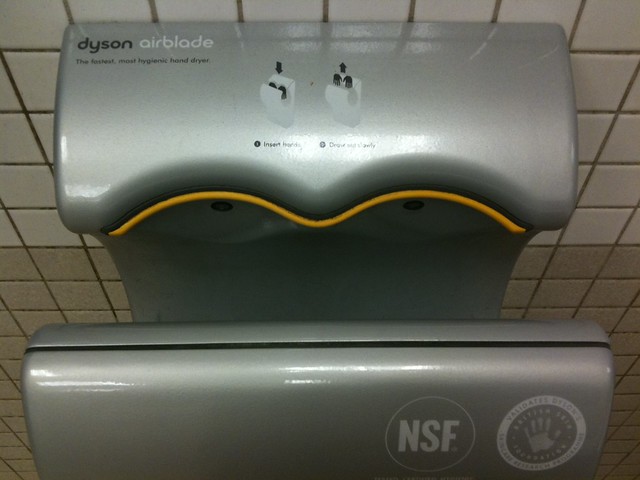
Ever use one of these Dyson Airblade hand dryers?
Even more striking than the design is the process.
Instead of "Rub hands vigorously under warm air," the process for traditional hand dryers (followed by the unwritten "Wipe hands on pants"), here's the process for a Dyson Airblade:
1. Insert hands
2. Draw out slowly
And how well does a Dyson work? Fantastically. By focusing warm air into a tiny sliver, the Dyson completely dries each part of your hand that passes through it.
Slow and focused beats vigorous and unfocused.
Now. What about your marketing? Could the same rules apply?
Think about what happens when a prospect comes into your business ...
Do you ask them qualifying questions, to gauge their interest and needs? Do you follow a script in the words you say or write to get the sale? And, most importantly, do you have a follow-up process to "touch" prospects at least 5-10 times after their initial contact with you?
In other words, is your marketing a slow and focused process?
Or ... do you wing it from start to finish -- sending emails and tweets, making phone calls, and following up whenever you have the time?
In other words, is your marketing a vigorous and unfocused mess?
Just like using a Dyson Airblade for the first time, it feels strange to put your prospects through a slow and focused process: qualifying questions, scripted presentations, disciplined/automated follow-up, etc.
But here's the good news: The "slow" method of drawing prospects through a focused marketing process will convert more of them into paying clients than a similar amount of vigorous, unfocused activity.
And you won't have to wipe your hands on your pants.
Bio: Kevin Donlin can help you grow your business and enjoy the breakthrough results your hard work deserves. If you're interested in boosting your revenues and profits, please click here.
Friday, May 21, 2010
Don’t Make This Mistake With Your Prospects
I'll write in the coming weeks about the importance of using contact management software in your business, SalesForce.com or Goldmine.com.
For now, to help you understand how many good things can happen when you follow up correctly with prospects, let me show you what can go wrong -- terribly wrong -- when you don’t follow up right.
Below is an actual email I got from a prospect who obviously never bought anything. I made just about every possible mistake with this man, all because I got lazy and didn’t use contact management software. My comments are in the body of his email message, IN ALL CAPITAL LETTERS.
I've decided to find someone locally to do my project. You told me 2 weeks ago that you would get right on it, I need it now. ACTUALLY, I NEVER TOLD HIM I’D GET RIGHT ON IT IN ANY EMAILS TO HIM, BUT ANY CHANCES I HAD OF CLARIFYING THIS FOR HIM ARE GONE
You didn't even remember who I was when I called. DOH! I DECIDED TO “WING IT” AND CALL HIM BACK WITHOUT FIRST LOOKING UP HIS NAME IN GOLDMINE
You came highly recommended to me, why I don't know. I FORGOT TO ASK HIM HOW HE HEARD ABOUT ME, SO I HAVE NO IDEA WHO RECOMMENDED HIM; IF IT WAS A CLIENT, I HAVE EGG ON MY FACE AS A RESULT
I'm going to tell people in the future here in Omaha not to do business with you, because all they will get is a bunch of empty promises. I'm very, very disappointed in your business. HERE’S A POSSIBLE PR DISASTER THAT’S ALL MY OWN DOING
I did email him back with an apology and to wish him well, not to salvage this lost sale, but to try to head off any negative word-of-mouth.
All in all, this is an excellent example of what can happen when you try to keep vital prospect details in your head, instead of in contact management software.
For now, to help you understand how many good things can happen when you follow up correctly with prospects, let me show you what can go wrong -- terribly wrong -- when you don’t follow up right.
Below is an actual email I got from a prospect who obviously never bought anything. I made just about every possible mistake with this man, all because I got lazy and didn’t use contact management software. My comments are in the body of his email message, IN ALL CAPITAL LETTERS.
I've decided to find someone locally to do my project. You told me 2 weeks ago that you would get right on it, I need it now. ACTUALLY, I NEVER TOLD HIM I’D GET RIGHT ON IT IN ANY EMAILS TO HIM, BUT ANY CHANCES I HAD OF CLARIFYING THIS FOR HIM ARE GONE
You didn't even remember who I was when I called. DOH! I DECIDED TO “WING IT” AND CALL HIM BACK WITHOUT FIRST LOOKING UP HIS NAME IN GOLDMINE
You came highly recommended to me, why I don't know. I FORGOT TO ASK HIM HOW HE HEARD ABOUT ME, SO I HAVE NO IDEA WHO RECOMMENDED HIM; IF IT WAS A CLIENT, I HAVE EGG ON MY FACE AS A RESULT
I'm going to tell people in the future here in Omaha not to do business with you, because all they will get is a bunch of empty promises. I'm very, very disappointed in your business. HERE’S A POSSIBLE PR DISASTER THAT’S ALL MY OWN DOING
I did email him back with an apology and to wish him well, not to salvage this lost sale, but to try to head off any negative word-of-mouth.
All in all, this is an excellent example of what can happen when you try to keep vital prospect details in your head, instead of in contact management software.
Monday, June 23, 2014
5 Wealth Ideas I Paid $3,197 to Get (Free for You)
Twelve days ago, on June 11, 2014, I landed in Cleveland, Ohio for Dan Kennedy’s Advanced Wealth Academy, an event I gladly forked over $3,197 plus hotel and airfare to attend.
The two days I spent with 200 other entrepreneurs locked in a room with Dan, were, simply, incredible.
I’ve been to intimate training sessions with Gary Halbert, Brian Tracy, Jay Abraham, and others ... but nothing compared to this event for the sheer number of light bulb moments I experienced. It was like fireworks in my brain.
And you missed out.
Or did you?
You see, I’m a copywriter. I have to type fast and take excellent notes to do my job. And I took excellent notes at Dan’s Advanced Wealth Academy -- 17 single-spaced pages of notes, to be exact.
Now, I can’t share my entire set of notes with you, out of respect for Dan’s intellectual property (and fear of his attorneys). However, I can share what I believe to be ...
The Top 5 Things Dan Kennedy Said That Can Make You Rich
#1: Money is attracted to enthusiasm.
Sincere, passionate interest in what you do causes money to come to you. If you lose track of time and forget to eat, you’re enthusiastic about what you do. MOST people are in a business they don’t love, selling to people they don’t love; this cannot turn out well
#2: Money loves shameless promoters, self-promoters and salesmen.
There’s a little PT Barnum in all the wealthiest people. Trump and Buffett do things differently, but both are Barnum-esque. Peers hate rich promoters. Money tends to flow to the people who get things sold
#3: Money is attracted to speed demons.
You can’t get any traction while you’re parked. A HUGE difference between poor and rich people is a sense of urgency. When Dan was broke, it was an urgent matter for him not to be broke tomorrow, not someday. For maximum speed to wealth, invent less and implement more
#4: Money favors the rogues and renegades.
A LOT of money is made by recognizing that rules are for other people. Disregard rules, disrupt established order, and leap-frog up the ladder
#5: Monetize EVERYTHING.
By monetizing only the “now” buyer, you waste 50-90% of your money. Understand this: Your marketing dollars don’t just pay for every buyer; you pay for every website visitor, caller, walk-in, email, and contact. You need aggressive lead capture, follow-up, and schemes to get money from unconverted leads. There is often more money in what you’re not monetizing now than in the buyers you’re getting now
Pretty good stuff, eh?
Action Step: Which idea will you implement first? I’d love to hear how you plan to do it!
Example from my own business -- just 3 days ago, I helped a client rake in $115,000 (and counting) from a webinar that we promoted via email and other methods. Today I’ll write him another email to monetize his unconverted leads; if we don’t bring in an extra $10,000, I’ll be disappointed. This, along with better lead capture, conversion, “lost” client reactivation, and systematic follow-up, is how you monetize EVERYTHING (Dan’s idea #5).
Why not give me a call today to brainstorm how these ideas can work for you? Even though I can’t show you any more notes from Dan’s Advanced Wealth Academy, I can share at least 3 more money-making tips with you. Give me a call today at (800) 723-1503 or send me an email.
The two days I spent with 200 other entrepreneurs locked in a room with Dan, were, simply, incredible.
I’ve been to intimate training sessions with Gary Halbert, Brian Tracy, Jay Abraham, and others ... but nothing compared to this event for the sheer number of light bulb moments I experienced. It was like fireworks in my brain.
And you missed out.
Or did you?
You see, I’m a copywriter. I have to type fast and take excellent notes to do my job. And I took excellent notes at Dan’s Advanced Wealth Academy -- 17 single-spaced pages of notes, to be exact.
Now, I can’t share my entire set of notes with you, out of respect for Dan’s intellectual property (and fear of his attorneys). However, I can share what I believe to be ...
The Top 5 Things Dan Kennedy Said That Can Make You Rich
#1: Money is attracted to enthusiasm.
Sincere, passionate interest in what you do causes money to come to you. If you lose track of time and forget to eat, you’re enthusiastic about what you do. MOST people are in a business they don’t love, selling to people they don’t love; this cannot turn out well
#2: Money loves shameless promoters, self-promoters and salesmen.
There’s a little PT Barnum in all the wealthiest people. Trump and Buffett do things differently, but both are Barnum-esque. Peers hate rich promoters. Money tends to flow to the people who get things sold
#3: Money is attracted to speed demons.
You can’t get any traction while you’re parked. A HUGE difference between poor and rich people is a sense of urgency. When Dan was broke, it was an urgent matter for him not to be broke tomorrow, not someday. For maximum speed to wealth, invent less and implement more
#4: Money favors the rogues and renegades.
A LOT of money is made by recognizing that rules are for other people. Disregard rules, disrupt established order, and leap-frog up the ladder
#5: Monetize EVERYTHING.
By monetizing only the “now” buyer, you waste 50-90% of your money. Understand this: Your marketing dollars don’t just pay for every buyer; you pay for every website visitor, caller, walk-in, email, and contact. You need aggressive lead capture, follow-up, and schemes to get money from unconverted leads. There is often more money in what you’re not monetizing now than in the buyers you’re getting now
Pretty good stuff, eh?
Action Step: Which idea will you implement first? I’d love to hear how you plan to do it!
Example from my own business -- just 3 days ago, I helped a client rake in $115,000 (and counting) from a webinar that we promoted via email and other methods. Today I’ll write him another email to monetize his unconverted leads; if we don’t bring in an extra $10,000, I’ll be disappointed. This, along with better lead capture, conversion, “lost” client reactivation, and systematic follow-up, is how you monetize EVERYTHING (Dan’s idea #5).
Why not give me a call today to brainstorm how these ideas can work for you? Even though I can’t show you any more notes from Dan’s Advanced Wealth Academy, I can share at least 3 more money-making tips with you. Give me a call today at (800) 723-1503 or send me an email.
Tuesday, August 3, 2010
Google Places -- a New Opportunity for Your Business
I've been in business long enough to remember when pay-per-click ads on GoTo.com (later Overture, later Yahoo Search Marketing) went for a penny a click back in 1998 ... and brought a ton of profitable traffic to my web site.
It was good to get in on that ground floor.
If you own a retail business or any business with a physical location, there's another ground floor you want to be on.
It's called Google Places.
Watch the video above to learn more.
Short answer: Google Places is a map listing relevant businesses when you do a geographically specific search, like "pet shop Chicago" or "electrician Los Angeles."
Even if you don't take walk-in clients, you need to list your business here. Just tell people that you work by appointment only, or by email and phone.
A listing on Google Places is free. All you need is a Gmail or Google Adwords account.
Here's how to make the best use of Google Places ...
1) Use direct-response ad copy to invite online browsers to visit your store. That means you need to make an offer right there in your Google Places listing. How? You could ...
2) Offer a coupon to get the first sale. Then, after they visit ...
3) Capture their address information, so you can follow up after the first sale. Ask something like: "Would you like to be on our mailing list to receive coupons and specials for customers only?"
4) Deliver an outstanding customer experience on that first sale.
5) Mail and email them after that to get follow-up sales (using the address info you collected in step 3).
Because, the only thing worse than not being found by your prospects is not converting them into clients for life who buy repeatedly and refer others.
Monday, August 22, 2011
Marketing Force Multipliers

Despite impossible odds, the 300 Spartans held off a force 50 times their number for two full days (before dying to the last man).
How did 300 Spartans equal 150,000 Persians?
With a force multiplier, defined as anything added to a fighting force which increases the effectiveness of that fighting force.
Look at the picture. See that narrow stretch of land the Spartans defended? It was a choke point. It forced the 150,000 Persians to squeeze in and battle the Spartans on even terms.
Thermopylae itself was just one force multiplier for the Spartans. They had others: superior training, equipment, and motivation (they were defending their homes).
Now. How can this help your business?
Ask yourself: What one thing, added to your marketing, greatly increases your effectiveness?
The answer is your force multiplier. And you want to do more of it.
Example: In my copywriting practice, my force multiplier is a follow-up phone call. It greatly increases the effectiveness of my marketing efforts, by 50% or more.
If I meet a prospect on a Monday, I will call them on Tuesday or Wednesday to follow up. Or if I mail something to a prospect and I know it arrived on a Wednesday, I'll call them on a Thursday or a Friday.
No matter what business you're in, you're doing at least one thing that greatly increases your marketing. That one thing is your force multiplier. Find it. Then, do more of it.
Meanwhile, if you want to more clients like your best clients, my free Client Cloning Kit can help. Grab your free copy now, while they last.
Wednesday, July 28, 2010
How I Doubled Sales Twice -- And You Can, Too
Do you own a business?
Want more revenue?
This is for you ...
Back in the 1990s, I doubled revenue twice in four years -- to a comfortable six figures -- for a resume service I operated amid fierce, price-cutting competition.
The methods that worked then still work today. They can get you more clients tomorrow.
Here's what I did: followed up, kept clients happy, and generated referrals.
1. Follow up
Using CRM software (Goldmine), I followed up by email and phone at least three times with every qualified prospect. And I used it to mail all clients at least once a year with news and/or promotions.
If I were doing it today, I would use Salesforce.com as my CRM. And I would mail clients every month. Not email -- snail mail. Prospects would get a monthly newsletter by mail, too.
2. Keep clients happy
My strategy was simple: I tried to over-communicate. That solved most problems when they were tiny flickers of dissatisfaction, before they grew into bonfires of anger.
Examples: I told clients what to expect at every stage of the process, then told them exactly why I did what I did for them, to resell them on the thought that choosing me was a good idea. Also, I sent them an extensive "user guide" to help them actually use what I created for them.
All of which worked very, very well.
3. Generate referrals
I used 10+ different referral methods, but the easiest to explain here is my formalized referral system.
Here's what I told clients:
What do all three have in common?
None of them requires you to spend another penny on advertising.
You can grow your business from the inside -- heck, double it -- by converting more prospects (by following up diligently), retaining existing clients (by keeping them happy), and "cloning" those clients (by generating referrals).
Try any or all of these in your business. Grow your business from the inside. Repeat as needed.
Want more revenue?
This is for you ...
Back in the 1990s, I doubled revenue twice in four years -- to a comfortable six figures -- for a resume service I operated amid fierce, price-cutting competition.
The methods that worked then still work today. They can get you more clients tomorrow.
Here's what I did: followed up, kept clients happy, and generated referrals.
1. Follow up
Using CRM software (Goldmine), I followed up by email and phone at least three times with every qualified prospect. And I used it to mail all clients at least once a year with news and/or promotions.
If I were doing it today, I would use Salesforce.com as my CRM. And I would mail clients every month. Not email -- snail mail. Prospects would get a monthly newsletter by mail, too.
2. Keep clients happy
My strategy was simple: I tried to over-communicate. That solved most problems when they were tiny flickers of dissatisfaction, before they grew into bonfires of anger.
Examples: I told clients what to expect at every stage of the process, then told them exactly why I did what I did for them, to resell them on the thought that choosing me was a good idea. Also, I sent them an extensive "user guide" to help them actually use what I created for them.
All of which worked very, very well.
3. Generate referrals
I used 10+ different referral methods, but the easiest to explain here is my formalized referral system.
Here's what I told clients:
For every new client you send my way, I'll discount their order $20 (as a gift from you), pay you $20 cash, or send you a $20 Amazon gift certificate. I settled on these 3 choices after much input from clients.Any client who referred two or more people was upgraded to Best Client status in my CRM. These clients got more mailings, more phone calls, and all-around "rock star" treatment. They responded by referring even more new clients. Virtuous circle.
What do all three have in common?
None of them requires you to spend another penny on advertising.
You can grow your business from the inside -- heck, double it -- by converting more prospects (by following up diligently), retaining existing clients (by keeping them happy), and "cloning" those clients (by generating referrals).
Try any or all of these in your business. Grow your business from the inside. Repeat as needed.
Tuesday, November 5, 2013
Announcing The Unadvertising Agency That Guarantees Results
Do you own or manage a service business, doing at least $500,000 in revenue?
If so, here's news ...
I’d like to help design a money-making plan for your business, identify your ideal clients, and show you how to compel them to ask you for help. This way you can bank more profits every month, without having to worry about where your next client will come from.
I offer this service because I’m a direct-response copywriter specializing in helping my clients boost their sales and profits …
… and there’s a good possibility that you already have a list of undeserved clients who are very responsive to the marketing plan that I’ll be giving you for free. It can make you TWICE as profitable.
If you find the plan that I create for you is valuable, you may wish to become a client of mine. If that’s the case, my rates start at $3995 per month, with no contracts or commitments.
How much new revenue can I deliver for you?
Rapid gains of $50,000 or more are possible. Keep reading to see how …
First, please understand I am not offering you a sales pitch in disguise. I promise not to pressure you or trick you in any way. In fact, if you feel I’ve wasted even one second of your time when we talk, just let me know and I will immediately write you a check for $250.
But before we go further, you need to know that I can’t help everyone …
There are 5 requirements to working with me. You must be able to say "Yes" to all of them:
1) Do you need help? If I think your business is doing all it can to maximize profits from your inactive clients, I'll tell you so. I'm not a know-it-all and you may be doing very well already.
2) Are you willing to let me create "unadvertising" that I know will sell? Except for legal or factual approval, I retain creative freedom. You, your spouse, or your Uncle Al can't mess with what I come up with.
3) Is your business doing at least $500,000 in revenue now? Any business below $500,000 doesn't have the volume to make this work.
4) Do you have a list of satisfied clients or customers I can speak with, to generate testimonials about you?
5) Are you honest, ethical, and do your references check out? I WILL call them. In other words, are you a "salt of the earth" Midwestern type who will honor an agreement to pay me when the money is due?
Now. You may be wondering, "Hey, what have you done for your clients?" Fair question.
I wish I could say that I hit a home run every time, but of course, I can't. But overall, my clients do very well. Here are a few examples ...
What should you do now?
If you’re interested and if you qualify, you can apply for a free Profit Discovery Session with me at this link
You’ll see a form there with a few questions about your business and what you’re hoping to accomplish. Once you submit that information, I’ll do some market research for you and set up a time to go over it together by phone.
Sound fair?
If so -- and if you think your business could use a cash windfall of at least $50,000 -- please apply for your no-cost Profit Discovery Session with me at this link.
Sincerely,
Kevin Donlin
Copywriter + Marketing Strategist
If so, here's news ...
I’d like to help design a money-making plan for your business, identify your ideal clients, and show you how to compel them to ask you for help. This way you can bank more profits every month, without having to worry about where your next client will come from.
I offer this service because I’m a direct-response copywriter specializing in helping my clients boost their sales and profits …
… and there’s a good possibility that you already have a list of undeserved clients who are very responsive to the marketing plan that I’ll be giving you for free. It can make you TWICE as profitable.
If you find the plan that I create for you is valuable, you may wish to become a client of mine. If that’s the case, my rates start at $3995 per month, with no contracts or commitments.
How much new revenue can I deliver for you?
Rapid gains of $50,000 or more are possible. Keep reading to see how …
First, please understand I am not offering you a sales pitch in disguise. I promise not to pressure you or trick you in any way. In fact, if you feel I’ve wasted even one second of your time when we talk, just let me know and I will immediately write you a check for $250.
But before we go further, you need to know that I can’t help everyone …
There are 5 requirements to working with me. You must be able to say "Yes" to all of them:
1) Do you need help? If I think your business is doing all it can to maximize profits from your inactive clients, I'll tell you so. I'm not a know-it-all and you may be doing very well already.
2) Are you willing to let me create "unadvertising" that I know will sell? Except for legal or factual approval, I retain creative freedom. You, your spouse, or your Uncle Al can't mess with what I come up with.
3) Is your business doing at least $500,000 in revenue now? Any business below $500,000 doesn't have the volume to make this work.
4) Do you have a list of satisfied clients or customers I can speak with, to generate testimonials about you?
5) Are you honest, ethical, and do your references check out? I WILL call them. In other words, are you a "salt of the earth" Midwestern type who will honor an agreement to pay me when the money is due?
Now. You may be wondering, "Hey, what have you done for your clients?" Fair question.
I wish I could say that I hit a home run every time, but of course, I can't. But overall, my clients do very well. Here are a few examples ...
-
For a Real Estate Investor, I created a sales letter that he mailed to prospects already in his database. The phone started to ring and sales started to happen automatically. Previously, his best year was $200,000. In less than half a year mailing my letters, he's at $660,000.
- For a Technical Sales Professional, I advised him on a simple follow-up process. Within 24 hours, he made a few calls to existing clients One call netted a sale for $193,000.
- For a Computer Support Service, I created a letter to a 2-year-old list of past clients. The letter did so poorly that I never got another chance. I took the loss on all creative fees and my client paid nothing, in keeping with my guarantee.
- For a Strategic Consulting Firm, I created a two-page letter to
mail to their past clients. It resulted in a windfall of $77,098 in new
revenues, with more to come by year's end.
- For an Insurance Agent, I created a new print ad for him to run in the newspaper. By making just a few changes in wording, I increased his profits by 671%.
What should you do now?
If you’re interested and if you qualify, you can apply for a free Profit Discovery Session with me at this link
You’ll see a form there with a few questions about your business and what you’re hoping to accomplish. Once you submit that information, I’ll do some market research for you and set up a time to go over it together by phone.
Sound fair?
If so -- and if you think your business could use a cash windfall of at least $50,000 -- please apply for your no-cost Profit Discovery Session with me at this link.
Sincerely,
Kevin Donlin
Copywriter + Marketing Strategist
P.S. -- A partial list
of media that have interviewed me on marketing includes Forbes, The Wall Street
Journal, Entrepreneur magazine, New York Times, KARE-11 TV (NBC), WXYZ
TV (ABC), KMSP TV (Fox), and WCCO Radio (CBS).
P.P.S.
--
As a courtesy, I give past clients first right of refusal on anyone who may
compete with them. So it may already be
too late for you, if someone else has contacted me from your geographic
area. Please schedule your free Profit
Discovery Session with me at this link …
before schedule fills up. After that, this offer will be withdrawn.
Tuesday, November 2, 2010
What's Your Marketing System?
Being from the Detroit area, I'm a big fan of statistician and management guru W. Edwards Deming, who basically shamed the Big 3 automakers into improving the quality of their products by first helping the Japanese to do so after World War II.
His philosophy has been summarized as follows, by Wikipedia:
So ... what's your system for marketing?
Your marketing system can be defined as everything you do with a person who comes into contact with your business, from their first email or phone call until the day exit the marketplace forever.
Here are essential elements of marketing system:
1) Lead capture. You record the name, email address, and other needed information from prospects in a database -- with your prospects' permission, of course.
2) Follow-up. You contact prospects who do not buy the first time, answering their questions and offering them information to move them along in the buying process.
3) Sales scripts. You deliver the same sales pitch to every prospect, tailored to their unique questions and objections, but as uniform as possible, to eliminate variation from tested "selling words" that have worked before.
4) Customer care. You have policies and procedures in place to maximize client satisfaction while minimizing frustration.
5) Referrals. You take the same steps with every customer to encourage and reward referrals.
Get the idea?
Unless you have a marketing system, you don't have a business. You have a hobby.
If you're unhappy with the results your marketing is producing so far this year, it may be tempting to blame the economy. Or Washington. Or penny-pinching customers who don't appreciate your brilliance.
But blaming outside forces leaves you powerless to make improvements where it counts, on the inside of your business.
Instead, the cause of low sales and miniscule profits more likely lies in your marketing system.
So blame the system. But only for about 10 seconds, because beating yourself up won't bring your sales up.
Instead, get busy improving your system, one small step at a time. That's how systematic, continual improvement in your profits happens.
(For more ideas like these, download Guaranteed Marketing for Service Business Owners.)
His philosophy has been summarized as follows, by Wikipedia:
Dr. W. Edwards Deming taught that by adopting appropriate principles of management, organizations can increase quality and simultaneously reduce costs (by reducing waste, rework, staff attrition and litigation while increasing customer loyalty). The key is to practice continual improvement and think of manufacturing as a system, not as bits and pieces.
So ... what's your system for marketing?
Your marketing system can be defined as everything you do with a person who comes into contact with your business, from their first email or phone call until the day exit the marketplace forever.
Here are essential elements of marketing system:
1) Lead capture. You record the name, email address, and other needed information from prospects in a database -- with your prospects' permission, of course.
2) Follow-up. You contact prospects who do not buy the first time, answering their questions and offering them information to move them along in the buying process.
3) Sales scripts. You deliver the same sales pitch to every prospect, tailored to their unique questions and objections, but as uniform as possible, to eliminate variation from tested "selling words" that have worked before.
4) Customer care. You have policies and procedures in place to maximize client satisfaction while minimizing frustration.
5) Referrals. You take the same steps with every customer to encourage and reward referrals.
Get the idea?
Unless you have a marketing system, you don't have a business. You have a hobby.
If you're unhappy with the results your marketing is producing so far this year, it may be tempting to blame the economy. Or Washington. Or penny-pinching customers who don't appreciate your brilliance.
But blaming outside forces leaves you powerless to make improvements where it counts, on the inside of your business.
Instead, the cause of low sales and miniscule profits more likely lies in your marketing system.
So blame the system. But only for about 10 seconds, because beating yourself up won't bring your sales up.
Instead, get busy improving your system, one small step at a time. That's how systematic, continual improvement in your profits happens.
(For more ideas like these, download Guaranteed Marketing for Service Business Owners.)
Friday, February 4, 2011
4 Tips for Successful Trade Show Exhibiting
I had coffee this morning with Colin Serle, owner of Black Cat Promotions.
Serle is an expert at marketing with advertising specialties, like key chains, ball point pens, apparel, and other items.
Over the past 40+ years, he's learned a thing or two about marketing and selling, particularly at trade shows.
If you never thought about marketing your service business by exhibiting at a trade show, think again.
For about the same amount of money as you'd spend on one display ad in the local newspaper, which might net 5 calls on a good day, you can meet dozens of prospects at a trade show and gauge their immediate reaction to your sales message.
Serle kindly shared these XX ideas to help you bring home the bacon -- and the sales leads -- the next time you exhibit at a trade show ...
1) Know the formula
"Write this down: the number of hours you'll be exhibiting at the trade show, multiplied by the number of people working your booth, multiplied by 30. That's the number of product samples or specialty items you can give away," says Serle, who devised this formula after years of experience.
So, plan accordingly when planning how many tchotchkes to pack for your next trade show.
2) Market before the show
Contact the trade show organizers and ask if you can mail an introductory letter to the registered attendees. You may be able to get this mailing list at no charge, but you will likely have to pay. Pony up the money if you have to, and send a letter. "Ask people to stop by your booth for a free item and tell them you're eager to meet. If you don't send a pre-show letter, you're relying on luck," says Serle.
3) Attract attention by demanding attention
If you're no good at drawing attention to yourself -- like me! -- Serle suggests letting your giveaway item do the work for you.
"I remember one trade show when one vendor had rubber balls that lit up inside when he bounced them. He had such a crowd around his booth that he gave away all his samples halfway through the first day," says Serle. "He had to call the supplier and ask for an emergency re-order," which is a nice problem to have.
So, consider working something lively and eye-catching into your trade show display.
4) Attract leads by giving away value
As a final bit of advice, Serle suggests you save pricier gift items or product samples ($5-$10+) for qualified prospects you talk to at your booth. "If you reach under the counter and hand prospects a nice item as a thank-you, that's powerful," he says.
Just be sure to get full contact information from every prospect you meet, so you can follow up with them after the show.
(More ideas like these in the Free Report, Guaranteed Marketing for Service Business Owners.)
Serle is an expert at marketing with advertising specialties, like key chains, ball point pens, apparel, and other items.
Over the past 40+ years, he's learned a thing or two about marketing and selling, particularly at trade shows.
If you never thought about marketing your service business by exhibiting at a trade show, think again.
For about the same amount of money as you'd spend on one display ad in the local newspaper, which might net 5 calls on a good day, you can meet dozens of prospects at a trade show and gauge their immediate reaction to your sales message.
Serle kindly shared these XX ideas to help you bring home the bacon -- and the sales leads -- the next time you exhibit at a trade show ...
1) Know the formula
"Write this down: the number of hours you'll be exhibiting at the trade show, multiplied by the number of people working your booth, multiplied by 30. That's the number of product samples or specialty items you can give away," says Serle, who devised this formula after years of experience.
So, plan accordingly when planning how many tchotchkes to pack for your next trade show.
2) Market before the show
Contact the trade show organizers and ask if you can mail an introductory letter to the registered attendees. You may be able to get this mailing list at no charge, but you will likely have to pay. Pony up the money if you have to, and send a letter. "Ask people to stop by your booth for a free item and tell them you're eager to meet. If you don't send a pre-show letter, you're relying on luck," says Serle.
3) Attract attention by demanding attention
If you're no good at drawing attention to yourself -- like me! -- Serle suggests letting your giveaway item do the work for you.
"I remember one trade show when one vendor had rubber balls that lit up inside when he bounced them. He had such a crowd around his booth that he gave away all his samples halfway through the first day," says Serle. "He had to call the supplier and ask for an emergency re-order," which is a nice problem to have.
So, consider working something lively and eye-catching into your trade show display.
4) Attract leads by giving away value
As a final bit of advice, Serle suggests you save pricier gift items or product samples ($5-$10+) for qualified prospects you talk to at your booth. "If you reach under the counter and hand prospects a nice item as a thank-you, that's powerful," he says.
Just be sure to get full contact information from every prospect you meet, so you can follow up with them after the show.
(More ideas like these in the Free Report, Guaranteed Marketing for Service Business Owners.)
Subscribe to:
Posts (Atom)