Showing posts with label problem solving. Show all posts

Monday, June 2, 2014

James and the Lawn Mower: The Power of Being Specific

Nearly every Sunday morning since last fall, I’ve had a short conversation with a man named James. He stands next to an exit off I-35W with a sign asking for help, so I stop on the way to church, give him a few dollars, and wish him well. He seems like a good guy who’s down on his luck.

Last Sunday was the end of a bad week. In my morning meditation, I decided that the problem was my selfish attitude. So I said a little prayer asking God to make me useful to other people that day. Being useful is a sure-fire way to forget myself and fix my attitude. Did it work? Well ...

Driving to church, there was James. But instead of saying good morning, he said, “Hey, do you know where I can get a lawn mower? I want to cut grass for people to bring in some money.” I replied, “I-I-I ... don’t know. But I’ll find out. Stick around, okay? I’ll be back in an hour!” James shook his head yes.

Pulling away, I thought, “What the heck did I just get myself into?” But I was confident I would find a lawn mower ... somewhere.

Now, I’m a lector at church, so I give the announcements at the end of mass. I told the priest about James and asked if I could ask the congregation for a lawn mower during announcements. He agreed. So here’s what I said ...

“I need your help. A resident of our parish has fallen on hard times. To make ends meet, he wants to mow lawns for money. He needs only one thing: a lawn mower. I would give him mine, but I don’t have one. So I’m asking you -- if you have access to a good, working lawn mower and you’re willing to donate or sell it to me, please meet me out front. I know you’re out there and I hope this message moves you.”

Not one, but two people were waiting for me outside.

A woman named Lucia had a more suitable mower, so I chose her. After getting her address, I ran to my car. A few minutes later, I pulled up at his corner and there was James. “I got you a mower, man -- let’s go!” I said. He jumped in and we sped off.

So far, this was turning out to be a good morning for James. But it got better.

At her house, Lucia told us, “My boys are off at college and I have a lawn service now. I don’t need this mower or this gas can. Would you like the can, too?”

“Yes ma’am. Thank you!” said James.

“How about this edger. Would you like that, too?” asked Lucia.

“Yes ma’am. Thank you very much!” said James.

James now had a built-in upsell (“Would you like edging with that?”) for his new lawn-mowing business. How cool was that?

Thanking Lucia one final time, James and I loaded his new equipment into my SUV and drove to his apartment. On the way I asked, “Have you ever asked anyone for a lawn mower before?”

“No, never,” he said. “I just got the idea this morning.”

“Isn’t that interesting?” I said. “I just decided to be useful this morning. Somehow this all turned into a new business for you. And you know what? If you’d asked me for $250 to buy a lawn mower, I would have turned you down flat. But because you asked for a lawn mower, you got it!”

Now, James and I talked about a lot of other things that are private to him and to me, about how Someone put us together to help each other ...

... but here’s what I took away from this: There’s great power in knowing exactly what you want, in your business and your life. Unless you know what you want, you’ll never know what to ask for. And you’ll never get it. But knowing and asking specifically can make a big difference. It did for James.

One last thing. I’ve never shared a story like this with a business reader like you, so I hope you found it useful and not too personal. Let me know what you think!

Meanwhile, if you want to grow your business, my free Client Cloning Kit can help. It's not some cheapo download -- this is a real business-building kit you can hold in your hands.
 
Grab your free copy now, while they last.

Tuesday, February 19, 2013

How to Give Bad News to Clients

Free coffee cake = Bad news forgiven
Have you ever been let down by a vendor? 

Of course you have.

Vendor screw-ups are like death and the Detroit Lions missing the playoffs -- they're gonna happen.

Last Sunday, my wife and I were let down by a vendor. But they recovered so well that we gave them extra money.

Here's the story ...

We sat down for brunch at The Grand Cafe in Minneapolis and waited for our order to arrive.

And waited. And waited ...

After a few minutes, our waiter rushed over to apologize and take responsibility. "We're missing our regular Sunday morning cook, so everything is behind. I'm really sorry. Here's a piece of coffee cake on the house, while you wait."

A few minutes later, he returned. "We're still behind, so I'm going to take your coffees off the bill. I'm very sorry about this!"

Our brunch eventually arrived and it was delicious. 

And here's the thing: Because our waiter got out in front of the problem and "owned" the slow service, we really didn't mind. In fact, I gave him a nice tip.

The lesson is this: If you've got bad news to deliver, do it quickly, with a smile, over-communicate to keep your client in the loop, and throw in a freebie to thank them for their patience.

You can own the problem, or be owned. Pick one :-)

Meanwhile ... if you want to put an end to "feast-or-famine" syndrome in your business, my free Client Cloning Kit can help you. Grab your copy here, while they last.

Monday, December 3, 2012

From Mental Fog to Creative Clarity

Yesterday, it was foggy all day here in the Twin Cities.

Below is a shot I took about a block from my house ...

Now, here's the thing: It's never foggy all day in the Twin Cities. Especially in December.

So this made for a very unusual day, especially when driving. I had to tune out distractions and focus on the road, or risk a crash.

But this had an unexpected benefit. By really observing where I was driving, I had to be fully present and mindful -- it was an accidental zen thing. No stray thoughts, worrying about the future, or replaying past events. Just driving.

What was the benefit?

Research cited in the book, The Laws of Subtraction shows that familiarity can stifle creativity.

By intensely focusing on the new, unusual driving conditions, my mind was jolted out of its normal thought patterns. Not surprisingly, it handed me several solutions later on to problems I had been trying to solve for days.

This happens to you all the time when you travel. Think about it: When you drive or fly to new places (or back home, if you live across the country), you pay more attention to your surroundings, which lets your mind break free of old thought patterns.

So, here's what I learned from the fog: You can wait for weird weather or a vacation to jolt you out of your mental ruts ...

... or you can take action and pay closer attention to your surroundings the next time you walk or drive across town. Doing so can boost your creativity and problem-solving powers, faster and cheaper than a trip across the country.

Meanwhile ... if you want to put an end to "feast-or-famine" syndrome in your business, a free Client Cloning Kit can help. Grab your copy here. 

Monday, August 29, 2011

How to Create a Big, Costly Problem

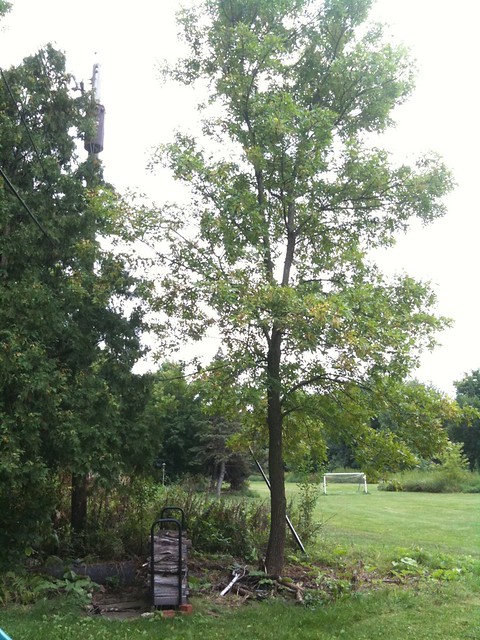
See that 40-foot tall tree to the right of the wood pile?

My wife hates it and wants me to cut it down.

She's been telling me so for 9 years. Since that problematic tree was about 4-feet tall.

I always thought it was a little thing. And it was. Plus, the tree is in a hidden corner of our yard.

So I ignored the problem ... until it grew too big to ignore.

Eight years later, that tree will now cost about $250 to get rid of, if I cut it down myself and rent a chipper.

If I neglect it another 9 years? It will cost about $1,000 for someone else to cut down and chip.

What's the point of all this?

There are little, "4-foot" problems in your business right now, which -- if ignored -- can grow into costly "40-foot" problems, faster than you think.

Look around. Pick one 4-foot problem in your business you have ignored for too long. Is it:
  • a non-performing employee or partner?
  • the growing amount of time you spend on Facebook?
  • daily tasks that keep you busy, but not productive?
  • a difficult client who eats up your time?
  • a cluttered office that saps your energy?
Whatever it is, chop that problem down today, while it's still a little thing ... before it grows into a big, expensive headache.

You'll find more ideas like these in my Free Report, Guaranteed Marketing.

Monday, November 1, 2010

New Way to Solve Problems: Get Physical

Got a problem? Want new insights on how to solve it?

Then keep reading ...

In April of this year, I spoke at a career seminar in Saskatoon, Saskatchewan. Among the presenters was Dr. Norman E. Amundson, a professor of Counseling Psychology at the University of British Columbia, who gave an outstanding talk on problem solving.

I took a lot of notes while he spoke; one page is pictured below.

We've all been stuck on a problem before. You rack your brains for a solution. You turn it over in your mind. You sit and stew. And all you get is a headache.

Why not try a physical approach instead? Dr. Amundson referred to it as "walking the problem."

He asked the audience to picture a problem we were trying to solve as located on the other side of the room. Then, he said ...

"Instead of walking toward the solution from the problem as a starting point, we should walk toward the problem from the solution.

"How did we get there? Thinking this way creates new patterns and gets you unstuck.

"Looking back at your problem while standing 'in the solution,' you might 1) not see a problem at all; and 2) take a different route to the problem or move at a different rate -- there are many ways to solve a problem.

"By starting from the position of 'problem solved,' you start from a position of strength, with a broader perspective. As a result, you will work with more energy and excitement."

Try this physical method for solving problems today. I've used it before with remarkable results.

Example: I don't get writer's block. Ever. Why? Because, any time I get stuck for more than 5 minutes on what to write, I get up from the keyboard and walk away. I imagine the ideal sentence will be sitting on my chair, waiting for me, when I get back. It may take 30 seconds of walking before I find the sentence sitting there ... or 20 minutes. But I always get a solution of some sort after I finish walking.

Kooky? Quirky? Who cares. It works.

Now. Would you like even more expert ideas to solve problems and grow your business?

If so, I'd like to give you my speaker notes from a three-day, $5,000 marketing seminar, put on by Jay Abraham in Los Angeles.

The speakers were phenomenal: Seth Godin, Stephen R. Covey, Stephen M.R. Covey, Marshall Thurber, John Assaraf, Donald Moine, Andy Miller, and others. If you can't find at least a dozen money-making ideas from these 25 pages of notes, you ought to move to Cuba ...

You can download my $5,000 seminar notes here.

Wednesday, October 13, 2010

Your Brain, Your Business, Your Life

I like my brain.

It's been very good to me, despite those four-and-a-half years of intensive neuron slaughter, otherwise known as college.

So I really liked the book, Brain Rules: 12 Principles for Surviving and Thriving at Work, Home, and School.

Author John Medina, a molecular biologist with a gift for clear writing, shares the latest science and its implications for your brain, your business, your marketing, your family, and your life.

Here are three takeaways from the book, which can help you improve your business from the inside ...

1) Exercise boosts brain power

Your brain evolved to survive in jungles and prairies, after our early ancestors routinely walked an average of 12 miles a day in search of (and in avoidance of becoming) food. As a result, your brain is NOT meant to sit in a cubicle or a classroom for 8 hours a day.

Think about it: The smartest senior citizens you know are probably the most active. And most of history's greatest thinkers were physically active: Aristotle, Immanuel Kant, Napoleon Bonaparte, Albert Einstein, and Douglas MacArthur all had a habit of pacing as they thought or taught, for example.

If you do nothing more than aerobic exercise, 30 minutes at time, two or three times a week, your brain will benefit. But don't stop there. Break up your workday with physical activity, such as walking, biking, or stretching.

2) Sleep well, think well

A lack of sleep retards your ability to pay attention, remember, reason logically, solve problems, or do any other thinking. For best results, your work schedule should match your productive times, whether it be morning, evening, or someplace in between.

And -- here's the fun part -- your businesses should encourage a nap in mid-afternoon, when productivity sags for almost everyone. So, instead of a Red Bull at 3:00, try a 20-minute siesta.

3) Vision trumps all other senses


Our brains see and think in pictures. Visual processing dominates how we interpret the world, with about half your brain power devoted to vision. As a result, pictures are easier to remember than words.

This has vast implications for your marketing and presentation efforts. Here are two:
  • Include pictures in your ads. Research shows that the eye is always drawn to pictures and  remembers them better than words alone. (A tough pill to swallow for a copywriter like me who loves words!)
  • Delete your presentations and start over. The typical PowerPoint business presentation has almost 40 words per slide. More pictures and fewer words would capture and hold an audience's attention far better.
There are way too many more useful tidbits than I have time to share here. If you love your brain, you owe it to yourself to read this book soon :-)

Brain Rules: 12 Principles for Surviving and Thriving at Work, Home, and School
Oh, and in the spirit of including pictures, here's one of the book ...

Tuesday, August 10, 2010

The 33:33 Secret to Greater Productivity

If you get more done every day, you can delight more clients ...

... which gets you more revenue

... which is a delight.

You may think you've heard or read every productivity secret under the sun.

But I'll bet the following "33:33" tactic is not only news to you -- it will also revolutionize your working day.

I know, because I've used it for 5 years, and it never fails to help me get more done, in less time and with less effort.

It truly is powerful. And simple!

So, take it away Sandy Barris from Fast Marketing Plan in this guest posting. I normally write all my own stuff, but Sandy has said it better ...

Thirty-Three Minutes and Thirty-Three Seconds.

That’s the magic number I use when I need to focus.

I’d love to tell you that it was my idea, but it comes for the late Eugene Schwartz, one of the world's greatest copywriters, who admits he never had a creative block using this technique.

It works like this: Set an egg timer (or your watch) for 33:33, hit Start, then ... stay seated in front of whatever you have to do at your desk. During that time, concentrate fully on the task at hand. Do not get up from your desk or allow yourself to be distracted by anything.

As soon as the timer goes off -- no matter what you are doing or how deeply engrossed you are -- get up from the desk, walk away, and take a 5-minute break. Get up, walk around, open mail, exercise -- whatever. You give your subconscious mind time to recharge, mull over what you just did, and make new connections.

This is the secret of getting things done: Do what has to be done in short bursts. Stay totally focused on the task at hand for 33 minutes and 33 seconds -- and not a second longer. And see if you don't become more productive, faster.

File this under "Simple. Brilliant."

Bio: Kevin Donlin can help you grow your business and enjoy the breakthrough results your hard work deserves. If you're interested in boosting your revenues and profits, please click here. 

Monday, May 17, 2010

Stuck on a Problem? Take a Walk

It's Monday, when we often struggle to get our minds into gear and focused on the workweek.

If you're stuck on a problem or in a bad mood, here's an idea:
"A vigorous five-mile walk will do more good for an unhappy but otherwise healthy adult than all the medicine and psychology in the world." —Paul Dudley White
As you probably know, about the worst thing you can do to solve a problem in business is to sit in front of a computer and stew over it.

Take a walk instead.

Not as a way of fleeing your problem, but as a way to get your conscious mind out of the way so your subconscious mind can solve it.

And, as a bonus, you'll get some exercise.

Don't have an hour or two free for a 5-mile walk? No problem. Fifteen or twenty minutes will do.

I've found this simple solution never fails to invigorate both body and mind, while producing solutions to most of the toughest problems we run into in business.

Try it today. Then, share your comments below.

Tuesday, May 11, 2010

Problems: Millstones or Stepping Stones?

How often do you run into problems as you try to grow your business?

Weekly? Daily? Every 10 minutes?

Left unsolved, problems in your business -- like how to get more clients, or get them to buy more often -- can drag you down, like a millstone around your neck.

But what if you looked at problems differently?

What if you could see them, not as millstones weighing you down, but stepping stones, leading you on to success?

Let me explain ...

It's entirely normal to look at a problem as a pain, something to solve and get out of your life as quickly as possible, like a toothache.

Viewed that way, problems are entirely negative, like a millstone tied around the neck of a man who is thrown into the sea (Luke 17:2).

But ... what if you viewed problems as the pathway to greater achievement?

Because, you cannot succeed in great things until you succeed in small things. One translation of Luke 16:10 is, "Whoever can be trusted with very little can also be trusted with much ..." (NIV).

What if you saw every problem solved as a stepping stone, leading from where you are to where you want to be?

There will always be problems in your business. That won't change.

But your attitude toward problems can change.

Stop seeing problems as negative. That only drags you down.

Start setting problems as a way to grow stronger and develop more skills. That paves the way for success in your business, like stepping stones to achievement.