Showing posts with label productivity. Show all posts

Tuesday, March 1, 2022

How to Make March a Leap Month

Today is March 1, not February 29.

So it's not a leap month right?

Wrong.

You can make March -- or any month -- into a leap month, by adding another day to it.

All you need do is recapture 24 hours of lost time this month. It's like giving yourself an an extra day to do whatever you want.

And I'll pay you $50 if I'm wrong ;-)

Let me explain.

First, take a look at the graphic below ...
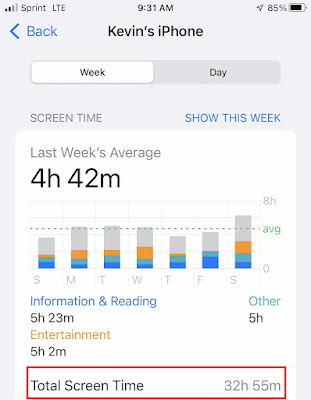

It's a screen shot of my cell phone's screen time for the week of February 20. For those 7 days, I used my phone for a total of 32 hours and 55 minutes, or 4:42 a day, on average.

And I'm sure you'll agree: We all use our cell phones too much, right?

To be blunt, every hour spent on your cell is an hour you're not living in the real world.

In my view, every hour of cell phone use I can recapture is an extra hour of real life -- not a virtual (fake!) life watching viral videos, reading politicized "news," checking social media for the 17th time today, etc.

Anyway.

If you agree that an hour offline beats an hour staring at your phone, then the task is simple: Replace screen time on your phone with time in the real world.

It's easier than you think.

Here's how: Simply measure your screen time for one week, then reduce it by 6 hours next week.

When you save 6 hours a week over 4 weeks, you recapture 24 hours to live in the real world.

You add an extra day of real living to this month.

You create your own leap month, on demand.

Bonus: That extra day is 33% more valuable, because you're not sleeping for 8 hours. You're alive for the whole 24 hours.

But don't believe what I say.

Watch what I do.

Come back to this post on Sunday, March 6 and see my updated screen time for this week.

If my Total Screen Time isn't 26 hours 55 minutes or less, I'll PayPal $50 to each of the first 5 people who call me out here.

Meanwhile, if this idea of replacing virtual time with real time intrigues you even a tiny bit, you can start tracking Screen Time on your phone today. Because what gets measured gets improved, almost automatically.

Until then, I hope you accept this "Leap Month Challenge" and recapture 6 hours from your cell phone this week ...

UPDATE: Today is March 6 and my little experiment was a success. Take a look ...
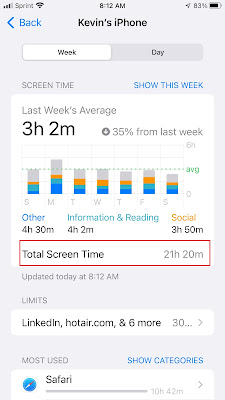

Instead of the planned 6 hours, I reclaimed 11 hours and 30 minutes of time from my cell phone last week. Which puts me on pace to get back an extra 46 hours in March -- nearly two full days of life.

Now, you may ask yourself: What's the big deal? 

What did I do with that extra time? 

How did I benefit? 

My answer is simple: How does it feel when you stop banging yourself in the head with a hammer?

Better. 

That's how it feels to reduce my screen time by 11:30 for a week. I feel BETTER about every single area of my life -- from fitness and personal relationships to productivity and my self-esteem.

From a financial perspective, I know for certain that I made more money last week. It's axiomatic. Because I value my time at work at $1,000 an hour. And of those 11:30 I saved, at least 5 of them were working hours. Which adds up to $5,000 of time that I didn't throw away reading news headlines or checking email on my phone, to name just two.

Meanwhile, I quickly finished a sales letter for my business that had been stagnant for weeks, in part of those reclaimed 11 hours and 30 minutes. And that's just one project. There were others.

I certainly did make March a "leap month" for myself. I hope you found this experiment helpful, too.

Now, may I ask a quick favor?

If you'd like to go deeper on this subject of getting more life from the same hours each day ...

... would you comment below and say YES?

Here's why I'm asking.

If someone stole your wallet, you'd be angry, right?

You would also call the cops.

So ... why don't people get angry or call for help when they're robbed of something much more valuable than money -- their time?

You can always make more money.

But you can never make more time.

That's why I wrote this article on making March a "leap month." To help you recapture 24 hours of lost time from your cell phone this month.

This idea of living a "leap life" is something I've been researching and working on since ... 1994. You might call it an obsession :-)

Anyway, I'm putting together a pilot program, at NO cost and NO obligation, to help busy people like you recapture an extra 24-48 hours every month.

If you're at all interested in the program, which is FREE and at NO obligation, please write YES! in the comments below ... and I'll send you the details.

A wise teacher once told me: "If you live the same day twice, you've just wasted one day of your life." Why not live today differently? And avoid wasting another day of your life? 

It's as simple as deciding to reclaim the hours that your cell phone is stealing from you every day. Just reply YES! in the comments below ... and I'll send you the details.


Thursday, September 19, 2019

More Clients From Less Work: The Magic of Focus


Have you ever read a book, watched a video, or gone to a seminar ...

... written down a long list of things to do ...

... and ended up doing NONE of it?

You're not alone.

It happens to us all.

But one insurance agent found a simple solution to that problem. And for him, it's been worth millions.

Louis, a sales rep for two Allstate Insurance offices in Texas, told me that he attended his first big marketing seminar a few years ago. He took a long list of ideas back to the office. He tried to do all of them ... and ended up doing none.

The reason? His to-do list was too long and intimidating to start on.

So, he did something different.

After his next seminar, he took another list of ideas back to the office. But this time, he focused on doing just ONE thing. That's it.

After putting that one idea to work, he did the next one. And the next. One at a time, step by step.

Results?

Louis and his team went from worrying about how to pay their bills to being on track for $3 million in annual premiums. With a ton of profits, and non-stop growth on the horizon.

Moral: New ideas mean nothing without new actions. But you won't implement if you're too intimidated to start. It's like trying to climb a mountain in one giant leap -- demoralizing and impossible.

So, take a moment today to look at your notes from that last seminar, podcast, or book. Pick just ONE idea and put it into action.

And one more thing ...

If you want more new clients faster, request your Free Client Cloning Kit at my website 

Tuesday, September 17, 2019

Are You the Boss of Your Business?

Strategic Marketing makes you the boss
Do you own a business?

If so, be careful.

Because your business may be bossing you around ... and costing you money.

Here's the story ...

I once overheard a discussion about strategy and tactics, between a boss and an employee. It went like this:

Boss: "Me strategy. You tactics. Me say. You do."

Employee: "Okay, boss."

Now, look at your calendar for last week. How much boss work did you do? And how much employee work?

If you own a business, you get paid the big bucks for doing boss work. Everything else is employee work ... which pays less.

You need to decide what's going to happen, who's going to do it, and by when. That's strategy -- boss work.

Answering email, updating your website, paying bills, those are tactics -- employee work.

And every minute you spend on that, you're under-paying yourself.

In the book, It's a Brand New Game, by Michael Patterson, Richard Branson says: "Try and find people to take over 99 percent of what you do, which will then free you up to think about the bigger picture."

So: You do boss work, strategy. Let employees do tactics.

If you found these ideas helpful, claim your Free Client Cloning Kit here.

Wednesday, February 10, 2016

How to Get One More Hour of Productive Time Every Day -- Guaranteed


What would it mean to you to gain an extra hour of productive time every day?

That's an extra 5 hours a week -- 250 hours a year.

That's equal to more than 30 full 8-hour working days a year, by the way.

Forget adding an extra day during leap year ...

... this is like adding an extra month to the calendar every year!

Could you use some of that extra time to build your business?

I think you could.

Well, here's what this is about: It's a little mind game I call the Daily Time Expander.

And if you play along with me for one week and don't get back at least one extra hour of productive each day, I'll write a check for $100 to your favorite charity.

Do I have your attention? Good.

Here's what to do: Grab your smart phone. Look at the bottom of the home screen. See the  email icon there? Move it!

Where to? Someplace where you won't see it -- and that little red number telling you how many emails you have to read -- every time you pick up your phone.

I moved my email icon 4 screens deep on my phone and then I buried it in a little folder, called Games.

As a result, I cannot be distracted by email when I look at my phone. I have to go hunting for it. And this is the simple secret that can save you an hour of productive time every day: Never let yourself get sucked into email when you pick up your cell phone.

And when you do the math, avoiding email like this can easily save you one hour a day.

One reason? Emails are like mice or cockroaches: There’s never just one. And once you start composing replies to emails, setting reminders to reply to the replies, visiting stray web sites -- 5, 10, or 15 times a day -- that always burns at least an hour a day of valuable time.

Now. This idea is more than interesting. This is potentially life changing for you. So I want to make sure you try it.

That's why I'm making you this very public challenge: Move the email icon off the home screen of your smart phone and keep it that way for 5 working days in a row. If you don't save at least 5 hours of time you otherwise would have wasted getting sucked into email, I will donate $100 to the charity of your choice.

Just send me a short note by mail. Include your contact info and the name of your charity. I will make the donation and email you the receipt to prove it. Here's my mailing address:

Kevin Donlin
Guaranteed Marketing
7455 France Ave. S., #263
Edina, MN 55435

This is a very public challenge. There's no hiding for me. And I hope you put this idea to the test.

By the way, The Daily Time Expander is the first of 11 marketing tools you can get for free, if you hurry, at www.MarketingMultipliers.com

What does time have to do with marketing? Everything.

Because, as Dr. Bernie Siegel once said, time isn't money -- time is everything.

Your time and your marketing are inextricably linked. If you can't manage your time, you can't market your business. So the first thing I want to do is free up at least 5 more hours each week for you to get more new clients. And that's what The Daily Time Expander does for you.

For Free Access to this and 10 other tools, visit www.MarketingMultipliers.com

Tuesday, February 17, 2015

The Marketing (and Productivity) Secret from Golf

"Golfers on green" by Sands Beach Lanzarote
 There's an unwritten rule of etiquette in golf: When you reach the green, repair your ball mark -- and one more.

That way, the green stays pristine for your group and the players who follow you. It's a great tradition, because it's quick, easy, and it works.

This idea of "and one more" has implications for your business, too.

Examples:
  • send a follow-up email to a prospect -- and one more
  • write and mail a thank-you note -- and one more
  • call to be helpful to a client -- and one more

So, think of your tasks in marketing (or anything) as ball marks on a golf green. Fix one -- and one more. Because you can't finish anything you don't start. And once you start, it's easy to ride the momentum ... and do one more.

Now. 

If you want more new clients like your best clients, grab your Free Client Cloning Kit.


Thursday, January 15, 2015

Just a Reminder: Email is Evil

If you own a business -- especially if you're a solopreneur -- your time is incredibly valuable.

You have the same 24 hours as your competitors to do what matters. And whoever gets more big stuff done wins.

But you probably knew that.

But did you know? Email is evil. Because it's keeping you from getting big stuff done.

I've written before that email is your to-do list that anybody can get on. All they need is your email address and they can send you a message that you've got to answer. Poof. There goes one more minute of your life, up in smoke.

But here are two more reasons to treat email like cholesterol -- and cut back:

1) Checking email decreases efficiency.

Why? Because you're more efficient those fewer times that you do. There's a fascinating article in the New York Times called "Stop Checking Email So Often," in which people who checked email less often reported that they spent 20% less time answering their email -- they were 20% more efficient.

Here's a quote from the story: "Constantly monitoring our inboxes promotes stress without promoting efficiency. When it comes to checking email, less might be more."

2) Checking email increases stress. 

For people in a study who agreed to check email only 3 times a day, "The reduction in stress was about as large as the benefit people get from learning relaxation techniques (e.g., taking deep breaths, visualizing peaceful imagery)."

In other words, email = stress. Less email may reduce stress as much as picturing yourself lying in the sun on a tropical beach several times a day.

According to the article, checking email less can reduce stress by cutting down on the need to switch between tasks. Our brains can't do two demanding things at once, so flipping back and forth between tasks -- multi-tasking -- is a drain on cognitive resources. As a result, you are less efficient in each of the tasks you’re trying to do.

Bottom line: Limit email, or email will limit you.

Try cutting back to checking email just 3 times a day. You can do that. And when you do, you'll free up at least one hour of newly productive time every day.

Now. What can you do to market your business in one hour? Here are 3 ideas -- pick one:

1) Grab the phone and call your top 5 clients, for 12 minutes each. Ask how they're doing and what they're working on. Then ask if you can be of service somehow. They will tell you how to help or say, "No, thanks." Either way, they will be blown away by your generosity.

2) Mail a copy of a helpful article (magazine or newspaper) to your top 20 clients. Include a handwritten message with each that says, "Saw this and thought of you." Sign it.

3) Call to interview your last 3 happy clients, for 20 minutes each. Ask how are they using your product or service, exactly? What has changed for the better, exactly? How much more time or money do they have as a result, exactly? Then ask if you can transcribe their comments to use in a "mini case study" on your web site or newsletter.

Now. If your business is doing at least $100,000 in revenue, my Free Client Cloning Kit can give you a slight edge -- and then some. It's NOT another download. This is a real business-building kit you can hold in your hands. Grab yours now, while you can.


Saturday, September 20, 2014

How Less Work Equals More Money

Ever read a book, watch a video, or attend a seminar ... come away with a long, exciting list of things to do ... and end up doing NONE of it?

You're not alone.

But here's how one insurance agency in Texas found a simple solution to that problem -- a solution worth millions. And it can work for you, too, no matter what your business is ...

Here's the story: I was just at the BGI Marketing Systems Super Conference, in Dallas. It's the event where the best insurance agency owners in America go to get better.

Louis, a top producing sales rep for two Allstate offices in Texas, told me that his team came to their first BGI event a few years ago, took a long list of money-making ideas back to the office, tried to do all of them ... and did none of them.

Reason? Their to-do list was too long and intimidating to start work on.

So they did something different.

After their next event, they took another long-list of great ideas back to the office. But this time, they implemented just one item. After putting one idea to work, they went on to the next one. And the next one. One by one, step by step.

The results?

Louis and his team went from worrying about how to pay their bills to being on track to do $3 million in premium this year. With a ton of profits left over, and non-stop growth on the horizon.

Your Takeaway: Ideas mean nothing without implementation. But you won't implement if your to-do list is a mile long. It's like trying to climb a mountain in one step -- impossible and demoralizing.

So take a look at your notes from that last seminar, video, or book. Pick just one idea, and do that one thing. After that, do the next thing. You'll get more done and make more money, with less stress and apparent effort.

You can't do everything, but you can always do one thing. And that can change everything.

Meanwhile, if you own a business, there's a box of 11 Marketing Multipliers waiting to be shipped to you. You can try it Free. Click here now


http://www.marketingmultipliers.com/

Wednesday, September 3, 2014

Time: The Priceless Ingredient

"Your time is the one finite resource you have as an entrepreneur," says Strategic Coach founder, Dan Sullivan. "Get control of it, and you can use it as a tool to produce all the results you want in every area of your life."

The opposite is true: If you can't control your time, you can't produce the results you want in life.

You already know that email is a tremendous time suck. And that you can get a lot more done when you do all your email in only 45 minutes a day or hide the email icon on your smart phone.

But what about the web? It sucks, too. Time, that is.

You've done it, I've done it, we've all done it. You sit down at the computer, you swear you're going to work ...

... next thing you know, it's time for dinner.

You've posted "work-related" updates on Facebook, browsed "work-related" trends on Twitter, read those "work-related" blogs, ego-surfed your name on Google (work-related, natch), and looked up at all your high-school crushes on LinkedIn.

What you haven't done is actual work.

There's a limitless number of web sites that can suck the time (and life) out of your working day: YouTube, ESPN, Facebook, Twitter ... news sites, political blogs ... etc.

Do this: Block those web sites. Otherwise, they will block your progress and erode your paycheck by burning your time -- the priceless ingredient in success.

Four months ago, I blocked Facebook on my work computer. Also blocked dozens of time-wasting web sites that used to eat up 2-3 hours of time every day. Since then, my productivity has soared. I get more done in less time, and I can always check Facebook on my iPad (after dinner).

As my marketing mentor, Dan Kennedy, says: "Your time must be your own. You dictate who, when and how and how much of it others get. Anything less is either slavery or anarchy."

For a list of handy productivity and web-site blocking tools, click here.

FYI, I use and recommend (and don't get paid by) OpenDNS.

Meanwhile, are you an entrepreneur with clients, not customers? Are you doing at least $200,000 in revenue, and want to do better? If so ...

... I can show you more "profit hacks" like the ones you just read in this article. Get them in my next Free Video Training Session. It's for $200k entrepreneurs ONLY, please.

Grab your spot here


Can't make that event? My FREE Client Cloning Kit can help. It's not some cheapo download -- this is a real business-building kit you can hold in your hands. Grab yours now, while you can.


Thursday, January 23, 2014

The Steve Jobs Question

This morning I read a quote from Steve Jobs that hit me harder than a fourth cup of coffee.

It goes like this:
“I have looked in the mirror every morning and asked myself: "If today were the last day of my life, would I want to do what I am about to do today?" And whenever the answer has been "No" for too many days in a row, I know I need to change something.”
Now, I had been having a bad couple of days this week; nothing earth shatteringly awful, just a nagging sense of boredom and frustration at sub-par results in my business.

But here’s the thing: If you're in business for yourself, like me, and you find that you're bored or unmotivated by your work, it's going to kill your business faster than any competitor ever could.

So I looked in the mirror and asked myself the Steve Jobs question: "If today were the last day of my life, would I want to do what I am about to do today?" And ... I knew I needed to change some things -- right away.

So I did.

First, I put on some different background music in my office and promptly wrote a really good promotion for a client that I know he’s going to love. Oh, and, I finished two hours early.

Then I shaved and put on a clean shirt with a collar (two things I don't do a typical work day) and I recorded two promotional videos for my business. Now I would rather drink paint than shoot a video. But by making the videos, I forced myself to get out of my comfort zone and grow a little bit.

So, anyway here's the point of this piece: I want to challenge you to look at your schedule for today, then look in the mirror, and ask yourself the Steve Jobs question. “If today were the last day of your life, would you want to do what you're about to do today?”

The answer, yes or no, is probably true -- if you listen to your heart.

At the risk of sounding obvious, if the answer is no, make changes to your plan. Even if you don't have 100% control over your schedule, you do have 100% control over your attitude, which controls everything you do. And you can change your attitude by changing your surroundings: the music in your work space, pictures on the wall, conversations you have (or don’t have), the blogs you read (or ignore), the thoughts in your head.

That's my thought for today. It’s made my day today more productive than all of yesterday -- and it’s not even lunch time yet.

What do you think? Please share your thoughts in the comment below.

Meanwhile, if you want to put an end to "feast or famine" syndrome in your business, my free Client Cloning Kit can help. It's not some cheapo download -- this is a real business-building kit you can hold in your hands.


Grab your free copy now, while they last.


Thursday, September 26, 2013

7 Ways to Manage Your Email (Before it Manages You)

Email is a great way to communicate and can save you time ... when used wisely.

It can also drive you insane.

I hear over and over again from clients how their inbox drives their day because they’re constantly reacting to the latest “ding” announcing the arrival of an email. They’re fearful of missing something important and let their inbox dictate what they will work on today.

If you find yourself in the same boat, here are 7 tips on how you can manage your email -- and stay sane -- taken from my book, Take Back Your Time: 101 Simple Tips To Shrink Your Work-Week and Conquer the Chaos in Your Life.

1. Schedule a block or two of time during the day to review and answer email, your volume of email will dictate frequency and how long to read email. I schedule a 45-minute session to review email in the morning and an hour session mid-day. Communicate that to your audience in your email signature to set expectations with them.

Here is the exact verbiage from my email signature: “Note: I set aside 7:15 a.m. - 8:00 a.m. CT and 1:00 p.m. - 1:30 p.m. CT every day to read and respond to emails. As time permits I also glance through my emails throughout the day. If you require urgent assistance (please ensure it is urgent) that cannot wait until 7:15 a.m. CT or 1 p.m. CT, please contact me via phone at xxx-xxx-xxxx. Thank you for understanding this move to more efficiency and effectiveness. It helps me accomplish more to serve you better.”

2. Write meaningful subject lines (for example, don’t reply to a random email with a completely unrelated topic) and change the subject line if the email has become a chain of emails and the topic has now shifted.

3. When replying “thank you” or writing a very brief email (one sentence), put the thank you or brief sentence in the subject with EOM (End Of Message) at the end. People will know that is the end of the message and there is no need to open your email. I would suggest adding EOM to your key in your email signature mentioned in tip 1 above.

4. Think of key people whose emails you want to stand out in your Inbox. Create rules to color code emails that come in from those individuals. For example, blue from your boss and green from key customers. Then you can quickly scan through your emails to find those that are most critical to respond to quickly.

5. If you are having difficultly composing an email, it usually suggests that a higher order of communication, such as a telephone call or face-to-face meeting, is necessary. Abandon your email and either call the recipient or set up a meeting with them.

6. If you need someone to answer a question right away, don’t send an email hoping she’ll see it instantly and promptly respond to you. Just call her.

7. Move emails directly from your Inbox to your calendar and schedule a block of time to complete the request in the email. This saves you time as you won’t need to add it to a task list and you’ll remember at an appropriate time in the future to complete the request.

What's your favorite way to manage email?

A guest article by Shari McGuire, founder of ShrinkYourWorkWeek.com and author of Take Back Your Time: 101 Simple Tips To Shrink Your Work-Week and Conquer the Chaos in Your Life.

Tuesday, July 2, 2013

Addition by Subtraction: Are You Choking Your Profits?

Many of the biggest breakthroughs in businesses have come from subtraction.

Examples: 
  • Subtract bank tellers from a bank and you get ATM machines
  • Subtract travel from out-of-town meetings and you get GoToMeeting.com
  • Subtract stamps from mail and you get email
You get the idea. By removing a limiting factor, you can unleash greater productivity and growth.

That's the good news.

The bad news? In your business, YOU are a limiting factor -- right now.

Here's why: Any process that requires your time or your physical presence is a limiting factor. Because in any workweek, there are only so many suits you can sew, pictures you can paint, cakes you can bake.

If you are "doing the thing" in your business, you are a choke point.

So answer this key question: How could you subtract yourself from your business and scale up to serve more people, more profitably? 

Example: If you provide a service, the logical "subtraction" is to turn what you do into a product. Top consultants, like Seth Godin and Tom Peters, do this all the time -- they write books.

Stated differently: What could you write, film, record, or otherwise put in a box that would remove your from your business processes and let you scale up?

The answer to that question is your shortcut to growth.

Meanwhile, if you want to put an end to "feast or famine" syndrome in your business, my free Client Cloning Kit can help. Grab your free copy now, while they last.

Tuesday, May 7, 2013

The Strange Case of the Lost Mojo and the Passionate Entrepreneur

My expert interview today is with Steve Adams, a very successful entrepreneur and business person, and author of the new book, The Passionate Entrepreneur.

Read on to discover how setting goals with a strong why can help find your lost mojo ... and how it helped one store boost their sales by more than 50% ...

Kevin: Could you give my readers a quick bio on where you’re coming from? What’s your business background, and why should people listen to you?

Steve Adams: Well, that’s a good question. I’m a middle class kid, grew up in Lansing, Michigan, and my dad was a General Motors employee at the Oldsmobile factory for 33 years. I went off to college as one of the first kids in our family going back many years, to ever go to college, and got a marketing degree.

I started in the banking business because I thought I could learn more about business as a banker. I got into the commercial corporate side and made loans for 14 years for three different banks and got a great training there about how to evaluate businesses and industries and management teams, and really fell in love with entrepreneurship as a banker, because I worked with so many bright ones and some not-so-bright ones where I learned about what not to do.

Then in 1995 I looked into the Pet Supplies Plus franchise. It’s based out of Detroit, Michigan. At the time, it only had about 70 stores. Today it’s about 300. Today we have 21 stores and a little over 400 employees and I just really enjoy what I do every day. It’s just been one day at a time, making mistakes, overcoming them, paying for them. I wrote my book as a means to train my staff as well as share our story with a broader entrepreneurial market.

Kevin: So you’re someone people really have to listen to. You’ve experienced tremendous growth, you’ve got a whole lot of life lessons to share, you’re doing a lot of things right.

Let’s talk about one of your employees, we’ll call him Tony. You told me before our call that he had lost his mojo. Talk about Tony’s problems, how you helped him turn things around, and the lessons that could hold for other entrepreneurs.

Steve: Well, Tony worked down in Tuscaloosa, Alabama. We acquired some stores down there and he was part of the prior ownership group. They were just kind of classic old school business people where they were only focused on costs and they didn’t invest in their people and so he had worked for the company for seven or eight years, and then when we purchased the company, we had quite a bit different culture than what they had.

One of the things I like to do is have ample face time with store managers, because they are the key people in our entire company, and Tony told me, “Steve, when you come, I’m excited for three weeks, and then I lose my focus.” And I found this was not just a problem for Tony, so I met with one of my friends who owns a company and really, I learned the following process from him.

The idea is that whenever we start something new, we’re excited about it and there’s a lot of learning that happens right away, so there’s a sharp upward trend in our growth. And then when it starts to get a little bit hard, we start to lose focus and ambition. And that’s where we were with Tony and, frankly, with all of our managers in that new market -- they were having a hard time staying motivated long enough to do what we asked them to do.

So the thing I learned from my business-owner friend is to have all of your leaders give their personal, professional and financial goals, and teach them about how to pursue them. Your readers are probably familiar with goals that are SMART: specific, measurable, actionable, realistic, and with a time frame.

The team created SMART goals and I met with each one of them. Tony was particularly enthusiastic about this and what I found out through this process (combining personal, professional and financial goals) was that he wanted to move to Mobile, Alabama, which is where he is from.

So I explained to Tony, “This is what’s going to happen now, you’re clear about what you want, and you have a strong why behind it.” And his why was, he wanted to move his kids to where he was from, where his parents were, so the kids would have grandparents and there was a private school there he wanted them in, and all of these things that ended up cascading and creating a very strong sense of purpose.

Then I said, “The only thing missing now, Tony, is a specific set of steps.” And so our regional manager helped him established the steps, because we couldn’t just move him, we had to train a team to replace him. So that’s the process we went through.

Kevin: How often did you review Tony’s goals with him?

Steve: Quarterly. We don’t it quarterly anymore because we’ve been doing this now for three plus years and all of our managers are in this program and have given it a lot of thought, they understand what it is, so we don’t need to meet so frequently on it.

But however often you need to, when you find yourself losing steam, a simple thing to do is to step back and ask, “Am I clear about what it is that I want, and do I have a strong why?” If the answer is no to either one of those, you’re going to drift.

Kevin: We’ve all heard about goals before, but what I think you’re saying is what’s been missing for a lot of people is the why, because that’s the fuel that keeps you going toward that goal.

And for Tony, until he got clear about moving to Mobile near his family, he didn’t have the juice to stay motivated and keep going forward. So you’re saying when you get clear on your why for your goal and you commit to regularly reviewing your goals, you’ve seen it increase motivation among your employees?

Steve: I have, Kevin. Anybody can sit and write down five goals, but if you don’t have a clear purpose about why you’re doing them, and a clear road map -- an action plan -- to achieve them, it’s just a dream, it’s a fantasy.

What we’ve done in our company is to institutionalize this philosophy, both personally and corporately. So within our company, and this is in the book also, we have the store managers set goals for the month for the store, then they have annual goals that they break down into quarterly goals. And then they set training goals monthly with each and every one of their employees. We call those our “30 Day Action Plans.”

So you’re going to have your own personal, professional and financial goals that you’re working; you’re going to have a set of goals for the store; and then a monthly goal review process with each one of the employees. And we’ve cascaded those into all three levels and that has enabled us to have performance that we’ve not seen before.

Kevin: So, did Tony get his mojo back?

Steve: Yes! About six months later, there was an opening at the store in Mobile for him, and I remember how excited my regional manager and I were to tell Tony. He had done everything he was supposed to do and he had trained his replacement.

But the interesting thing was his replacement had a goal of wanting to run the Tuscaloosa store because that’s where she had grown up and that’s where she wanted to stay for her whole career!

It was really exciting because it was a double win. And Tony got there in January of 2011 and today the store is doing more than 50% higher sales than it was before he took over.

Kevin: Wow! Very cool. Okay, let’s break this down and finish up. If you’re talking to an entrepreneur who wants to get to your level of success, what are their takeaways based on what we’ve just talked about?

Steve: Kevin, what I would say is as an entrepreneur you have to be clear about what it is you want.

If you’re in a job, in a corporate job and you want to become an entrepreneur, then your whole set of goals should be to identify your opportunity and the launch.

In any case, if it’s just for money, you won’t sustain it. I mean, I’m as much of a capitalist as anyone, and I want to do well financially, but I have learned over the years that money alone sustains very few people over a long period of time.

So get really clear about what you want, understand why you want to do it, and then when you map out a set of action steps, that’s where you start to confront where I’m going to have to change.

If I want to have 8 dry cleaning locations instead of one, or if I want to double the size of my window replacement business, that means I’m going to have to scale up and build infrastructure and develop people. So by going through these steps, you give yourself a much better chance.

Kevin: Steve Adams, thanks very much for sharing your insights today. How can people get a hold of your book, The Passionate Entrepreneur?

Steve: You can go to PassionateEntrepreneur.com and if you sign up for our ezine, you’ll be eligible for a free copy sometime in the next three weeks. Otherwise you can just go straight to Amazon.com.

Meanwhile, if you want to more clients like your best clients, my free Client Cloning Kit can help. Grab your free copy now, while they last. 

Thursday, April 25, 2013

Productivity Secrets from Jason Womack

My expert interview today is with author, speaker, and productivity coach, Jason Womack.

Jason is author of one of my favorite books, Your Best Just Got Better. It’s on my short shelf of 20 or so books that I refer to over and over again.

Welcome, Jason!

Jason Womack: Hey, Kevin. Thanks for inviting me here and the smile I’m wearing after that introduction is huge.

Kevin: The subtitle of your book is Work Smarter, Think Bigger, Make More. Do you want to touch on any of those subjects? Which of those three ideas are resonating most with your readers?

Jason: People who read the book consistently tell me, “Jason, I can implement a couple of things and immediately two things are happening. Number one, I have an outlook on life that’s 36 to 60 months bigger. The second thing is in my everyday, I’m getting 15 to 30 extra minutes to do things that I want to do.”

Kevin: Both of which are outcomes that I’ve seen in my life, too. I’m much clearer on my goals for 3-5 years out, and I definitely have more time each day to do what I really want to do.

I especially love your idea in the book about how to look at blocs of 15 minutes as precious things. When you divide the 1,400 minutes in a day by 15, you get 96. So 15 minutes equals about 1% of your life each day. Understanding this has made me more cognizant of how I spend my time, which has made me more productive. It's just a very enlightening way to look at the clock.

Jason: Thank you.

Kevin: What else can we talk about in terms of productivity?

Jason: The way that I hear that in my head is there are things that I have to do and there are things that I have, to do. I want to make sure that I get to that second group. What is it that I have ... to do? Why was I put on the planet? I wasn’t put on the planet to manage my email inbox. That’s not why I’m here.

Yet, the more effectively that I manage my email inbox, the more effectively I manage that meeting that I’ve been invited to, the more effectively that I manage that commute, whether I’m driving or flying, all of a sudden then, there’s this opening that I can step into.

Kevin: Speaking of why we were put on the planet, talk about how your ideas relate to the people in our lives.

Jason: Think of that short list of the 5 people you spend the most time with, the people who will influence you the most this week. They’re going to influence what YouTube video you watch, what restaurant you eat in … they may even influence what book you read or magazine you subscribe to.

Here’s a test I need everybody to run this week. When you leave a conversation with someone -- whether it’s digital, face-to-face, or hand written -- when you walk away from that conversation, ask yourself this question: How do I feel about me right now?

What’s fascinating is it is either/or. It is plus or it is minus. I do not walk away from someone at a neutral level. I either am stoked on life and excited … or I’m not. And the more times I walk away from the same person where I don’t feel great, I want to look at that. Thirty-six to 60 months from now, is that a relationship I still want to be in?

Kevin: That’s fantastic advice. You don’t need any technology or outside input. The answers are inside you -- how do you feel? That’s going to be very accurate feedback.

What are some other areas of leverage if people want to work smarter, think bigger, make more?

Jason: Beyond what we just talked about, another concept from the book is an activity called, I Am At My Best When. When I begin working with a client or facilitate a workshop, early in that conversation, I ask everyone to pull out a piece of paper. On the top of the piece of paper, you write, “I am at my best when.”

Then you write down 5, 7, maybe 9 indicators -- the critical few. What are the 5, 7, 9 things that if they happen, the chances of me having a better day increase?

For example, I know if I eat a balanced breakfast, the chances of me having a better day go up. If I write a thank-you card to someone during the day, it goes up. Or, if I reach out to a mentor for help during the day, the chances of me having a better day are higher.

By contrast, everyone that I’ve ever talked to can bring to mind the kinds of things that if go wrong, they’ll have a bad day. If you commute, you’ve probably climbed in your car and thought, “I hope there’s no traffic today. I hope there’s not an accident on the freeway today. I hope my boss is not in a bad mood today.”

What’s fascinating is that you actually start looking for accidents, traffic, and a boss in a bad mood. I’m not suggesting by any means that because I think I’m going to have a good day that it’s guaranteed, but the likelihood goes up.

Kevin: I love that idea. Your exercise forces you to find things you can do to have a better day, like sleep a bit more or eat the right breakfast. And those factors are entirely under your control, unlike traffic on the freeway or a crabby boss.

Jason: If you pop over to WomackCompany.com you can download the first 42 pages of the book free, and it includes the I Am At My Best When activity in chapter one.

Kevin: Thanks, Jason. This is great stuff!

Meanwhile, if you want to more clients like your best clients, my free Client Cloning Kit can help. Grab your free copy now, while they last. 

Thursday, March 14, 2013

Want to Get More Done? Stop Doing These 2 Things

Today's guest blog post is from Dr. Glenn Pickering.

If you want to get more done in business, you need to subtract two things from your life.

What are they?

Procrastination and busyness.

At first glance, these two behaviors may seem like opposites, since one involves inaction and the other involves too much action.

Yet, both have much in common -- both are thoughtless, vision-less, and fear-driven.

Whether I avoid taking bold action by doing nothing or by busily occupying myself with mundane daily tasks, the result is the same -- more of the same, the status quo.

Success requires purposeful activity, which stems from a clear sense of direction, which takes time to develop. In my first book, Blinding Insights and Blind Alleys, I wrote, “In order for me to have a clear sense of direction, I need time for inactivity and reflection. Direction comes not from fevered activity but from a clear sense of self.”

So, how do you subtract procrastination and busyness from your life?

Let’s start with procrastination. Here’s the key. The way to get something done is to start. Not to finish -- to start.

Often, if I find myself procrastinating, it is because I am honestly confused as to how to proceed, because I can’t see the whole picture. At times like that, I have found it helpful to simply start somewhere. Almost always, once I have taken the first step, the next step becomes clearer and the finish line gradually begins to come into focus.

How about busyness? To stop frittering away your days in pointless activity, make an honest assessment of the tasks you are avoiding. In general, you will find that these tasks fall into two groups: things you’re uncomfortable doing and things you don’t do well.

To deal with “uncomfortable” tasks, you may need to put one of those at the top of your to-do list tomorrow, enlist the aid of an accountability partner, pray/relax/meditate to make yourself less anxious, or recall previous successes, as a way to remind yourself that you can indeed tackle this.

To deal with things you’re not good at, you may need to improve your delegating skills, ask for help, acknowledge your struggles to others, or ask for suggestions. We need to admit that there are certain things that we will never be good at and then allow others to do them, help us with them, or guide us though them.

By subtracting procrastination and busyness from your life, you make room for more productivity -- and more happiness.

Monday, December 3, 2012

From Mental Fog to Creative Clarity

Yesterday, it was foggy all day here in the Twin Cities.

Below is a shot I took about a block from my house ...

Now, here's the thing: It's never foggy all day in the Twin Cities. Especially in December.

So this made for a very unusual day, especially when driving. I had to tune out distractions and focus on the road, or risk a crash.

But this had an unexpected benefit. By really observing where I was driving, I had to be fully present and mindful -- it was an accidental zen thing. No stray thoughts, worrying about the future, or replaying past events. Just driving.

What was the benefit?

Research cited in the book, The Laws of Subtraction shows that familiarity can stifle creativity.

By intensely focusing on the new, unusual driving conditions, my mind was jolted out of its normal thought patterns. Not surprisingly, it handed me several solutions later on to problems I had been trying to solve for days.

This happens to you all the time when you travel. Think about it: When you drive or fly to new places (or back home, if you live across the country), you pay more attention to your surroundings, which lets your mind break free of old thought patterns.

So, here's what I learned from the fog: You can wait for weird weather or a vacation to jolt you out of your mental ruts ...

... or you can take action and pay closer attention to your surroundings the next time you walk or drive across town. Doing so can boost your creativity and problem-solving powers, faster and cheaper than a trip across the country.

Meanwhile ... if you want to put an end to "feast-or-famine" syndrome in your business, a free Client Cloning Kit can help. Grab your copy here. 

Tuesday, October 30, 2012

The Vital Few 20 Seconds of Any Task

I clipped out the tip below from a February 2012 Reader's Digest article ("20 New Ways to Get Energy for Life!") on one of my favorite topics, energy.

It's excellent:


This is just a scientific way of getting your logical left brain to buy into what your emotional right brain has always believed: Well begun is half done.

Think how this applies to your business:
  • If you want to make prospects and clients happier, put thank-you notes and a pen on your desk (so you’ll mail them)
  • If you want to read a business book in the morning, put it on your bed-side table tonight (so you’ll read it)
  • If you want to make a promotional video during lunch, put the camera on your desk this morning (so you’ll do it)
  • Etc. etc.
This advice ties perfectly into another of my favorite topics, the 80/20 Rule, which states that only a few things matter -- 20% or so; most things -- 80% or so -- don't matter.

When completing any task, the vital few things are the first 20 seconds. Eliminate or get past them, and you will likely finish the whole task.

No doubt: The 20-Second Rule is a great idea. But what are you going to do about it?

Resource: If you want to put an end to "feast-or-famine" syndrome in your business, the free Client Cloning Kit can help. Grab your copy here.  

Wednesday, October 17, 2012

Script Your Day and Save Your Life

I love writing about time management.

Because it's really life management.

You can't do good things with your life until you do good things with your time.

Yesterday I wrote about how moving the email icon off the home screen of your smart phone can help you get back at least 2 hours of productive time each day.

Today, here's another simple idea: Script your day.

In other words, you should know at least 24 hours in advance everything you're going to do on any given day, from what projects you'll work on and whom you'll call to what you'll have for lunch and when you'll answer email.

But don't take it from me ...

Here's what Joe Girard, known as "The World's Greatest Salesman" for selling more than 13,000 Chevrolets -- including 18 in a single day -- says about scripting your day ahead of time:

As a salesperson, I didn’t leave home without organizing my appointment book the night before and charting every move I was going to make. Most people don’t know where they’re going. I didn’t start my engine unless I knew the route I was taking. That approach was tested on the firing line for 15 years.

Another way to think of scripting is as if you were a Hollywood director.

Do you think Steven Spielberg turns up at the set each morning without knowing EXACTLY what he's going to accomplish that day, right down to the minute?

Of course not.

So: Plan every minute and every hour of every day, as if you were shooting a big-budget movie and every minute cost you big bucks.

Because time is money.

Actually, time isn't money. It's more than that. Time is everything.

In the words of Dr. Bernie Siegel, "Time is the only thing we really have."

Resource: If you want to put an end to "feast-or-famine" syndrome in your business, grab your free Client Cloning Kit here.  

Tuesday, October 16, 2012

Productivity For Busy People: Move Your Email

Last Friday, I returned to my alma mater, Michigan State University, for homecoming.

After wandering around campus all morning, I had lunch with a successful member of the university administration.

He said something that struck me: "One of the biggest challenges of my job is email. I spend hours every day reading emails that I've been cc'd on and trying to answer others as quickly as I can."

We spent the next 30 minutes brainstorming ideas to help him overcome this challenge. I gave him 4-5 proven ways to reclaim at least two hours of productive time every day. And if he implements just one or two of them, the savings to him and his employer will easily add up to $30,000 every year.

Here's the easiest of those productivity tips: Move the email icon off your smart phone's home screen. 

What do I mean?

Take a look at the white circle in the screen shot below ...


See the email icon? No, you don't.

I moved the icon for email, which is 100% reactive, to the last screen on my iPhone.

I replaced it with the Dragon Dictation app, which is 100% productive.

Now, when I turn on my phone, I'm never distracted by a little red number showing how many emails I need to read. There's no temptation to dive into trivia and no loss of physic energy worrying about the chore that is email.

Instead, I get to live my time on my terms. Which is the only way to live. Productive, too.

Resource: If you want to put an end to "feast-or-famine" syndrome in your business, grab your free Client Cloning Kit here.  

Monday, June 4, 2012

How to Take Control of Your Morning (and Day)

Mel Robbins writes rightly in Success magazine:

What's the first thing you did this morning? I bet it was reading messages on your cellphone. The question is why?

Recent studies suggest almost 80 percent of cellphone users sleep with their phones in their bedrooms. Among entrepreneurs, I bet that number is even higher. So why is reaching for the phone first thing such a problem? Because how you start the day sets the tone for the rest of your day.

If your first act is to check for texts or emails, then someone else sets your priorities before you’ve had breakfast. And those emails seek your time, attention, help and brain space. You start your day being reactive to other people rather than proactive about your goals. You have surrendered control—which is crucial to your well-being, success and happiness—to others.

When you check your smartphone first thing in the morning, you're saying, in effect: "Hey, world, please tell me what to think." In other words, you're making yourself a slave to outside forces.

No, thanks.

I've written before that email is your public to-do list that anybody can get on. The longer I go each day without checking email, the more I get done. Every. Single. Time.

Just think: To become more productive, starting tomorrow, you don't need to spend one penny or one minute on a technology upgrade. It's a technology downgrade you need.

Try it and post your results in the comments section below.

Bio: Kevin Donlin can help you grow your business and enjoy the breakthrough results your hard work deserves. If you're interested in boosting your revenues and profits, please click here.

Monday, April 23, 2012

Slow and Focused Marketing Wins


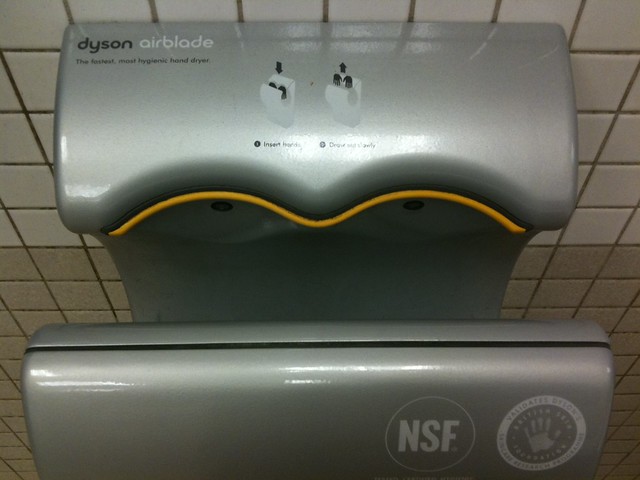
Ever use one of these Dyson Airblade hand dryers?

Even more striking than the design is the process.

Instead of "Rub hands vigorously under warm air," the process for traditional hand dryers (followed by the unwritten "Wipe hands on pants"), here's the process for a Dyson Airblade:

1. Insert hands
2. Draw out slowly

And how well does a Dyson work? Fantastically. By focusing warm air into a tiny sliver, the Dyson completely dries each part of your hand that passes through it.

Slow and focused beats vigorous and unfocused.


Now. What about your marketing? Could the same rules apply?

Think about what happens when a prospect comes into your business ...

Do you ask them qualifying questions, to gauge their interest and needs? Do you follow a script in the words you say or write to get the sale? And, most importantly, do you have a follow-up process to "touch" prospects at least 5-10 times after their initial contact with you?

In other words, is your marketing a slow and focused process?

Or ... do you wing it from start to finish -- sending emails and tweets, making phone calls, and following up whenever you have the time?

In other words, is your marketing a vigorous and unfocused mess?

Just like using a Dyson Airblade for the first time, it feels strange to put your prospects through a slow and focused process: qualifying questions, scripted presentations, disciplined/automated follow-up, etc.

But here's the good news: The "slow" method of drawing prospects through a focused marketing process will convert more of them into paying clients than a similar amount of vigorous, unfocused activity.

And you won't have to wipe your hands on your pants.

Bio: Kevin Donlin can help you grow your business and enjoy the breakthrough results your hard work deserves. If you're interested in boosting your revenues and profits, please click here.