Showing posts with label guarantees. Show all posts

Monday, April 11, 2016

3 More Reasons Why You Need a Strong Guarantee

If you've read any of my 576 blog posts in the last 6 years, you know that I'm a strong believer in strong guarantees.

As long as you don't sell crap, a money-back guarantee can grow your business faster than almost anything else.

(NB: If you do sell crap, a money-back guarantee will put you out of business faster than almost anything else. Hey, sorry. Don't sell crap.)

Anyway, here are 3 reasons why you need a strong money-back guarantee in your business ...

... based on the "Lifetime Satisfaction Guarantee" from The Great Courses. That's it above.

Study it. Because that guarantee is worth millions to The Great Courses. And you need one like it in your business, for 3 important reasons.


Reason #1: You will get more new clients, faster, from the same marketing

Quick, which guarantee is stronger?
  • "Your satisfaction is 100% guaranteed" (which is how far most timid, lazy marketers go, i.e., not very)
  • "Your satisfaction is 100% guaranteed. If a course is ever less than completely satisfying, you may exchange it for another of equal value at any time. You may also return any course, within one year of initial purchase, for a full refund" (which is how far The Great Courses goes)
Duh. The one that promises you a refund. It's clearly stronger. And all things being equal, the stronger guarantee wins more sales. Consequently, The Great Courses got my money.


Reason #2: Your clients will buy and refer longer

Now, it may surprise you to learn that I just returned a DVD to The Great Courses for a refund today. And I've returned stuff to them before.

Yet, I've been buying from The Great Courses going on 10 years. I've given them at least $700 in business, minus about $75 in refunds. So they're still ahead.

BUT ... that doesn't take into account the referrals I've sent them, like family members and clients, to whom I rave about The Great Courses. And now you, my loyal readers.

One reason I recommend The Great Courses is because they offer ... great courses.

Another reason? I can't look like a dolt for recommending them. Because anyone who dislikes a purchase can get a refund. That kind of "insurance" is important to anyone before making a referral.

Now, think. If you don't offer a guarantee, what does that say about your business? Does it make you more referral worthy or less?


Reason #3: You will do better work. Which makes everything better

Look at that last line in The Great Courses' guarantee. It's brilliant: "This guarantee not only protects your investment in learning, it also compels us to produce great courses."

Nothing like tightrope walking without a net to compel your best effort, eh? I can tell you from experience, after offering an unconditional money-back guarantee on my copywriting and consulting services since 1998, that it compels you to do your best work. Which is good for everyone.

Hey, I'm not perfect. Neither are you. I give refunds about once a year. And if you offer a strong money-back guarantee, you'll give refunds, too. But if your sales go up 25% ... 50% ... or more, will you really care?

One more thing: If you own a business, you can get a box of 11 Marketing Multipliers delivered at no cost, if you hurry. Learn more at www.MarketingMultipliers.com

Friday, December 11, 2015

Money Back Guarantees: How to Grow Your Business Faster

Want to grow your business?

Guarantee your work ...


Money-back guarantees are not new or high tech. Maybe that’s why they’re over-looked or under-used by most entrepreneurs.

But they’ve made millions for successful mail-order companies, like L.L. Bean and Land’s End.

And guarantees were key to the early success of FedEx, Amazon, and Zappos, to name a few.

If your clients are mostly satisfied now, there’s nothing to worry about. By offering a risk-free guarantee, you’ll simply call more attention to the quality you already have. Make the strongest promise you can comfortably live up to, and feature it prominently in all your marketing materials -- your Web site, advertisements, letterhead, business cards, on your telephone hold message, etc.

Of course, if you offer a guarantee, some people will take advantage of you. But if you double your sales with a guarantee, will you really care?

Besides ... you already have a guarantee. Here's why: If an unhappy client calls with a problem, you will fix it, replace it or refund part (or all) of their purchase. Otherwise, they will tell the world, starting with their friends on Facebook, LinkedIn, and Twitter ... not to mention Yelp and GooglePlus reviews.

In short, you can NOT afford even one unhappy client if you want to stay in business. Refunding a disgruntled client today is a bargain in the long run.

So, here's what I suggest: Make your guarantee a focal point in your marketing efforts.

Boldly spread the word that you have no unhappy clients. Because unhappy clients get their money back. To the extent that you do this, you’ll enjoy a competitive edge. Your courage will pay you back with more new clients, sales, and profits.


Now get a box of 11 tools to build your business, delivered FREE by U.S. Mail. Try Marketing Multipliers Here

Wednesday, June 26, 2013

How Do I Close More Business?

Here's a question from entrepreneurs and business owners that I hear all the time: How do I close more business?

Wait, stop.

I hate the verb "close" in a selling context. It makes it seem like your job is over once the prospect gives you their credit card number or hands you a check.

Nothing could be further from the truth, of course. As any sales pro will tell you, the real work begins only after the prospect says, "Yes." You're not closing a sale, you're opening a relationship (if you have any brains).

So, let's rephrase the question: How do I earn more sales and open more relationships?

That's better. And here are 3 steps to help you do it ...


1) Use the right words

I'm a big fan of sales scripts. By scripts, I mean proven responses to objections, like: "It costs too much," or "I want to think it over."

Every multi-million dollar actor uses a script. So do multi-billion dollar credit card companies, banks, and other smart businesses whose employees have to sell by phone.

What do they know that you don't? Why keep winging it when it comes to your livelihood?

There's no good reason NOT to use a sales script, whether it's on the phone or in person.

The good news is, if you’ve ever made a sale and can write down what you said, you have the basis for a life-changing sales script. It all starts when you "can and clone" that first collection of winning words.

And I'll even give you the words to use as a basis for your first sales script. Ready? Just ask, "How were you hoping I could help you?"

Whatever comes out of your prospect's mouth in answer to that question will tell you what they want. Your job becomes very simple at that point: Tell them how you will deliver.

This is a great place to start any sales conversation -- and earn more sales.


2) Deliver overwhelming value

This is a stumbling block for loads of people. But it's easier than it seems. You simply have to find out the dollar value of the problem(s) you solve. Then, keep adding it up until the prospect feels compelled to buy.

Here's an example. Let's say you sell software that boosts efficiency. On average, you save 15 minutes every working hour for the people who use your software.

Those people earn $40,000 per year, or $20 an hour. If your software saves them 150 minutes a week, that adds up to 7,500 minutes (125 hours) saved a year, or $2,500 in annual savings ... $5,000 in two years.

You can then tell prospects, "If, for an investment of $495 today, you save $5,000 in two years, you've just earned a return on investment of 910%. You're really buying money at a discount here. And I don't think even Warren Buffett can top those numbers."

That changes the conversation, doesn't it?


3) Guarantee your results

When you make it risk-free to buy from you, more people will buy.

Guarantees have been used by mail-order companies for decades. Companies like L.L. Bean and J. Peterman are hugely successful today, but they were once small businesses. Their profits grew from a trickle into a mighty torrent because customers knew they could buy without the fear of being stuck with an item they didn’t like. Strong guarantees and quality products are an unbeatable combination.

Yet, guarantees frighten many business owners. If you’re like most, it might only take five or six big refunds or major revisions in a year to spell financial trouble. What if your clients called their friends and all started asking for refunds at once? What if word got out around that your business was an easy target for crooked people who could rip you off?

The way I see it, you already have a guarantee -- you just don’t know it.

It's like this: If a client called to complain, what would you do? Offer to redo or replace the work, probably. Because it’s better to satisfy one angry client now than to combat a lot of bad word-of-mouth later.

Especially when you consider that, thanks to social media, your clients all have audiences. And bad news travels fast. So, really, you need to satisfy your clients. And a guarantee makes it all possible.

So there you go. Three ways to earn more sales -- and open more relationships.

Meanwhile, if you want to put an end to "feast or famine" syndrome in your business, my free Client Cloning Kit can help. Grab your free copy now, while they last.

Monday, December 31, 2012

What's the Best Way to Get New Clients?


That's a trick question. There is no ONE best way.

But there is a very easy way to get new clients: Remove the risk of buying from you.

How? With a money-back guarantee.

And guess what? You already have a money-back guarantee -- you just don't know it.

The longer your guarantee and the fewer conditions you put on your guarantee, the more new clients it will bring you.

Watch this to learn how to use a money-back guarantee as a marketing tool.

Best part: A guarantee costs you $0 to implement, will bring you much more money in sales than it will ever cost you in refunds (if you're any good at what you do), and you can create one today.

Meanwhile ... if you want to put an end to "feast-or-famine" syndrome in your business, my free Client Cloning Kit can help you. Grab your copy here, while they last. 

Wednesday, August 22, 2012

Are You Playing by the Wrong Rules?

Ever feel like you have to work harder and harder to stand out in a crowded marketplace?

Maybe you're playing by the wrong rules.

Other people (your competitors among them?) may tell you that:
  • you need more certifications or degrees (or both)
  • you need to publish a book
  • you need more prospects in your pipeline
  • you need a blog
  • you need to be on Facebook, Twitter, YouTube, and/or LinkedIn
May I suggest a shortcut?

First, watch this short video ...


Get that?

You can certainly play by other peoples' rules. But that could be deadly to your business.

Because, no matter how good you are with a sword, there's always going to be a better, faster swordsman who can cut you down.

Instead, why not play by your own rules? It worked for Indiana Jones in that crowded marketplace.

It's worked for me in my businesses. And it's worked for most super-successful people I know.

Want an example? 

When I first started out in business in 1996, I was a resume writer. A quick look through the Yellow Pages told me two things:
  1. There was a lot of competition (Yay. That meant there was a market for my services) and ... 
  2. There was a lot of competition (Boo. Most were very experienced and ran big, expensive ads).

Had I played by other peoples' rules, I would have had little chance of succes. How can a startup compete against "22 years' experience" (I had 0 years) or "We accept all credit cards" (I didn't) or "Published author" (I wasn't).

So I changed the rules. How? Simple: I offered an unconditional money-back guarantee. Nobody else did.

By changing the rules, I changed the game. And I won.

Sure, I refunded a few clients ... less than 2%. But my sales took off the day the new Yellow Pages came out with my ad. And they never slowed down. (Math tip: keeping 98% of $100,000 with a money-back guarantee is better than keeping 100% of $20,000 without one.)

In fact, within 18 months of starting, I had to hire two former competitors part-time to handle the overflow business that was coming in.

So. What can you do to change the rules in your favor?

Here are some ideas ...

1) If your competitors' voice-mail greetings are boring (and they probably are), why not try a voicemail greeting that's (GASP) fun or lighthearted? The #1 sin in marketing is being boring, as my mentor Dan Kennedy likes to say.

2) If your competitors' websites all say basically the same thing (and they probably do), why not look outside your industry for inspiration? That's how I found the idea for a money-back guarantee -- not from parroting other resume writers, but borrowed from a prior client, FedEx.

3) If your competitors rely nearly 100% on email or phone calls to contact prospects (and they probably do), why not use direct mail, in-person seminars, teleseminars, etc. to get your message out? Even if your message is similar, a different medium can drive it home better.

I could (and will) write more on this, but you get the idea.

If you're not winning the marketing game, take a look at the rules. Are they slowing you down? If so, try writing your own rules and playing your own game. You may find it's easier to win.

Resource: If you want to put an end to "feast-or-famine" syndrome in your business, the free Client Cloning Kit can help. Grab your copy here. 

Monday, February 20, 2012

The Money-Back Guarantee: Kill or Cure?

Guess which 5 words on that box of lasagna caused my wife to buy it?

Right. The guarantee: Love It Or It's Free!

(By the way, we did love it.)

But we never would have found out if the maker hadn't removed the risk of trying this new product by guaranteeing we would love it, or not have to pay.

So, here's the lesson for your business: A strong money-back guarantee is an accelerant that works in one of two ways ...

1) A strong guarantee can work like gasoline, if your business sells crap and/or treats clients poorly. The more people who buy and tell their friends about your crappy business, the faster it burns to the ground.

Or ...

2) A guarantee can work like steroids, if your business sells cool stuff and/or treats clients like royalty. The more people who buy and tell their friends about your remarkable business, the faster it grows.

Bottom line: If you're any good at what you do, a strong guarantee can accelerate your sales ... and you can enjoy bucket-loads of new profits.

If you're not, it won't ... and you can't.

Bio: Kevin Donlin can help you grow your business and enjoy the breakthrough results your hard work deserves. If you're interested in boosting your revenues and profits, please click here.

Thursday, January 27, 2011

How to Make Your Offer Irresistible

Back when I wrote resumes for a living in the 1990s, I used to have a very easy time selling to people. 

Here's why: I made them an offer they couldn't resist.

That's because every one of my competitors were all saying variations of this: "We guarantee results, or we'll rewrite your resume." Which is like saying: "We'll make you happy or ... we'll keep trying to make you happy."


Meanwhile, I used to say this: "Your resume will get results. Or it's FREE."

That was saying something. It was an offer most people could not resist. Which is how I sold to more people than my competitors (and ended up hiring two of them to work for me, part-time).

So. If you want to sell more of your services to more people, faster and easier, you can do it by making them an offer they can't resist.

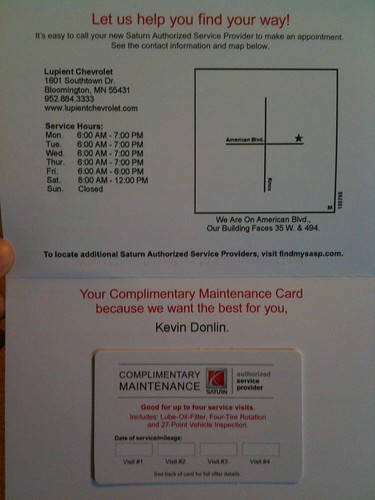
To illustrate, here's an offer I recently got in the mail, which I found irresistible:


Background: I own a Saturn. Back when Saturn went out of business, a local Chevrolet firm took over the service contracts from the former Saturn dealer. So I got several letters in the mail, asking me to come in and give the Chevy guys a try.

I ignored every letter.

Because none was half as compelling as the offer above, which has what I call "The 4 Rs of Irresistible Offers." The offer is:
  1. Riveting
  2. Relevant
  3. Realistic
  4. Risk-free
1) Riveting. You can't beat 4 free maintenance visits with a stick.

Application: Your offer should be so riveting that clients and prospects will feel like they're ripping you off. I almost feel that way about this offer. Almost.

Because, even though I know there's a cost to them of offering 4 free service visits, once they get me into their building, they can find lots of things wrong with my car to fix above and beyond the free service -- after they win my trust. They will no doubt make money on this long-term ... IF they earn my trust.

2) Relevant. They address me by name and know that I still own the car. Plus, they're a 10-minute drive from my house. So they've demonstrated knowledge of me and my life. This offer is relevant.

Application: How relevant are your offers to your prospects and clients? Are you speaking directly to them and their needs?

3) Realistic. They aren't promising anything incredible -- just a free oil change, tire rotation, and vehicle inspection.

Application: How realistic are your offers? You can actually repel buyers with outlandish offers, like $500 in free gasoline or a free iPad. When in doubt, ask 3-5 clients whose judgment you trust. If they don't roll their eyes, your offer is likely realistic enough to roll out to a bigger audience.

4) Risk-free. Very important. This offer costs me nothing. Sure, I fully expect them to charge me a couple of bucks for tax, etc., but I will still come out ahead.

Making offers risk-free by offering a money-back guarantee is one thing I counsel all of my copywriting clients to do.

Sure, you may refund 2-3% of buyers. But if your sales double as a result of your guarantee, do you really care? In other words, would you rather have 100% of $100,000 ... or 95% of $200,000? A risk-free offer can get you that larger figure.

Make your next offer Riveting, Relevant, Realistic, and Risk-free. When you do, you will be making an irresistible offer.

And you will realize this great truth: The whole point of your marketing is to make selling superfluous.


You'll find more ideas like these in my Free Report, Guaranteed Marketing.

Wednesday, July 7, 2010

Two Guarantees. Which is Better?

I write a lot about how guarantees can grow your business by removing the risk of buying from you. 

I learned about the power of guarantees working for FedEx as a Webmaster from 1995-1998. One key to the success of FedEx since its inception in 1973 is their money-back guarantee -- your package will get there on time, or it's on them.

Today, companies like Zappos are enjoying similar success using money-back guarantees.

But ... there's a right way and a wrong way to make a guarantee.

Below are two recent examples. Which works better, do you think?

First, the "Forever Guarantee" from Everett Bogue, who sells an ebook, called Minimalist Business ...


I think it's effective. The language is clear, non-salesy, reassuring. He goes the extra mile by going beyond Paypal's 60-day refund limit and promising to "send you a check if I have to." 

This guarantee should increase sales, though he could sell a LOT more if he included a real-world mailing address and phone number on his site, along with testimonials, to prove he's really real.

Now, the "125% Guarantee" from M.S. Rau Antiques ...


I think it falls short. It starts off in fine fashion, billing itself "The Strongest Antiques' Guarantee in the World!" and promising a duration of 5 years and a 5% annual return on investment.

But then the lawyers take over.

The second paragraph of weasel words (italicized, for harder reading!), while perhaps necessary, undermines the whole guarantee. (Never use the word "prorated" and expect it to boost sales, for example.) After reading paragraph two, I'm no longer impressed. Pity.

While I'm no lawyer, they could have said something like this: "Some reasonable conditions apply. Example: You can't buy a Queen Anne chair, toss it in the East River, and ask for a refund. Please contact us for details." Just because you have to make restrictions on a guarantee doesn't mean you have to include them all upfront, nor does it mean you can't have fun with them.

Final note: There's no limit to how bold and creative you can be in crafting a guarantee for your business.

Yes, offering to give your customers their money back may cost you a few bucks in refunds. But if your products or services are any good, that won't happen often -- people are more honest than we think. That's been my experience since 1996.

And if your sales go up 25%, 50%, 100% -- or more -- will you really care about refunding 1-3% of them?

Friday, June 25, 2010

How to Create Your Guarantee: Part 2

This week, I've written about how a guarantee can grow your business, why you already have a guarantee, why guarantees cause more people to buy, and how to start creating your own guarantee.

Today, I'll finish by explaining how to create a sales-boosting guarantee for your business.

Let's start by thinking about your business ...

How big, specific and outrageous a guarantee can you think of?

What would set your industry on its ear?

What would keep your competitors up all night throwing darts at your picture?

That’s the kind of guarantee you want to use.

Here are example guarantees to get your mind in gear. Which one would be easiest for you to modify and use?
  • Real estate agent: I’ll sell your home in 90 days. Or you get $1,000 cash.
  • Restaurant: You’ll love our food. Or your next meal is free.
  • Sports therapist: We’ll stop your pain in 24 hours. Or your money back.
  • Dog walking service: We’ll be there on time, every time. Or you get a $50 bag of dog food -- Free.
  • Florist: Guaranteed "gasp" when she gets our flowers. Or she gets a free box of chocolates on us.
Now. Know this. There are two ways you can screw up a guarantee ...

1) You can fail to put teeth in your guarantee. There must be a penalty if you fail to delight your customers. So, if you say "Satisfaction guaranteed" ... and nothing else, you're not saying anything. And your sales will stay flat as a result.

2) You can fail to perform on a massive scale. Example: if BP had guaranteed "spill-free" oil wells, that might have produced an even bigger, more-expensive PR nightmare for them (if you can imagine that).

To avoid failure on a massive scale, test on a small scale. This is vital. You must know how well your guarantee is performing before you roll it out on a wide scale.

How to test?

You might advertise the guarantee on a special Web page, visible only to people who come there after reading a special promotion or Google Adwords ad. Or mention it on your voicemail message. Or on one set of business cards. Or in a letter you mail to one segment of your customer base.

You could test 45-, 60- or 90-day money-back guarantees, for example. (Longer guarantees almost always work better.) You might even use a lifetime guarantee. Experiment!

You can devise a guarantee based on how fast you fill orders, how fast you deliver them, whether you’ll always have a certain item in stock, etc.

Okay. That's it for guarantees.

Done right -- by testing new variations on a small scale, before rolling it out -- a guarantee can quickly help you get more clients like your best clients, without advertising any more than you do now.

Thursday, June 24, 2010

How to Create Your Guarantee: Part 1

This week, I've written about how a guarantee can grow your business, why you already have a guarantee, and why guarantees cause more people to buy.

Today, let's talk about how to create a guarantee for your business.

Start by knowing what your customers are really buying.

There’s an old advertising adage that nobody goes to a hardware store to buy a drill bit. They really want the hole a drill bit makes.

Your customers are the same.

You may sell resumes and cover letters, for example. But your customers want a job.

You may sell industrial lighting. But your customers want to see the inventory in their warehouse more clearly, so they can fill orders faster.

You may sell tires. But your customers want peace of mind as they motor down the highway with their family to the lake cabin.

Your job is to figure out what your customers are really buying and then guarantee they will get it from you.

Marketing experts have known this for decades.

In 1925, advertising legend Bruce Barton told the American Petroleum Institute that they were selling gasoline as a bad smelling liquid. This was a mistake. Instead, he told them they were selling “the juice of the fountain of eternal youth.” He explained that fuel enables people to experience travel, romance and even health. He got to the heart of what customers were really buying.

Once you understand what customers are really buying, you can articulate this result in your guarantee.

In tomorrow's final installment, I'll give you more example guarantees you can use to create your own.

Wednesday, June 23, 2010

Why Guarantees Work

This week, I've written about how a guarantee can grow your business and that, whether you realize it or not, you already have a guarantee.

Today, let's talk about the psychology of guarantees. 

Why do they work?

Answer: risk removal.

Whenever any two parties meet to transact business, there’s a risk. Money and products are changing hands, and one side might get burned. In most cases, it’s the customer who assumes all the risk. Without a guarantee, if the product or service doesn’t perform, the customer is out his or her money.

Risk makes people wary ... and less likely to buy.

But what if a business removed all of the risk involved in buying? More sales and higher profits would result.

When you stand behind your work with the strongest guarantee possible, you put customers in control of the buying process. Which puts them at ease. Which makes them more likely to lower their guard, relax and listen to your offer.

But don’t believe me ...

Look at any catalog from Land’s End, Damark, SkyMall, or any successful mail-order firm. Visit Zappos.com or Amazon.com (which paid a fortune to buy Zappos!)

What you’ll find -- prominently displayed -- is some sort of money-back guarantee. Why? Because buying something long-distance or online from a person you’ll never meet is scary. By making strong guarantees, smart businesses eliminate risk and open a floodgate on sales.

It’s worth repeating: you already have a guarantee. 

If an unhappy customer called with a problem, you’d fix it, replace it or refund part (or all) of their purchase price. If not, your reputation would get trashed on Epinions.com, Angie's List, or someplace else. Or you'd hear from your credit card processor or Paypal.

In other words, if you refuse to fix problems or refund customers, you won’t be in business for long.

So, why not make your guarantee central in your marketing efforts?

Your opportunity is in aggressively telling the world about your guarantee. To the extent that you do, you’ll enjoy a competitive advantage over all other companies in your industry. Your business courage will pay you back with tremendous long-term dividends.

You'll find more ideas like these in my Free Report, Guaranteed Marketing.

Tuesday, June 22, 2010

More Guaranteed Growth in Your Business

Yesterday, I wrote: "A guarantee is one of the most powerful ways to grow your business."

And I told you that, whether you realize it or not, you already have a guarantee in your business.

So why not make the most of that guarantee?

Let me explain ...

If a customer called to complain that the work you did was unsatisfactory, what would you do? Offer to redo or replace it, probably.

Because it’s a easier to satisfy one customer today than to battle a tidal wave of bad publicity later. Especially when one unhappy customer can post a nasty review on Epinions.com, Angie's List, or some other web site -- and ruin your reputation overnight.

In fact, there's a book that says -- right in the title! -- all you need to know about customer service: Satisfied Customers Tell Three Friends, Angry Customers Tell 3,000.

You need to put those numbers in your favor. You need to satisfy your customers. And a guarantee makes it easy to do.

In my experience, working for and with such companies as FedEx and Orvis, only about 2-4% of  customers will ever ask for their money back if offered a refund. So, unless your product or service is pure crap, offering a guarantee is a safe bet.

By offering a risk-free guarantee, you simply call more attention to the quality you have in place. Make the strongest promise you can comfortably live up to, and feature it prominently in all your marketing materials -- your web site, business cards, Twitter profile, voicemail message, email sig file, etc.

Of course, if you offer a guarantee, a small percentage of people will take advantage of you and will ask for their money back. But if you double your sales in the process, are you really going to care?

So, today, start getting comfortable with the idea of making your prospects feel comfortable, by offering a money-back guarantee.

You'll find more ideas like these in my Free Report, Guaranteed Marketing.

Monday, June 21, 2010

Guaranteed Growth in Your Business?

A guarantee is one of the most powerful ways to grow your business.

Because, if you make it risk-free to buy from you, more people will buy from you.

Period.

Few businesses really guarantee what they sell. So the opportunity for you to stand out in your industry is staggering.

Before going any further, here’s a quick quiz ...

Look at the following list of successful companies. What one thing do they all have in common?
  • Nordstrom
  • FedEx
  • Prestone
  • LensCrafters

Answer: All of them rose to the top using strong guarantees of satisfaction. By strong, I mean offering to refund your money or easily exchange what you bought.

These companies reversed the risk of doing business with them. Customers were given another reason to buy today, without fear of looking bad tomorrow. And tremendous profits followed. You should do the same.

Guarantees are not new.

They’ve been used by successful mail-order companies for decades. Companies like L.L. Bean, The Teaching Company, and SkyMall, to name a few. They’re hugely successful today, yet they were once small businesses. Perhaps smaller than yours is now. But their sales surged after customers knew they could buy without fear of being stuck with an item they didn’t like.

Yet ... guarantees frighten many small business owners.

If you’re like most, it might only take five or six big refunds in a month to spell financial trouble. What if your clients called their friends and all started asking for refunds at once? What if word got out that your business was an easy target for crooked people who could take your product or service and then get back their money?

The way I see it, you shouldn't worry. Because you already have a guarantee -- you just don’t know it.

You'll find more ideas like these in my Free Report, Guaranteed Marketing.