Showing posts with label Dan Kennedy. Show all posts

Thursday, September 25, 2014

11 Marketing Nuggets from The Titans of Direct Response

Titans of Direct Response
Titans assembled, left to right: Brian Kurtz, Ryan Lee, Parris Lampropoulos, Mike Fishman, Fred Catona, Arthur Johnson, Eric Betuel, David Deutsch, Jay Abraham, Ken McArthy, Joe Sugarman

Do you love marketing? You should, if you own or manage a business. Otherwise, you’ll run out of clients.

Do you love direct-response marketing? You should, if you want to track and improve your marketing. Otherwise, you’ll run out of money.

... Still with me?

Good!

Then you’ll understand why I was thrilled to attend “The Titans of Direct Response” event hosted by Brian Kurtz and Boardroom Publications.

Imagine a Mount Rushmore of marketing legends with 11 heads ... that suddenly started talking ... for two days straight. That reeks of hyperbole, sure. It’s also true.

Anyway, you can read their bios here, but let’s get to it -- here are 11 nuggets of marketing wisdom I learned at "The Titans of Direct Response" ...

1) Dan Kennedy: There are only really two kinds of copy: product information and emotional manipulation. Wage everything on emotional manipulation; this sells way more than facts. Example: To sell a cat toy, don’t talk about the toy. Talk about how neglected and bored the cat is while you’re away at work. The toy will pretty much sell itself.

2) Ken McArthy: The System Formula for any website is this: traffic plus conversion equals profits. You need to obsess over these simple elements. And remember that it’s not a web site -- it’s a sales system.

3) Perry Marshall: The best unique selling proposition (USP) won’t need a copywriter; it’s not about stringing words together. Ordinary people will discover and share a USP with each other -- it’s baked into the product or service.

4) David Deutsch: Here’s a test of how good your sales letter or promotion is. When people see it they should say “Wow!” and want to show someone.

5) Parris Lampropoulos: Novelty creates dopamine. By telling people something new, you are generating dopamine and your copy is literally addictive.

6) Eric Betuel: To get new ideas and see winning examples of salesmanship, look at videos on Kickstarter.

7) Gary Bencivenga: Your self-image (as described in the book Psycho Cybernetics) is the key to achieving any goal and living a life without limits. If you believe strongly in the image you have in your mind, you won’t need will power to hit a goal. As a copywriter, his self-image was “Gary Bencivenga the Control Beater.” This became his operating system. It motivated him all the time. Ideas began to pop up everywhere, even when he wasn’t working on projects. This philosophy vastly out-performed everything else for him.

8) Brian Kurtz: Contribution is better than networking. Think first about how you can help others and be willing to give 100%, expecting zero in return. This is real contribution and it’s made him millions.

9) Joe Sugarman: Every problem has an opportunity within it so great that it dwarfs the problem. Example: He had an empty page in his catalog, which he had to scramble to fill with another product. That product was a strange pair of sunglasses, given to him by a friend, that had been used by NASA --  BluBlockers, now a multi-million dollar brand.

10) Greg Renker: What does it really take to break through barriers and grow exponentially? Two things have helped: one, his Mastermind group (which includes Jay Abraham and others at a high level); two, plowing profits back into the company and taking more risks.

11) Jay Abraham: Any problem for you is an opportunity for somebody else. Example: A motorcycle maker in Japan needed money to expand. They found a lawnmower maker in Malaysia with a second shift they weren’t using, who agreed to make motorcycles in their factory. Result: Both sides made $10 million on the deal.

There you have it. Eleven marketing nuggets from more than 100 that I collected over two days one weekend in September.

Which nugget can you use first?

Meanwhile, are you an entrepreneur with clients, not customers? Are you doing at least $200,000 in revenue, and want to do better? If so ...

... I can show you more "profit hacks" like the ones you just read in this article. Get them in my next Free Video Training Session. It's for $200k entrepreneurs ONLY, please.

Grab your spot here

Monday, June 23, 2014

5 Wealth Ideas I Paid $3,197 to Get (Free for You)

Twelve days ago, on June 11, 2014, I landed in Cleveland, Ohio for Dan Kennedy’s Advanced Wealth Academy, an event I gladly forked over $3,197 plus hotel and airfare to attend.

The two days I spent with 200 other entrepreneurs locked in a room with Dan, were, simply, incredible.

I’ve been to intimate training sessions with Gary Halbert, Brian Tracy, Jay Abraham, and others ... but nothing compared to this event for the sheer number of light bulb moments I experienced. It was like fireworks in my brain.

And you missed out.

Or did you?

You see, I’m a copywriter. I have to type fast and take excellent notes to do my job. And I took excellent notes at Dan’s Advanced Wealth Academy -- 17 single-spaced pages of notes, to be exact.

Now, I can’t share my entire set of notes with you, out of respect for Dan’s intellectual property (and fear of his attorneys). However, I can share what I believe to be ...

The Top 5 Things Dan Kennedy Said That Can Make You Rich

#1: Money is attracted to enthusiasm.
Sincere, passionate interest in what you do causes money to come to you. If you lose track of time and forget to eat, you’re enthusiastic about what you do. MOST people are in a business they don’t love, selling to people they don’t love; this cannot turn out well

#2: Money loves shameless promoters, self-promoters and salesmen.
There’s a little PT Barnum in all the wealthiest people. Trump and Buffett do things differently, but both are Barnum-esque. Peers hate rich promoters. Money tends to flow to the people who get things sold

#3: Money is attracted to speed demons.
You can’t get any traction while you’re parked. A HUGE difference between poor and rich people is a sense of urgency. When Dan was broke, it was an urgent matter for him not to be broke tomorrow, not someday. For maximum speed to wealth, invent less and implement more

#4: Money favors the rogues and renegades.
A LOT of money is made by recognizing that rules are for other people. Disregard rules, disrupt established order, and leap-frog up the ladder

#5: Monetize EVERYTHING.
By monetizing only the “now” buyer, you waste 50-90% of your money. Understand this: Your marketing dollars don’t just pay for every buyer; you pay for every website visitor, caller, walk-in, email, and contact. You need aggressive lead capture, follow-up, and schemes to get money from unconverted leads. There is often more money in what you’re not monetizing now than in the buyers you’re getting now

Pretty good stuff, eh?

Action Step: Which idea will you implement first? I’d love to hear how you plan to do it!

Example from my own business -- just 3 days ago, I helped a client rake in $115,000 (and counting) from a webinar that we promoted via email and other methods. Today I’ll write him another email to monetize his unconverted leads; if we don’t bring in an extra $10,000, I’ll be disappointed. This, along with better lead capture, conversion, “lost” client reactivation, and systematic follow-up, is how you monetize EVERYTHING (Dan’s idea #5).

Why not give me a call today to brainstorm how these ideas can work for you? Even though I can’t show you any more notes from Dan’s Advanced Wealth Academy, I can share at least 3 more money-making tips with you. Give me a call today at (800) 723-1503 or send me an email.

Wednesday, April 16, 2014

GKIC Copywriter? My Weird Success Story

I get asked all the time, "Are you a GKIC copywriter?"

My answer: "It depends."

You see, I've been writing direct-response copy, online and off, since 1994.

And it's been a long, weird journey ...

In 1994, I may have sold the first ebook online.

You see, before the web, there was this giant bulletin board called Usenet. I sold the ebook ("How to Find a Job on the Internet") by including short blurbs at the end of my postings, asking people to email me for more information. (You could NOT sell stuff outright on the Internet back then, or you would be "flamed" into oblivion.)

In reply, I would email you a long-form sales letter. To buy the ebook, you had to snail-mail me a check with your email address written on the memo line. After depositing the check, I sent you the ebook (really a giant text file) by email.

That was e-commerce in 1994.

I went on to work as Webmaster for FedEx.com (1995-1996) ... write more than $310,000 in Google Adwords (with an ROI of 1,300%) ... email promotions ... and direct-mail. All based on the direct-response marketing principles that Dan Kennedy teaches.

And I've been a reader and follower of Dan Kennedy, along with Jay Abraham, John Caples, Claude Hopkins, David Ogilvy, Gary Halbert, and John Carlton, since 1998.

Back to Dan Kennedy. I've been fortunate enough to meet with him and talk copywriting strategy (along with 2 of his Titanium Mastermind clients) on a couple occasions.

In fact, I just met Dan again in Dallas, on March 28.

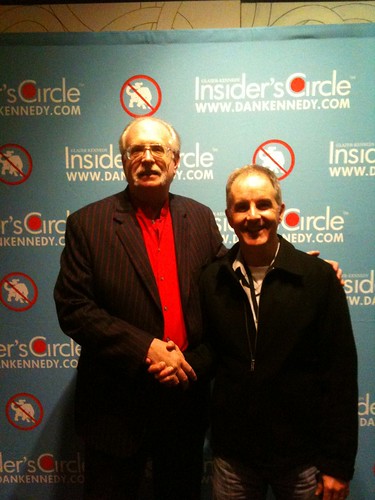
That's Dan and me (the short guy) at left, holding a copy of his new book, No BS Branding.

You'll find 2 ads that I wrote, featured as winning examples on pages 119 and 120 of his book.

For a copywriter like me, that's like Ted Williams praising your hitting, twice. An honor and a thrill.

On top of that, my copywriting clients include 5 of Dan's Titanium Mastermind clients.

If you know GKIC and Dan Kennedy, you know my clients.

Now, I'm not perfect, but I do get more hits than strikeouts. Here's a recent success story from a GKIC member ...
"The Client Reactivation Sequence of letters you created for us more than paid off. In just one example, an inactive client came back and purchased the following as a result of the letters you wrote: a $5,262 project, then a $1,517 project, followed by project worth at least $19,287 -- maybe more. That's only one client; there were others."
-- George Platt, President, Harty Integrated Solutions; New Haven, CT
I've got more on file -- just ask.

Bottom line: Am I a GKIC-certified copywriter? No.

But have I lived and breathed enough GKIC copywriting principles since 1998 (along with others dating back to the 1920s) to tackle nearly any direct mail or online marketing project? Most definitely, yes.

That's why I'm the only copywriter I know who offers an unconditional money-back guarantee.

To learn more about what I do -- and get a sneak peek at The $32,400 Email and 5 other breakthrough tools -- request your FREE Client Cloning Kit. It's not some cheapo download. This is a real money-making package you can hold in your hands.
 
Grab your free copy now, while they last.

Thursday, June 7, 2012

Why School Is Never Out For The Professional

Kevin Donlin and Dan Kennedy
It's June. Shouldn't I be writing about summer vacation?

No. Because school is never out for the professional.

Case in point: That's a picture of me with Dan Kennedy, one of the world’s premier marketers.

Last month, I invested $4,000 and 4 days "going back to school" with Dan at a small gathering of marketers in Cleveland, where that picture was taken.

A copywriter like me training with Dan is like a chef training at Le Cordon Bleu.

What did I study?

The latest and best tips for using direct mail: list rental, list segmentation, psychographics, demographics, and other fun stuff.

My goal?

To serve my clients and readers, better -- by getting smarter.

Think about it: Would you trust a doctor who didn't keep up with the latest medical research? Or a pilot who stopped taking flight simulator training? Of course not.

So, why does lifelong learning seem surprising in any other field? I have no idea. But it's a golden opportunity for you, if you seize it.

Especially if you continue to get better at those things you already do well. For me, that's marketing -- finding, getting, and keeping clients. I can't learn enough. I study before breakfast, on Friday nights, even weekends. I listen to marketing CDs in the car ... even in the shower (it's complicated).

Bottom line: It's your strengths that make you successful. In Strengths Finder, Tim Rath writes: "People have several times more potential for growth when they invest energy in developing their strengths instead of correcting their deficiencies."

This is counterintuitive. Most people work on their weak areas, hoping to learn something new or improve a basic skill. And, in life, most people are … unsuccessful.

By contrast, successful people are often unbalanced. While I haven't yet reached the pinnacle of success, I sure am unbalanced. Bookkeeping? Taxes? Graphic design? Web site geekery? Mailing this newsletter? I outsource all that stuff.

Long ago, I learned that the world's two greatest investments are self-development and marketing.

Marketing offers you unlimited opportunities to create wealth. You could spend weeks of research ... plunk down $3,000 to buy a stock ... then cross your fingers, hope and pray for a return of 15% -- 15 cents for every dollar. That's how ordinary people "invest."

Or you could invest $3,000 in a sales letter mailed to your best prospects and clients ... and reasonably expect a return of 50%, 75%, 100%, or more -- getting back $1 or more for every dollar you invest. Marketing is how smart people invest.

And I'm happy to help you with your marketing.

But when it comes to self-development, you get the best return on your investment by focusing on your strengths -- getting better at what you already do well.

So, three big questions:
  1. Where are you strong?
  2. How can you get stronger? 
  3. How soon can you start?

Bio: Kevin Donlin can help you grow your business and enjoy the breakthrough results your hard work deserves. If you're interested in boosting your revenues and profits, please click here.

Friday, August 19, 2011

$18,000 Worth of Marketing Advice - Dan Kennedy Consulting Takeaway #1

If you don't know about Dan Kennedy, you should.

Mike Capuzzi does. He's created Copy Doodles, a product I use and recommend.

Anyway, Mike recently paid Dan $18,000 for one day of consulting, to pick his brain on ways to grow his business.

On his blog, Mike writes that this was the #1 takeaway he got from that $18,000 day with Dan:

"Your growth will have less to do with your talent, your skill, your expertise or your deliverables than it will your ability and willingness to create and exploit your own status."

What does this mean?

People don't buy what you do. People buy you.

So, the greater your status -- the more people who know and like you -- the greater your income.

Think about it: Who has a bigger income, Dr. Oz or your doctor, Dr. Obscure? The former. Why? Because Dr. Oz has created and exploited a bigger status with his books and TV appearances.

How can you "create and exploit your own status," according to Kennedy?

Here's a simple, proven way to start: Make a big splash in a small puddle.

Because it's faster and easier to gain "celebrity" status in a smaller market than a bigger one. You can later build on local celebrity status to build a statewide or national following, but you have to start somewhere.

This is why smart real estate agents work hard to create visibility in a small geographic area by mailing postcards and flyers. (The idea is good, it's just that most of those mailings are not.)

Really intrepid real estate agents will even knock on every door in their "farm" territory, to build their status -- and their incomes.

So here's the $18,000 question: What can you do to create and exploit a profitable status within your market? The bigger your status, the bigger your income.

You'll find more ideas like these in my Free Report, Guaranteed Marketing

Saturday, April 30, 2011

Dan Kennedy - Extreme Productivity Secrets - SuperConference 2011 #gkicsc11

Here are more great ideas from Dan Kennedy at the 2011 SuperConference in Chicago, building on his ideas on how to turn adversity into opportunity and how to transform your business with Kennedy-style marketing and thinking ...

Dan Kennedy on Extreme Productivity

Huge growth is in business is extremely rare. To produce extreme results requires extreme behavior. Like expecting to lose weight by sprinkling a magic powder on your food, don’t expect to make the leap to great productivity and revenue with ease. Killing time is a very apt expression.

1) Ambition
Why are people unproductive? Three reasons:

·         10% is from bad methodology
·         20% is from insufficient pressure
·         70% is from insufficient motivation

Yet, we discuss poor productivity as a time management problem; it is not. Low productivity is mostly an ambition problem – you don’t have enough strong reasons to do what’s necessary.
If your life depended on your behavior, you would behave better. Pretend your child would lose a finger if you didn’t perform at peak efficiency -- you will get stuff done. Goal: Find the right motivation for you.

Case study in ambition: for years, Harvey Firestone never saw a man without money without turning over in his mind how he could transfer some of that money into his corporate stock.

Approach extreme productivity with the same ambition: Be on the hunt every day for ways to do be more productive.


2) Awareness
Where does the time go? You can’t manage what you don’t measure. Measure time daily in Excel or something else, then analyze at the end of the week. This can deliver an instant breakthrough. 

·         Think: Know thyself. Ask, “How can I extract the highest and best value from myself right now?” Be very aware of what goal you’re trying to achieve, what activity you’re engaged in, and how you’re doing it – are these all congruent? Be aware of what you’re permitting to happen to your time. (Also think of the Tom Hopkins quote: I must do the most productive thing right now.)
·         Think: What are the enemies and obstacles of your ambition? Kill them. You must be willing to defend your time aggressively; be intolerant of anything that screws up your productivity, including your own (in)actions.


3) Specific Decisions
Be aware of and exercise control over these elements of daily activities:

·         Who: People who work under or with you should be there to maximize your productivity; there is no neutral position
·         What, When, Where, How

4) Action -- Key Requirements:
·         Immediate: The start matters most. It’s better to get started in the wrong direction than to never start; you can fix the direction more easily than inaction. The best time to plant an oak tree was 25 years ago; the next best time is right now. There is enormous power in starting.
·         Visible: it puts you on the spot and conveys decisions to others when your action is visible to others.
·         Simultaneous, not sequential: You’ve been conditioned that everything ought to be Step 1, Step 2, etc. Perpetual, controlled chaos is how most high-achieving, high earners live. You never reach the perfect time for things to happen in order, so start doing the right things right away. Most people never complete all the steps anyway. When Schwarzenegger came to America he invested in real estate as soon as he came to America, even though he was essentially homeless; if he had waited, he would not be wealthy now.
·         Massive: Put a lot of stuff in motion, with urgency.
·         Urgent: The quickest way to create a product is to sell it with a shipping date before it’s made. Also, think of how fast a football team can move the ball during the 2:00 drill; why not play the 2:00 drill every time?
·         Congruent: Dress, talk, act like what you want to achieve
·         Synergistic: How can you make the same piece of work, relationship, etc. do more than one thing? How many benefits can you get from each action?

5) Common Drains on Productivity:
Doing the wrong work entirely, not based on the facts of where the money actually comes from; doing trivial, worthless work. Example: You may think you need a better ad, but if your refund rate is 22%, you need to focus on fixing the product.

Lost minutes adding up to lost weeks. Example: 10 minutes a day stopping at Starbucks x 300 working days a year = 3,000 minutes … 50 hours … more than one full working week LOST every year. 

Confusing the business with the deliverables. The business you run is “the marketing of ____.” Leverage comes when you focus on driving people through the door – the marketing -- not on what happens when people get in the door, i.e., the deliverables.

Failure Environments. Don’t put yourself in a place where you have to battle against bad influence to get good things done. Example: if you’re on a diet and can’t resist eating donuts, don’t go where donuts are. Your time-draining temptation may be the iPhone, email, whatever. Put yourself in a a success environment – a place that’s conducive to what you want to accomplish.

Poor, undisciplined work habits. Don’t get on the phone or go to a meeting unprepared. Woody Allen was only partially right about just showing up. Example: 14 financial planners have met with Dan trying to manage his money, but only one has shown up prepared. In all but two instances, they scheduled appointments in noisy restaurants/public places they did not control; only one person had Googled to learn about him.
·         Starting from scratch and a blank slate is bad. The less historical knowledge you have, the harder and slower your present work is. Use past work as starting points for future work.
·         Disrupted rhythm is bad. Starting and stopping kills productivity. Example: Dan has never seen a horse race stop in the middle; start, go, finish.

6) Highly Productive Actions to Take:
·         If you’re going to work, make every minute as productive as possible. Kill a sky full of birds with one stone. Example: When hired to give a speech, what will you do before, during, after the speech? Can you invite guests to attend, see you, and be suitably impressed to book you later, for example?
·         Use tight time allotments, to impose discipline on others and yourself. Leave no time for yourself or others to waste.
·         Script everything – plan every minute and every hour of every day, as if you were shooting a big-budget movie and every minute cost big bucks. Because it does.

Resource: If you want to put an end to "feast-or-famine" syndrome in your business, grab your free Client Cloning Kit here.  

Friday, April 29, 2011

Dan Kennedy - How Adversity Leads to Opportunity #gkicsc11

Here are more great ideas from Dan Kennedy's talk today, building on his ideas from yesterday at the 2011 SuperConference in Chicago ...

How Adversity Can Lead to Opportunity

1) By forcing you to do something you otherwise would not do
  • Example: A guy running chain of tanning booths saw that his video rental shops were dying and decided to put tanning booths in. 
  • Example: Joan Rivers started her jewelry business on QVC because she couldn’t get a job and needed to make money; it was a Plan B invented out of adversity. 
  • Example: Disney’s original deal with ABC was driven when they were out of money just before opening of Disney World and signed 5-year deal; it ended up being a great deal because ABC advertised Disney every Sunday night.
"Plan B ending up better than Plan A" is common in business, so Plan B is not to be feared. In fact, you should always ask what your Plan B will be -- it’s a good creative question.

2) It can build a new foundation
  • Example: the book, “What a Way to Make a Living: the Lyman Wood Story” about a guy who started a mail order religion out of necessity. He had been successful in mail order, selling lucky rabbit’s feet via print ads; they made big claims for the rabbit’s feet re: getting good luck, and the U.S. Postal Inspectors showed up to investigate the claims. Because there was no regulation for religion (then or now) they took out the rabbit’s feet, kept the incantations and sold them as religious tracts, which skirted the law successfully. This was a creative, profitable solution. 
  • Another story: Tupperware was dying with ugly products and facing adversity. It drove them to go somewhere that was at least a decade behind the U.S. culturally –South America and Asia -- where they prospered with that they had and used the money to come back here and create better products; to this day, they do 70% of revenue overseas. Without this thinking, Tupperware would be out of business now.

3) It can create a million-dollar story
The stories of your pain are incredibly valuable, because the one thing all people have in common is adversity. So if you want to connect with people, a story of adversity has widespread, valuable appeal – in the millions.
  • The first Chicken Soup book was rejected by 33 publishers and 17 agents. The adversity that Mark Victor Hansen and Jack Canfield overcame through all the rejection and the perseverance has helped them win credibility with authors and other people they sold other products to. 
  • Example: the founders of Amway used to tell about their 15+ failed businesses as a way to bond with audiences and build credibility. 
  • Almost every time something horrible happens, you can use the story later to profit. Think: “This is going to a great story.”

4) You can capitalize on others’ misfortunes, tragedies, and failures
When other people screw up, there is opportunity for you.
  • Example: Sellers of gold thrive in a recession.
  • Example: Joe Costman realized would hunt for under-marketed products and find new channels of distribution. His biggest success was The Ant Farm, which had been sold via school supply catalogs as a teaching aid. He sold it via print ads directly to kids all over America and made millions. Moral: Look at your own business this way, for untapped channels of distribution.

More ideas like these in my Free Report, Guaranteed Marketing for Service Business Owners.

Thursday, April 28, 2011

Dan Kennedy Opening Remarks SuperConference 2011 #gkicsc11


That's Dan Kennedy and me at Day 1 of the 2011 SuperConference in Chicago.

(If you're wondering, that camera setting for this photo was Make Kevin's Face Look Like a Skull.)

Dan is one of the two biggest influences in my business life, along with Jay Abraham.

It may help to think of Jay as "Mr. B-52" and Dan as "Mr. Boots on the Ground" -- their approaches complement each other perfectly.

Anyway, I'm in town for Dan's annual SuperConference, where direct-marketing practitioners come to sharpen their skills.

I'll be sharing my notes and photos over the coming days, starting with today's opening remarks by Dan about how to market the Glazer-Kennedy way.

Dan's ideas were brilliant. Read them and reap ...

Here are the key transformations that happen to Kennedy students who pay attention and take action. 

They:

Move from being doer of the thing to marketer of the thing. The doing of the thing is the least valuable part of any business and the easiest to replace, in most cases. Example: Houdini was a master marketer of magic and profited wildly; others, like Howard Thurston, were better doers of magic and profited far less.

Move from being marketer to the direct marketer of the thing, using mail-order based marketing strategies and tactics. Results are measured objectively, empirically, and ruthlessly. David Ogilvy said that only the mail-order advertisers knew what they were doing; this is still correct.

Become a direct marketer of anything, using direct-marketing skills to move into any industry. Example: Ecommerce marketer of anti-aging products, Ed O’Keefe, started as a marketing advisor to dentists (never having been a dentist). 

Move from being their own boss to being an entrepreneur. They move from owning a business that never changes to developing it by adding pieces, later diversifying into serial businesses.

Move from merchant or peddler to rancher. The merchant/peddler goes after customers to make sales; when they wake up, they think: "Who can I go find or get in the door today?" Flip this. Ranchers make sales to get customers; the sale is not the objective, it is the path to equity that comes by creating a herd of long-term customers. 

Move from spender to investor. Most business owners try to spend as little as possible to get as many customers as needed to meet income goals, because they are focused on the front-end sale; they think of all marketing as an expense. When you realize you are buying customers with long-term value, you become an investor. Advantages to this are:
  1. You are in the income-at-will position. Think of your expenses or income needs as an invoice. You can send them to your herd, in the form of a new product or promotion.
  2. Your herd of customers is your only real equity.
  3. You are in the “toll” position because others will pay for access to your herd.
  4. You have your own currency because you can “print your own money” by monetizing the media you control (newsletters, emails, web site, etc.) via joint ventures, etc.
Move from generalist to specialist. This moves you up the money pyramid. Example: a specialist doctor makes more than a general practitioner.

Move from casual "skimmer" to serious student. Most people go through life skimming, not seriously. The majority of Americans do not read a single book in a year. Donald Trump once asked Dan 3 questions backstage at an event; two were about how the money at the event was being made; the third was: "What 3 books are you reading now?" Only serious students read that many books at once, so Trump wanted to find out if he was talking to one. How serious are you?

More ideas like these in my Free Report, Guaranteed Marketing for Service Business Owners.