Showing posts with label kaizen marketing. Show all posts

Thursday, September 2, 2021

One-Word Shortcut to Success in Business

Want a shortcut to success in your business?

Try kaizen.

Literally, the two Japanese characters in kaizen mean "change" and "good."

But for our purposes, let's use this definition: Small, daily improvements.

It's a simple concept that produced a small fortune for me a few years back.

Here's the story.

In a nutshell, I spent 60 minutes a day trying to add $10 net profit to my business. Day in, day out, like clockwork.

At first, the gains were ... small. A buck a day here, $20 there.

After about 3 months, however, I found a sweet spot of lead-generation promotions and Google AdWords ads that produced $2.1 million in revenue.

Here's the thing: Had I spent my time looking for a single $2.1-million jackpot, instead of many tiny revenue streams ...

... I would probably still be looking. And no closer to success.

But, by searching for small, daily gains, I discovered a huge breakthrough.

I'm convinced that kaizen worked for me then for the same reason it can work for you now -- buy-in from your brain puts your butt in gear.

Because my brain bought into the idea of adding just $10 a day in revenue ("That's easy. I can do this!") it put my butt in gear ... and I did it. Again and again, until the results really added up.

So: What small improvements can you make to your business today -- and every day?

Ideas for you:

* add $10 in revenue, or find $10 in savings -- or both

* add one email to your autoresponder series

* write one short blog post (which add up to articles, which add up to books)

* call one client to ask how they're doing and how you can help

* write and mail one thank-you note to a client, prospect, vendor, or referral partner

* send one article to one prospect, with a note that says: "Saw this and thought of you"

Those aren't big ideas, are they? That's the point. They're small. But done every day, they can produce big gains for your business.

Caution. There's no getting around the two essential parts of kaizen:

  1. small improvements
  2. every day

If you can't commit to that simple process for never-ending improvement, your butt may never get in gear and you'll just keep doing what you've been doing. Are you okay with that? 

One more thing.

If you want more clients like your best clients, go here

Thursday, September 19, 2019

More Clients From Less Work: The Magic of Focus


Have you ever read a book, watched a video, or gone to a seminar ...

... written down a long list of things to do ...

... and ended up doing NONE of it?

You're not alone.

It happens to us all.

But one insurance agent found a simple solution to that problem. And for him, it's been worth millions.

Louis, a sales rep for two Allstate Insurance offices in Texas, told me that he attended his first big marketing seminar a few years ago. He took a long list of ideas back to the office. He tried to do all of them ... and ended up doing none.

The reason? His to-do list was too long and intimidating to start on.

So, he did something different.

After his next seminar, he took another list of ideas back to the office. But this time, he focused on doing just ONE thing. That's it.

After putting that one idea to work, he did the next one. And the next. One at a time, step by step.

Results?

Louis and his team went from worrying about how to pay their bills to being on track for $3 million in annual premiums. With a ton of profits, and non-stop growth on the horizon.

Moral: New ideas mean nothing without new actions. But you won't implement if you're too intimidated to start. It's like trying to climb a mountain in one giant leap -- demoralizing and impossible.

So, take a moment today to look at your notes from that last seminar, podcast, or book. Pick just ONE idea and put it into action.

And one more thing ...

If you want more new clients faster, request your Free Client Cloning Kit at my website 

Monday, September 1, 2014

More Media Means More Money

Whatever you're doing to grow your business, you can do it better by doing it via more media.

By distributing your best sales message in more ways, you appeal to the communications styles of more people -- and sell more stuff.
  • If you sell in person or by phone, you can distribute your sales message via direct mail, email, video, email, etc.
  • If you sell by email or web pages, add direct mail, seminars, video, etc. to your mix
  • If you sell by direct mail, add email, seminars, video, etc.

Want examples? Here you go ...

  • Phone + Mail: For a real estate investor, I turned his best phone sales message into a series of letters and postcards... and netted him $770,000 in profits (and counting)
  • In Person + Print Ad: For an insurance agent, I turned his in-person sales message into a newspaper insert (FSI) ... and increased his net profits 670% 
  • In Person + Mail: For a chain of pet stores, I turned their best employee's sales message into a sales letter... and delivered a 23.02% response and an ROI of 683%
  • In Person + Email: For a business coach, I turned his in-person sales message into a series of emails to promote a webinar ... and helped deliver $115,000 in 24 hours
  • Text + Video: For a consultant's landing page, I turned the written copy into an added video ... and conversion rates nearly doubled, from 25% to more than 40%
Note: Research shows that your tone of voice and body language -- NOT your words -- can account for up to 93% of communications, depending on the topic. So, if you add a new medium to your marketing mix, consider doing a video. This is supported by research from Mashable, showing that adding video content to your web site can increase conversions by 86% and sales by 44%.

Task: Find your best sales message -- that thing you're doing or saying that brings in the most sales and profits. Then, distribute it via one new medium. Then add another. And another.

Rinse. Repeat. Profit.
 

Meanwhile, are you an entrepreneur with clients, not customers? Are you doing at least $200,000 in revenue, and want to do better? If so ...

... I can show you more "profit hacks" like the ones you just read in this article. Get them in my next Free Video Training Session. It's for $200k entrepreneurs ONLY, please.

Grab your spot here


Can't make that event? My FREE Client Cloning Kit can help. It's not some cheapo download -- this is a real business-building kit you can hold in your hands. Grab yours now, while you can.


Thursday, March 21, 2013

How to Turn $10 Into $300,000

Huge growth is made of small gains -- so small, they may seem trivial.

Example: By adding just $10 a day, every day, to your business, it can add up to $300,000 in revenue per year. I know this for a fact, because I've done it twice.

First, some background ...

The notion of turning $10 a day into $300,000 a year is closely related to financial guru Dave Ramsey's idea of the "debt snowball."

To recap his idea: You list all your debts, pick the smallest one, and pay it off ASAP. This small gain feels good. You think, “Hey, I can do this!”

Then, use the payments you made on your first debt to pay off your second debt. With each debt you pay off, your “snowball” of money rolls and grows faster. Momentum builds -- and all your debts are paid off.

Now, here's how to turn
$10 a day into $300,000 ...

First, find one source of revenue that reliably and automatically delivers an average of $10 per day. It can be a small source ($10 a day) or a bigger source ($300 a month). Both work out to $10/day.

Example: If you add an upsell feature to your shopping and it produces 2 sales every month at $150 per sale, congratulations! You've just added an automatic source of $10 a day.

Other example sources of $10/day in average, automatic sales:


  • create 3-5 new ads in Google AdWords or Bing every day (one of them could deliver $10/day)
  • ask your assistant to call and check in on 1-5 clients every day (one of them could buy $10/day)
  • test 1-3 web sales pages to increase conversions every day (one of them could deliver $10/day)
You get the idea.

There are two requirements for a revenue source:

  1. it must be AUTOMATIC (it works whether you're working or not) and
  2. it must deliver $10 in revenue PER DAY, Monday through Friday
Now, here's where the magic happens ...

If you add one new source of $10/day every day, Monday through Friday, you add $200/day to your business in 4 weeks (do the math and see).

After 8 weeks, you've added $400 a day ...

After 12
weeks, you've added $600 a day ...

And after 17 weeks, you've added $850 a day in new revenues.

You can stop there, if you'd like. Because $850/day x 365 days = $310,250 a year. And that's where I got, not once but twice, following this same simple program for one of my businesses.

In my case, I got most of that revenue by adding 3-5 new ads in Google AdWords every day for 6 months. Individually, they brought in maybe $2-5 a day in revenue ... but together, those ads brought in more than $2.1 million in just under 5 years for me. All on auto-pilot, while I did other things.

Now, admittedly, there's a LOT more competition these days on Google AdWords than there was when I hit it big with this idea back in 2005. But the principles still work.

If you attract just one new joint-venture partner every day who's worth $10/day to you, you win.

If you delight just one client every day who refers business worth $10/day to you, you win.

Get the idea?

And here's a pro tip: If you carve out just one hour a day for this, you'll see progress. Plus, your diligent efforts will inevitably dig up revenue streams worth $20/day ... $100/day ... maybe more. So you can afford to goof off for a few days if you'd like, after you hit your daily quota.

But beware -- goofing off is how I got off track.

When Google is bringing you $2,000 or $3,000 a day in revenue automatically, as it did for me, it's easy to fall into bad habits. That's what I did. And the Google Gravy Train went off the tracks for me after about 5 years.

But never again. I learned my lesson ... and set up a system of "checks and balances" to keep me disciplined, even when I don't feel like it.

This "10-300 Plan" is simple, but it takes effort. Some days, you'll be able to find a $10/day revenue stream in about 10 seconds. Other days, you may not find any. That's okay. Just find 2 the next day.

You can add 85 new revenue streams to your business, one day at a time, Mon.-Fri., over 17 weeks. And those little income streams will add up to
$310,250 a year.

Now, before you scoff at this idea, how many revenue streams did you add last year? Three? Five? NONE?

So, why not give this "10-300 Plan" plan a try for just 30 days and see what happens?

Meanwhile, if you want to put an end to "feast-or-famine" syndrome in your business, my free Client Cloning Kit can help. Grab your Free Kit here, while they last.

Monday, September 10, 2012

You, a Strange Creature of Habit?

You are a creature -- a creature of habit.

So am I.

We all are.

We think and do a LOT of the same things every day, almost without thinking.

You see, of the 60,000 thoughts you and I have each day (about one every second that we're awake), "95 percent of them are the same thoughts you had yesterday, and the day before, and the day before that." That's according to research in the book, Happy for No Reason, by Marci Shimoff.

And studies show that up to 45 percent of what we do every day is habitual.

We often act without thinking, usually because of subtle cues. Example: You feel tired (cue), so you grab a cup of coffee (routine). You're bored (cue), so you check out Facebook (routine).

That's a lot of non-thinking routine every day, isn't it?

However ... this preference for shortcuts in your thinking and acting doesn't mean you're lazy. It simply means you're human.

That's because our brains naturally prefer doing things that require less effort, according to Thinking Fast and Slow, by Daniel Kahneman:
   "... if there are several ways of achieving the same goal, people will eventually gravitate to the least demanding course of action. In the economy of action, effort is a cost, and the acquisition of skill is driven by the balance of benefits and costs. Laziness is built deep into our nature."
So. To sum up: You and I are largely bundles of habits.

It follows, then, that if you want to change your thoughts and actions -- and grow your business -- you must change your habits.

The good news is, you don't have to change all of your habits to change your world. You need only adopt a few critical routines, called "keystone habits," according to New York Times writer and author, Charles Duhigg.

In his book, The Power of Habit, Duhigg describes keystone habits as causing a cascade of positive effects to support the success of other habits. A keystone habit is like three or four good actions for the price of one. Example keystone habits include exercise, visualization, safety, meditation, and relaxation.

Now. What are your keystone habits?

Stated differently, what one or two things, if you did them consistently and well, would have the greatest impact on your business?

Answering this question could unlock untold potential for you and your business.

Now. To discover 3 simple habits that let you create more for yourself in the next 30 days than in the previous 6 months, click here

Wednesday, August 29, 2012

Kaizen for Fun and Profit (Mostly Profit)

One of the most-powerful shortcuts to a better business (and life) is kaizen.

Kaizen many definitions, but I like this one: small, daily improvements.

It's a simple concept that produced a small fortune for me a few years back. In a nutshell, I spent 60 minutes a day trying to add $10 net profit to my business. Day in, day out, like clockwork.

At first, the gains were ... small. A buck a day here, $20 there.

After about 3 months, however, I found a sweet spot of lead-generation promotions and Google AdWords ads that produced $2.1 million in revenue.

And I am still profiting from those ads today.

Had I spent my time looking for one $2.1-million jackpot instead of many tiny revenue streams, I would probably still be looking ... and no closer to success.

But by searching for small, daily profit gains, I discovered a huge breakthrough.

I'm convinced that kaizen worked for me then for the same reason it can work for you now -- buy-in from your brain puts your butt in gear.

Because my brain bought into the idea of adding just $10 a day in income ("That's easy. I can do this!") it put my butt in gear ... and I did it. Again and again, until the results really added up.

So: What small improvements can you make to your business today -- and every day?

Ideas for you:
  • add $10 in revenue, or find $10 in savings -- or both
  • add one email to your autoresponder series
  • write one short blog post (which add up to articles, which add up to books)
  • call one client to ask how they're doing and how you can help
  • write and mail one thank-you note to a client, prospect, vendor, or referral partner
  • send one article to one prospect, with a note that says: "Saw this and thought of you"
Those aren't big ideas, are they? That's the point. They're small ideas. But done every day, they can produce big gains for your business.

Caution. There's no getting around the two essential parts of kaizen:
  1. small improvements
  2. every day
If you can't commit to that simple process for never-ending improvement, your butt may never get in gear and you'll just keep doing what you've been doing. Are you okay with that?

Resource: If you want to put an end to "feast-or-famine" syndrome in your business, grab your free Client Cloning Kit here

Friday, April 13, 2012

Perfect Enemies: Why a Little Better is a Lot Better Than Not Better

You've heard it said that the perfect is the enemy of the good.

But it's worse than that ...

The perfect is the enemy of the better, and it's also the enemy of improvement.

Why?

Because, when we fret and fume over why something isn't yet perfect -- and probably never will be -- it's depressing as hell.

And depressed people don't take action to make things better. Depressed people watch TV, check Facebook, or drink coffee/beer/martinis.

So, just for the rest of today, screw perfection.

It may be the most productive thing you do all week.

Here's why: A little better is a lot better than not better.


Let's unpack that idea ...


1) "A little better is ..." making one small improvement to whatever you're doing. One small change for the better. One. Small. Improvement.

The fun part is, you may not stop at one. You may find that improving your marketing emails, customer support, blog, web site, or prospect follow-up is so enjoyable that you keep going until you create a wholesale makeover.

But you can't finish what you don't start. And starting is the hard part. So make your start small, with the goal of simply trying for a little better.


2) "... a lot better than not better" is the other side of that equation.

If the daunting goal of perfection has kept you from starting, guess what? You won't start. You won't improve.

That article you need to write, PowerPoint you have to create, or proposal you must submit won't happen by itself. Taking no action can NOT make anything better.

That's how the perfect really is the enemy of the better.

And that's why a little better is a lot better than not better.

Bio: Kevin Donlin can help you grow your business and enjoy the breakthrough results your hard work deserves. If you're interested in boosting your revenues and profits, please click here.

Tuesday, October 18, 2011

Kaizen Marketing and Your Online Advertising

Kaizen Marketing is the continuous improvement of your most valuable activity -- creating and keeping customers.

The first step in the process is discovery.

Because you can't improve what you don't measure -- and you can't measure what you don't know -- you must know where your money is coming from.

And here's a corollary: To improve your online marketing, you must first know where your traffic is coming from.

With Google Analytics, that's pretty easy. Just check your stats.

When you do, you'll find data like that in the following graphic:


See the search term in blue? Two people visited my site after typing market my business into Google.

Looking through my pay-per-click (PPC) ads, I noticed that I wasn't bidding on that keyword combination in on MSN AdCenter. So I added the words market my business to my paid search ads.

A few days later, I found the following results from my ads on MSN AdCenter:


See that? Six people clicked on my ad after typing market my business into a search on Yahoo and/or Bing. And two of those visitors to my site became conversions at a cost of $1.32 -- they downloaded and are now building their businesses using my Free Report.

What should you do now? Three things:

1) Discover where natural search traffic to your web site is coming from by looking at your Google Analytics or web server logs to find the keywords people use to find your site.

2) Bid on those keywords in your paid-search accounts in Google AdWords or MSN AdCenter.

3) Rinse. Repeat. Profit.

Bio: Kevin Donlin can help you grow your business and enjoy the breakthrough results your hard work deserves. If you're interested in boosting your revenues and profits, please click here.

Tuesday, October 11, 2011

2 Questions that Build Your Business Without Fail

What's the easiest way to build your business?

Do more of what works and less of what doesn't.

How do you know the difference?

Ask the only people who matter -- your clients.

Specifically, anytime anybody buys anything from you, ask them these two questions:

1) Where did you find out about us?

The answers will tell you which of your business-building efforts are actually ... building your business. Is it referrals? Your Google Adwords? A business card you handed them 6 months ago?

Whatever attracted this client is working. So, spend more time and money DOING it.


2) Why did you decide to do business with us?

The answers will tell you what you (or someone else) said or did to cause your client to open their wallet. Was it your money-back guarantee? The many testimonials on your web site? Your membership in the Better Business Bureau? Over the years, clients have given me each of those answers.

Whatever sold this client is working. So, spend more time and money SAYING it.

Building your business can't get much simpler than this: Do more of what works and less of what doesn't.

Best part: You never have to guess. Your clients will tell you exactly what to do and say. But only if you ask.

You will get better and more profitable every time you ask these two questions -- and act on the answers:

  1. Where did you find out about us?
  2. Why did you decide to do business with us?

Bio: Kevin Donlin can help you grow your business and enjoy the breakthrough results your hard work deserves. If you're interested in boosting your revenues and profits, please click here.

Saturday, October 8, 2011

The Formula for Success? Add, Add, Add

In an interview with The Information Marketing Association, author, coach, and entrepreneur Lee Milteer offers a simple way to build your business.

After creating her "Millionaire Mindset" program, Milteer did something important: She didn't stop.

Instead, she kept creating and improving her program, through the simple power of ... addition. Milteer explains:
"The program has changed dramatically since the first version. In fact, one of the questions I ask myself every single month is 'What can I do to add to the program to give my clients more benefits?' Some months I do not come up with anything new, but there are other months when I have a brainstorm and think, 'Oh I can do this for them, or I can interview this person, or I can add a transcript, or I can add calls, or I can add more reports or I can add, I can add, I can add.'"
By asking yourself that same question every week -- What can I add? -- you can create tremendous value for your clients and your business.

Just like compound interest, which has been called "the 8th Wonder of the World," adding value to your products and services every month is NOT sexy.

It is NOT high-tech.

It will NOT help you get rich quick.

But it can help you get rich sure.

So, what can YOU add this week?

One more thing: If you want more new clients like your best clients, grab your Free Client Cloning Kit at my website, here

Tuesday, October 4, 2011

How to Find Time to Work On Your Business

As I've written before, there are (at least) 3 small ways to boost your business in only 15 minutes a day:

1) Pick up the phone and call your #1 client. Ask how they're doing and what they're working on. Then ask if you can be of service somehow. They will tell you how to help or say, "No, thanks." Either way, they will be blown away by your generosity.

2) Mail a copy of a helpful article (magazine or newspaper) to your top 3 clients. Include a handwritten message with each that says, "Saw this and thought of you." Sign it.

3) Call to interview your last happy client. Ask how are they using your product or service, exactly? What has changed for the better, exactly? How much more time or money do they have as a result, exactly? Then ask if you can transcribe their comments to use in a "mini case study" on your web site or newsletter.

But, incredible as it may seem, some people just can't find time to work on their business instead of in it.

So, here's a proven way to recover at least 15 minutes of "lost" time in your daily schedule: Cut back on email.

And here's my story to illustrate ...

Back in 2004, I tracked how I spent each day, logging my time in 15-min. increments, as an attorney does.

What I found was shocking: I spent 6 hours per week reading and responding to email.

Not so much, you say?

Six hours add up -- to 24 hours per month ... 288 hours in a 50-week year ... 36 FULL WORKING DAYS per year.

Unacceptable.

So I resolved to check email once an hour instead of every 15 minutes (or anytime I got bored).

Yes, withdrawal was painful (there's no methadone equivalent for this). But my productivity soared.

So I took it a step further: I limited checking email to only 4 times a day. Then I cut back again. And again.

Now, I check email only twice a day, most days: at about 10:00 AM and 4:00 PM.

As a result, I spend only about 3 hours a week on email.

That's a 50% productivity gain -- an extra 18 working days recovered every year.

How do I handle urgent problems by email? There are none. Anyone with a "hair on fire" emergency that I must solve also knows my cell phone number and calls it.

How do I handle regular problems by email? They wait until 10:00 AM or 4:00 PM.

Yes, it really is that simple. Do this:

1) Block off time on your calendar to read and respond to email. I suggest 3-4 blocks of 20-30 minutes at first, so you can wean yourself and stay sane. You will still save at least 15 minutes per day in "transition time" shuttling back and forth from email to other activities.

2) Delay checking email until late morning, if possible. This closes the door to letting other people hijack your morning, which is the rudder for the rest of the day (according to my mentor, Brian Tracy).

Do these two things each day and you will save enough time to make small, profitable improvements in your business.

Bio: Kevin Donlin can help you grow your business and enjoy the breakthrough results your hard work deserves. If you're interested in boosting your revenues and profits, please click here.

Friday, September 30, 2011

Force Your Business to Improve - Kaizen with Teeth

How can you turn small steps into big profits?

Let your clients tell you where you're screwing up.

Here's what I mean ...

Jim Collins, author of Good to Great, offers this story worth emulating:

Consider, for example, Granite Rock Company, a small construction-materials outfit that won the Baldrige award in 1992. The company espouses continuous improvement in customer satisfaction.

They tell their customers, "If there’s anything about an order you don’t like, simply don’t pay us for it. Deduct that amount from the invoice and send us a check for the balance."

They call it shortpay; I call it a thorn in the laurel or a mechanism with teeth. While many successful organizations rest on their laurels, Granite Rock does the opposite. They devised a system that makes it difficult if not impossible to become complacent about continuously improving customer satisfaction.


A mechanism with teeth -- what a great visual.

By telling customers NOT TO PAY for anything they don't like, Granite Rock finds out FAST where it's under-performing, so they can fix the problem FAST.

Personally, I'm jealous. Although I work without a safety net, too, by offering an unconditional money-back guarantee on my copywriting, Granite Rock's "shortpay" invoice concept is way sexier.

If you send out invoices (I don't, or I would borrow this idea yesterday), why not test this out on a small scale, and see what kind of results you get?

If you're any good at what you do, a shortpay invoice will pleasantly blow away your clients ... not to mention the referrals you'll get. Because an outstanding product or service is often the best form of marketing.

Bio: Kevin Donlin can help you grow your business and enjoy the breakthrough results your hard work deserves. If you're interested in boosting your revenues and profits, please click here.

Tuesday, September 27, 2011

The Leap Not Taken

Henry Ford said a lot of smart things.

One of them was this: "You can't build a reputation on what you are going to do."

Now. Take a look at your recent accomplishments.

Are the BIG things you're going to do actually getting done?

If not, you might get more accomplished by thinking small.

Example: One referral given today beats 10 that you're going to give later this week.

Or: One prospect you call today beats 25 prospects who might call you, after your web site gets overhauled next week/month/year.

Or: One thank-you note you write and mail to a client today beats that book you're going to write next month/year/decade.

Many small steps taken will build your business -- and your revenue -- faster than one giant leap not taken.

This is all Kaizen Marketing by another name, by the way.

Small steps taken will build your reputation -- and revenue -- faster than a giant leap not taken.

You'll find more ideas like these in my Free Report, Guaranteed Marketing

Thursday, September 15, 2011

One Small Step Toward Bigger Profits

Here's more about Kaizen Marketing, the continuous improvement of your most valuable activity -- creating and keeping customers.

To recap: The first, simple step in the Kaizen Marketing process is discovery.

Because you can't improve what you don't measure -- and you can't measure what you don't know -- you must know, clearly, where your money is coming from.

Here's a case study from James Dunworth on ProBlogger that illustrates this perfectly ...

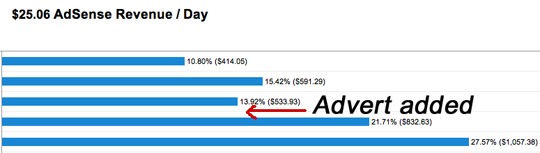
By systematically discovering where his income came from, Dunworth got a 56% jump in revenue from a $15 investment and about an hour of work.

How did he do it?

1) He linked Google Analytics to his Google AdSense account. This showed him exactly which clicks on his web site were producing AdSense revenue. In his words, "The results were astounding."

2) He discovered that, of the 800 pages on his web site, 70% of the revenue was generated from just 3 pages (a perfect illustration of the 80/20 Rule).

3) He hired a freelancer to create an ad and displayed it prominently his web site, presumably on one of those 3 high-value web pages. Cost for the ad? Just $15!?

4) Within the month, his AdSense revenue rose from $533 to $832 (that's a 56% increase).

Here's a graphic to show how his revenue jumped:


The moral of the story?

Big profits often lurk in small areas. But you'll never know unless you look. Carefully. Painstakingly. Look.

Now. Know this: You do NOT need to hook up Google Analytics to your web site to enjoy a 56% jump in revenue.

You don't even need a web site.

All you need do is open QuickBooks or call your bookkeeper. Get a report for the top 5 sources of revenue for your business. And study it carefully for surprising insights you can exploit, as Dunworth did.

I promise you this: No matter what you think your top 5 revenue streams are, you won't be 100% accurate. And you may find results that are "astounding," as Dunworth did.

As I wrote previously, this search for unexploited revenue streams led me on a Kaizen Marketing odyssey that ultimately put $2.1 million in the bank.

But you can't improve or exploit what you don't know. So start looking at where your revenues are coming from. That's the first small step toward bigger profits.

You'll find more ideas like these in my Free Report, Guaranteed Marketing.

Monday, September 12, 2011

Want to Improve Your Business? Do This First

"The purpose of a business is to create and keep a customer." - Peter Drucker

Exactly right, of course.

Even with $500 million in funding ... nifty new technology ... without customers, your business dies. Just ask Solyndra.

If customers are the lifeblood of your business, then marketing -- creating and keeping customers -- is the heart of your business.

Business is marketing. Marketing is your business.

So, anything you can do to improve your marketing is a good thing.

That's why I'm writing a lot these days about Kaizen Marketing, the continuous improvement of your most valuable activity -- creating and keeping customers.

Here's the first, simple step in the Kaizen Marketing process: Discovery.

Specifically, you can't improve what you don't measure. And you can't measure what you don't know. That means you must dig into your records and discover where the money is coming from.

Do this: Open QuickBooks or call your accounting person. Get a report for the top 5 sources of revenue for your business over:
  • this quarter
  • last quarter
  • this year
  • last year and 
  • 2-5 years prior

I promise you this: No matter what you think your top 5 revenue streams are, you won't be 100% accurate.

Because Quicken, like your calendar, never lies.

But your instincts and hunches about what makes your business money are almost always fuzzy.

So make this a first step in the Kaizen Marketing process, which I will explain in the coming weeks.

Discover what your top 5 sources of revenue are. That's half the battle in improving them -- and growing your business inevitably, one small step at a time.

You'll find more ideas like these in my Free Report, Guaranteed Marketing.

Friday, August 26, 2011

3 Small Ways to Boost Your Business in 15 Minutes

"The secret of getting ahead is getting started. The secret of getting started is breaking your complex overwhelming tasks into small manageable tasks, and then starting on the first one." - Mark Twain

If you're not happy with your marketing, the task of meeting your revenue goals may seem complex.

It may even overwhelm you to the point that you take little or no action. "What's the use?" you may think.

But Twain, who earned a fortune from his work, was exactly right: The secret of getting ahead is getting started.

What small, manageable marketing task could you get started on, right now? Now, as in NOW, before your next bathroom break?

Here's a list of 3 small marketing tasks to get you started ...

1) Pick up the phone and call your #1 client.
Ask how they're doing and what they're working on. Then ask if you can be of service somehow.


2) Mail a copy of a helpful article (magazine or newspaper) to your top 3 clients.
Include a handwritten message with each that says, "Saw this and thought of you." Sign it.


3) Call to interview your last happy client.
Ask how things have changed since whatever you did for them: How are they using your product or service, exactly? What has changed for the better, exactly? How much more time or money do they have as a result, exactly?

Ask if you can transcribe their comments to use -- with their name, city, and state -- in a "mini case study" on your web site or in your email newsletter.


Note: Doing any or all of the above tasks won't earn you a million bucks -- today.

But each will surprise and delight your clients. Each will give you a surge of endorphins. And completing any of these tasks will put you in motion toward your goals. (Are you moving now? In any direction?)

As Jim Collins and Jerry Porras, wrote in Built To Last:

With mottoes like Make A Little, Sell A Little and Take Small Steps, 3M understood that big things often evolve from little things. But since you can't tell ahead of time which little things will turn into big things, you have to try lots of little things, keep the ones that work, and discard the ones that don't...

Small tasks and little things can put you on the path to big results.

You'll find more ideas like these in my Free Report, Guaranteed Marketing.

Wednesday, August 24, 2011

Marketing Leverage: 3 Small Areas of Big Opportunity

Peter Drucker wrote: "Concentrate on those very few areas where a relatively minor increase in efficiency will produce a major increase in economic effectiveness."

In other words, look for small areas of big opportunity to exploit in your business. Not only can you earn more money; you can do it by working smarter, not harder.  

Here are 3 small areas of BIG opportunity in most businesses. How many can you exploit?  


1) Transaction Size -- Before chasing after market share (by selling to strangers), be sure to get wallet share (by selling to your current clients).

Two easy ways to do increase the size of your transactions are ...

  1. Cross-Sell: "Would you like fries with that?"
    In your business, what are your burgers and what are your fries? Example: If you’re an accountant doing bookkeeping, can you do taxes too? How about document storage? Document shredding? If you provide dog training, can you sell dog walking? Poop scooping? Of course you can.

  2. Upsell: "Would you like to Super Size that?"
    Do you sell a Deluxe Model? An Executive Version? An Expanded Edition? Why not? Some people aren't happy unless they spend the most and get the best. If that weren't true, there would be no first-class seats on airplanes.

2) Lost Clients -- You know the drill: It costs 5-10 times more to sell to a new client than to an existing one. But what are you doing about it?

Here's an idea: Reactivate your "lost clients" -- sell again to those people who have not bought from you in too long. When you do this, you enjoy windfall profits because your cost of acquisition is $0. An easy way to do this is to use a client reactivation letter.


3) Scripting -- Selling is like cooking: When you find a winning combination of ingredients, write them down!

Think of the last time a prospect said, "Yes" and became a client. What did you say that caused it? Was it an email you sent, a way of asking for the sale, one bullet point in your presentation?

Find that winning combination of words and use them again the next time you're in front of a prospect. And again. And again. That's a recipe for success. (FYI, the best sales script book ever written is here.)  


Think: If you get just one more sale per week by exploiting one of these 3 areas in your business, that's 50 extra orders a year. Use all 3 ideas and you could get 150 extra orders this year. What would that be worth to you?  

Bio: Kevin Donlin can help you grow your business and enjoy the breakthrough results your hard work deserves. If you're interested in boosting your revenues and profits, please click here.

Friday, July 1, 2011

3 Kaizen Marketing Questions

Today is the first day of Q3 2011.

Feeling reflective?

Here are 3 kaizen questions to help build your business in the coming quarter -- and beyond ...

1) What's working? (Do more of that.)

2) What's not? (Do less or none of that.)

3) What's next? (Plan to do more of what's working and less of what's not.)

If you're interested, I've written here and here about Kaizen Marketing.

Bio: Kevin Donlin can help you grow your business and enjoy the breakthrough results your hard work deserves. If you're interested in boosting your revenues and profits, please click here.

Tuesday, June 28, 2011

Stop Managing Your Time. Start Managing This

"Time isn't money. Time is everything." - Dr. Bernie Siegel

I used to love that quote.

And I still do.

But I don't agree 100% with it anymore ...

Yes, time is precious and limited to only 24 hours a day.

And, yes, how you use your time determines your results in business and in life.

Yet ... while we all get an equal amount of hours in a day, not all hours are created equal.

Some of us are morning people and perform at our peak before noon. Others are afternoon or evening people, and have more energy later in the day.

Which means that not every hour has equal value.

So, why not take advantage of your natural tendencies and schedule important tasks for when you have the most energy? This is like riding a horse in the direction it wants to go.

If you don't know when your hours of peak performance are, find out. Carry a voice recorder (your smart phone has one) or small notebook and record those times of day when you feel energized, as well as times when you feel sluggish.

Then, schedule your most-important activities during your peak-performance times.

You will find that when you manage your energy effectively, the hours take care of themselves -- you will get more done and build your business faster as a result.

Stop managing your time. Start managing your energy.

You'll find more ideas like these in my Free Report, Guaranteed Marketing

Monday, May 30, 2011

Know Your Numbers - 3 Vital Questions About Your Business

You can stump most business owners by asking them the following 3 questions:
  1. What is your total lifetime client value (LCV)?
  2. What are your top 3 sources of business?
  3. Which 5 clients send you the most referrals?
If you don't know off the top of your head, you should be able to find the answers within 15 minutes in QuickBooks and/or your client database. Otherwise, you don't really have a business -- you have a hobby.

Example: if you don't know how much a client is worth to you over their buying lifetime (LCV), how can you know how much to spend when "buying" new clients with your marketing? You can't know. So you will fly blind ... and probably crash, eventually.

When you know your numbers, you can do more of what works and less of what doesn't.

That's a sure recipe for success.

Know your numbers.

You'll find more ideas like these in my Free Report, Guaranteed Marketing