Showing posts with label continuous improvement. Show all posts
Thursday, September 19, 2019
More Clients From Less Work: The Magic of Focus
Have you ever read a book, watched a video, or gone to a seminar ...
... written down a long list of things to do ...
... and ended up doing NONE of it?
You're not alone.
It happens to us all.
But one insurance agent found a simple solution to that problem. And for him, it's been worth millions.
Louis, a sales rep for two Allstate Insurance offices in Texas, told me that he attended his first big marketing seminar a few years ago. He took a long list of ideas back to the office. He tried to do all of them ... and ended up doing none.
The reason? His to-do list was too long and intimidating to start on.
So, he did something different.
After his next seminar, he took another list of ideas back to the office. But this time, he focused on doing just ONE thing. That's it.
After putting that one idea to work, he did the next one. And the next. One at a time, step by step.
Results?
Louis and his team went from worrying about how to pay their bills to being on track for $3 million in annual premiums. With a ton of profits, and non-stop growth on the horizon.
Moral: New ideas mean nothing without new actions. But you won't implement if you're too intimidated to start. It's like trying to climb a mountain in one giant leap -- demoralizing and impossible.
So, take a moment today to look at your notes from that last seminar, podcast, or book. Pick just ONE idea and put it into action.
And one more thing ...
If you want more new clients faster, request your Free Client Cloning Kit at my website
Thursday, January 1, 2015
The Huge ROI of Increased Conversions
Today, January 1, is the start of a new year.
It's also the start of Financial Wellness Month, so you will hear a lot about finance and wealth.
Here's a sure-fire way to improve your finances: get richer, faster, with what I call The Best Investment on EarthTM.
That would be marketing.
The real estate market can and does collapse. So do stocks. Investment gurus can and will take your money.
That's why Marketing is The Best investment on EarthTM. Because, done correctly, the marketing of your business is a money making asset that pays you back more than you pay in, just like a share of stock, real estate property, or a piece of capital equipment.
What's nice about it is you can control the entire process. You don't have to bet on a hedge fund or give money to someone like Bernie Madoff who runs off with it.
And here's a way to improve your marketing and invest in yourself at ZERO risk: increase your conversions. Because anything you can do to convert more of the leads you've already paid for into clients who pay you will deliver an enormous return on investment.
Let's say you have 100 leads that it cost you about $1,000 to generate.
And let's say you currently convert about 2% of them into clients who pay you $1,000 each over their buying lifetime. So, from your $1,000 investment in marketing, you get back 2 new clients who pay you $2,000.
Now let's say you increase your conversion rate from 2% to 3%. First, congratulate yourself: going from 2% to 3% is actually a 50% increase in conversions, so get happy. But more importantly, you now get 3 clients instead of 2 clients -- an extra $1,000 from that same initial $1,000 investment. Your ROI just shot up from 200% to 300%.
How do you increase conversions? It can be as simple as testing:
NONE of the above ideas is high-cost. Most are low-cost or NO-cost. That's the beauty of increased conversions. By getting more sales from the leads you already have, you mine a seam of gold, hidden in your business, that NONE of your competitors can ever see or steal from you. Your only cost is a bit of time and effort, systematically invested, to test new ideas.
Now. If your business is doing at least $100,000 in revenue, my Free Client Cloning Kit can give you a slight edge -- and then some. It's NOT another download. This is a real business-building kit you can hold in your hands. Grab yours now, while you can.
It's also the start of Financial Wellness Month, so you will hear a lot about finance and wealth.
Here's a sure-fire way to improve your finances: get richer, faster, with what I call The Best Investment on EarthTM.
That would be marketing.
The real estate market can and does collapse. So do stocks. Investment gurus can and will take your money.
That's why Marketing is The Best investment on EarthTM. Because, done correctly, the marketing of your business is a money making asset that pays you back more than you pay in, just like a share of stock, real estate property, or a piece of capital equipment.
What's nice about it is you can control the entire process. You don't have to bet on a hedge fund or give money to someone like Bernie Madoff who runs off with it.
And here's a way to improve your marketing and invest in yourself at ZERO risk: increase your conversions. Because anything you can do to convert more of the leads you've already paid for into clients who pay you will deliver an enormous return on investment.
Let's say you have 100 leads that it cost you about $1,000 to generate.
And let's say you currently convert about 2% of them into clients who pay you $1,000 each over their buying lifetime. So, from your $1,000 investment in marketing, you get back 2 new clients who pay you $2,000.
Now let's say you increase your conversion rate from 2% to 3%. First, congratulate yourself: going from 2% to 3% is actually a 50% increase in conversions, so get happy. But more importantly, you now get 3 clients instead of 2 clients -- an extra $1,000 from that same initial $1,000 investment. Your ROI just shot up from 200% to 300%.
How do you increase conversions? It can be as simple as testing:
- a new headline in your ad or on your web page
- a new opening in your phone script
- a new closing in your sales presentation
- a better offer
- new payment terms
- a better guarantee, etc.
NONE of the above ideas is high-cost. Most are low-cost or NO-cost. That's the beauty of increased conversions. By getting more sales from the leads you already have, you mine a seam of gold, hidden in your business, that NONE of your competitors can ever see or steal from you. Your only cost is a bit of time and effort, systematically invested, to test new ideas.
Now. If your business is doing at least $100,000 in revenue, my Free Client Cloning Kit can give you a slight edge -- and then some. It's NOT another download. This is a real business-building kit you can hold in your hands. Grab yours now, while you can.
Friday, December 21, 2012
3 Ways to Boost Sales This Week, Without Advertising
I just consulted with the owner of a tutoring school with 3 branches. He really needs to grow his sales.
Before prescribing any marketing "medicine," I asked a few questions to diagnose his condition.
Turns out that his average student stays for 9 months, paying $250/month, for $2,250 in lifetime value.
Before joining, prospective students pay $200 to take an assessment test. And 33-50% of those prospects sign up at his 3 branches (he couldn't be specific about the exact conversion percentage).
After a few more questions and answers, I gave him these 3 easy ways to boost his sales ...
1) Find out the exact conversion percentage at each school. That way, you know who's marketing well and who needs help, so you can prioritize your efforts.
2) Find out exactly what the manager says and does at the school with the highest conversion percentage. Then, roll out their "script" to the other 2 schools.
When you know what works and you do more of it, you are guaranteed to increase sales. So following steps 1 and 2 are a slam-dunk certainty.
(Wait. What about you? What works best to turn prospects into clients for your business? Are you doing as much of it as possible? Why not??)
Here's my last suggestion to the school owner ...
3) Waive the $200 fee on initial assessments, for anyone referred by an existing student.
I told him NOT to worry about the $200 he'll lose by not charging these prospects for tests. Because they walk into his lobby with $0 acquisition costs.
He can still charge the general public $200 for testing, but when people are referred and get the assessment for free, they feel part of an exclusive club ... AND they feel obligated to reciprocate in some way for receiving a $200 gift ... which will likely boost conversions above the current 33-50%.
And I told him to focus on the figure $2,250, which is the lifetime value of every new student who signs up during the "Free Assessment" referral campaign. That's a very motivating number.
(Wait. What about you? What's your lifetime client value, or LCV? Don't know it? Then how can you know how much you can afford to "buy" new clients for with your marketing?)
I hope you find these 3 ideas helpful. None of them will cost you a nickel in advertising. None requires any investment in new technology. And all can be done this week.
Meanwhile ... if you want to put an end to "feast-or-famine" syndrome in your business, my free Client Cloning Kit can help you. Grab your copy here, while they last.
Before prescribing any marketing "medicine," I asked a few questions to diagnose his condition.
Turns out that his average student stays for 9 months, paying $250/month, for $2,250 in lifetime value.
Before joining, prospective students pay $200 to take an assessment test. And 33-50% of those prospects sign up at his 3 branches (he couldn't be specific about the exact conversion percentage).
After a few more questions and answers, I gave him these 3 easy ways to boost his sales ...
1) Find out the exact conversion percentage at each school. That way, you know who's marketing well and who needs help, so you can prioritize your efforts.
2) Find out exactly what the manager says and does at the school with the highest conversion percentage. Then, roll out their "script" to the other 2 schools.
When you know what works and you do more of it, you are guaranteed to increase sales. So following steps 1 and 2 are a slam-dunk certainty.
(Wait. What about you? What works best to turn prospects into clients for your business? Are you doing as much of it as possible? Why not??)
Here's my last suggestion to the school owner ...
3) Waive the $200 fee on initial assessments, for anyone referred by an existing student.
I told him NOT to worry about the $200 he'll lose by not charging these prospects for tests. Because they walk into his lobby with $0 acquisition costs.
He can still charge the general public $200 for testing, but when people are referred and get the assessment for free, they feel part of an exclusive club ... AND they feel obligated to reciprocate in some way for receiving a $200 gift ... which will likely boost conversions above the current 33-50%.
And I told him to focus on the figure $2,250, which is the lifetime value of every new student who signs up during the "Free Assessment" referral campaign. That's a very motivating number.
(Wait. What about you? What's your lifetime client value, or LCV? Don't know it? Then how can you know how much you can afford to "buy" new clients for with your marketing?)
I hope you find these 3 ideas helpful. None of them will cost you a nickel in advertising. None requires any investment in new technology. And all can be done this week.
Meanwhile ... if you want to put an end to "feast-or-famine" syndrome in your business, my free Client Cloning Kit can help you. Grab your copy here, while they last.
Thursday, September 6, 2012
How To Do All Your Email In 45 Minutes
I read, replied to, and wrote all of my emails (including the jokes from my mother) in less than 45 minutes today.
Want to know how?
Batching.
You see, writing, reading, and replying to emails is a process, just like everything you do at work.
By doing all your email just once a day -- twice at most -- you can save incredible amounts of time.
Here's the funny thing: No email is so urgent that it requires an immediate response. If it were an urgent, life-changing matter, that message would have come to you by phone or in person.
Not only is 99.9% of all email not urgent, but answering it efficiently is not hard.
In fact, it's soft. Like bread. (Work with me here.)
Think, for a moment, about how a baker works.
He doesn't bake 3 loaves of wheat bread, then 2 loaves of pumpernickel, then another 2 loaves of wheat bread.
No. He bakes one batch of similar bread all at once, then moves onto the next one.
Email (like paying your bills, answering the phone, etc.) is a process, just like baking. And batching makes it go faster and easier.
So ... try batching your email tomorrow. Better yet, outsource or delegate it.
The less repetitious crap you have to slog through each day, the more mental energy you'll have to work on your business, instead of in your business.
Now, if you'll excuse me, I had so much time left over this afternoon that I'm going for a walk with the dog :-)
Resource: If you want to put an end to "feast-or-famine" syndrome in your business, grab your free Client Cloning Kit here.
Want to know how?
Batching.
You see, writing, reading, and replying to emails is a process, just like everything you do at work.
By doing all your email just once a day -- twice at most -- you can save incredible amounts of time.
Here's the funny thing: No email is so urgent that it requires an immediate response. If it were an urgent, life-changing matter, that message would have come to you by phone or in person.
Not only is 99.9% of all email not urgent, but answering it efficiently is not hard.
In fact, it's soft. Like bread. (Work with me here.)
Think, for a moment, about how a baker works.
He doesn't bake 3 loaves of wheat bread, then 2 loaves of pumpernickel, then another 2 loaves of wheat bread.
No. He bakes one batch of similar bread all at once, then moves onto the next one.
Email (like paying your bills, answering the phone, etc.) is a process, just like baking. And batching makes it go faster and easier.
So ... try batching your email tomorrow. Better yet, outsource or delegate it.
The less repetitious crap you have to slog through each day, the more mental energy you'll have to work on your business, instead of in your business.
Now, if you'll excuse me, I had so much time left over this afternoon that I'm going for a walk with the dog :-)
Resource: If you want to put an end to "feast-or-famine" syndrome in your business, grab your free Client Cloning Kit here.
Friday, July 27, 2012
The Power of Written Goals: How I Built a House with Words
You already know about persistence. It's more than just important. Persistence is a requirement for success.
And persistence starts with motivation.
If you're not motivated to start the hard work involved in every successful business, you won't persist until it's done. You'll be like most people who talk and think and plan ... but don't execute.
And you will fail.
So, to motivate yourself, write down the BIG GOAL that your work will help you achieve.
Better yet, cut out a picture from a magazine that clearly shows what you're after, whether it be a new home, a car, a vacation or whatever. Put this picture on your desk or next to your computer.
The next time the going gets tough refer to your written goal or the picture of what you're really after. This will force you to focus on the outcome of what you're doing, and take your mind off the arduous task at hand.
Here's an example from my own life ...
While engaged to my fiancée in 1994, I wrote down this simple goal on a 3x5 card: "By June 24, 1995, I will build my wife a house with words."
I wasn't sure how I would do that exactly, but it sounded good at the time -- especially because I was doing it for my wife. There's extra motivation that comes from doing work to benefit others.
I kept that 3x5 card in my wallet and read it out loud at least once a day. Then, things began to happen ...
Within a year, I got a great job as an Associate Editor for a marketing communications firm in Minneapolis.
And on September 1, 1995 (only about 60 days late!), my wife and I moved from our cramped apartment to a nice little house in the city, a block from a park, two blocks from a dozen restaurants, and just down the road from gorgeous Lake Calhoun.
I didn't plan how to do any this in detail. I simply knew that I would be living in a nice house as a result of my writing. I was right. But it happened only because I had a written goal that motivated to persist through the many, many long hours of work necessary to reach that goal.
So ... what motivates you? What is the BIG GOAL that your work will help you achieve? Write it down. There's real power in having a written goal, with a deadline, that you carry around with you and read out loud often.
Sure, you may have heard about the power of written goals before. But ... what are you doing about it?
Resource: If you want to put an end to "feast-or-famine" syndrome in your business, my free Client Cloning Kit can help. Grab your copy here.
And persistence starts with motivation.
If you're not motivated to start the hard work involved in every successful business, you won't persist until it's done. You'll be like most people who talk and think and plan ... but don't execute.
And you will fail.
So, to motivate yourself, write down the BIG GOAL that your work will help you achieve.
Better yet, cut out a picture from a magazine that clearly shows what you're after, whether it be a new home, a car, a vacation or whatever. Put this picture on your desk or next to your computer.
The next time the going gets tough refer to your written goal or the picture of what you're really after. This will force you to focus on the outcome of what you're doing, and take your mind off the arduous task at hand.
Here's an example from my own life ...
While engaged to my fiancée in 1994, I wrote down this simple goal on a 3x5 card: "By June 24, 1995, I will build my wife a house with words."
I wasn't sure how I would do that exactly, but it sounded good at the time -- especially because I was doing it for my wife. There's extra motivation that comes from doing work to benefit others.
I kept that 3x5 card in my wallet and read it out loud at least once a day. Then, things began to happen ...
Within a year, I got a great job as an Associate Editor for a marketing communications firm in Minneapolis.
And on September 1, 1995 (only about 60 days late!), my wife and I moved from our cramped apartment to a nice little house in the city, a block from a park, two blocks from a dozen restaurants, and just down the road from gorgeous Lake Calhoun.
I didn't plan how to do any this in detail. I simply knew that I would be living in a nice house as a result of my writing. I was right. But it happened only because I had a written goal that motivated to persist through the many, many long hours of work necessary to reach that goal.
So ... what motivates you? What is the BIG GOAL that your work will help you achieve? Write it down. There's real power in having a written goal, with a deadline, that you carry around with you and read out loud often.
Sure, you may have heard about the power of written goals before. But ... what are you doing about it?
Resource: If you want to put an end to "feast-or-famine" syndrome in your business, my free Client Cloning Kit can help. Grab your copy here.
Monday, June 4, 2012
How to Take Control of Your Morning (and Day)
Mel Robbins writes rightly in Success magazine:
When you check your smartphone first thing in the morning, you're saying, in effect: "Hey, world, please tell me what to think." In other words, you're making yourself a slave to outside forces.
No, thanks.
I've written before that email is your public to-do list that anybody can get on. The longer I go each day without checking email, the more I get done. Every. Single. Time.
Just think: To become more productive, starting tomorrow, you don't need to spend one penny or one minute on a technology upgrade. It's a technology downgrade you need.
Try it and post your results in the comments section below.
Bio: Kevin Donlin can help you grow your business and enjoy the breakthrough results your hard work deserves. If you're interested in boosting your revenues and profits, please click here.
What's the first thing you did this morning? I bet it was reading messages on your cellphone. The question is why?
Recent studies suggest almost 80 percent of cellphone users sleep with their phones in their bedrooms. Among entrepreneurs, I bet that number is even higher. So why is reaching for the phone first thing such a problem? Because how you start the day sets the tone for the rest of your day.
If your first act is to check for texts or emails, then someone else sets your priorities before you’ve had breakfast. And those emails seek your time, attention, help and brain space. You start your day being reactive to other people rather than proactive about your goals. You have surrendered control—which is crucial to your well-being, success and happiness—to others.
When you check your smartphone first thing in the morning, you're saying, in effect: "Hey, world, please tell me what to think." In other words, you're making yourself a slave to outside forces.
No, thanks.
I've written before that email is your public to-do list that anybody can get on. The longer I go each day without checking email, the more I get done. Every. Single. Time.
Just think: To become more productive, starting tomorrow, you don't need to spend one penny or one minute on a technology upgrade. It's a technology downgrade you need.
Try it and post your results in the comments section below.
Bio: Kevin Donlin can help you grow your business and enjoy the breakthrough results your hard work deserves. If you're interested in boosting your revenues and profits, please click here.
Friday, April 13, 2012
Perfect Enemies: Why a Little Better is a Lot Better Than Not Better
You've heard it said that the perfect is the enemy of the good.
But it's worse than that ...
The perfect is the enemy of the better, and it's also the enemy of improvement.
Why?
Because, when we fret and fume over why something isn't yet perfect -- and probably never will be -- it's depressing as hell.
And depressed people don't take action to make things better. Depressed people watch TV, check Facebook, or drink coffee/beer/martinis.
So, just for the rest of today, screw perfection.
It may be the most productive thing you do all week.
Here's why: A little better is a lot better than not better.
Let's unpack that idea ...
1) "A little better is ..." making one small improvement to whatever you're doing. One small change for the better. One. Small. Improvement.
The fun part is, you may not stop at one. You may find that improving your marketing emails, customer support, blog, web site, or prospect follow-up is so enjoyable that you keep going until you create a wholesale makeover.
But you can't finish what you don't start. And starting is the hard part. So make your start small, with the goal of simply trying for a little better.
2) "... a lot better than not better" is the other side of that equation.
If the daunting goal of perfection has kept you from starting, guess what? You won't start. You won't improve.
That article you need to write, PowerPoint you have to create, or proposal you must submit won't happen by itself. Taking no action can NOT make anything better.
That's how the perfect really is the enemy of the better.
And that's why a little better is a lot better than not better.
Bio: Kevin Donlin can help you grow your business and enjoy the breakthrough results your hard work deserves. If you're interested in boosting your revenues and profits, please click here.
But it's worse than that ...
The perfect is the enemy of the better, and it's also the enemy of improvement.
Why?
Because, when we fret and fume over why something isn't yet perfect -- and probably never will be -- it's depressing as hell.
And depressed people don't take action to make things better. Depressed people watch TV, check Facebook, or drink coffee/beer/martinis.
So, just for the rest of today, screw perfection.
It may be the most productive thing you do all week.
Here's why: A little better is a lot better than not better.
Let's unpack that idea ...
1) "A little better is ..." making one small improvement to whatever you're doing. One small change for the better. One. Small. Improvement.
The fun part is, you may not stop at one. You may find that improving your marketing emails, customer support, blog, web site, or prospect follow-up is so enjoyable that you keep going until you create a wholesale makeover.
But you can't finish what you don't start. And starting is the hard part. So make your start small, with the goal of simply trying for a little better.
2) "... a lot better than not better" is the other side of that equation.
If the daunting goal of perfection has kept you from starting, guess what? You won't start. You won't improve.
That article you need to write, PowerPoint you have to create, or proposal you must submit won't happen by itself. Taking no action can NOT make anything better.
That's how the perfect really is the enemy of the better.
And that's why a little better is a lot better than not better.
Bio: Kevin Donlin can help you grow your business and enjoy the breakthrough results your hard work deserves. If you're interested in boosting your revenues and profits, please click here.
Thursday, March 1, 2012
How to Do More Great Work -- Expand the Definition
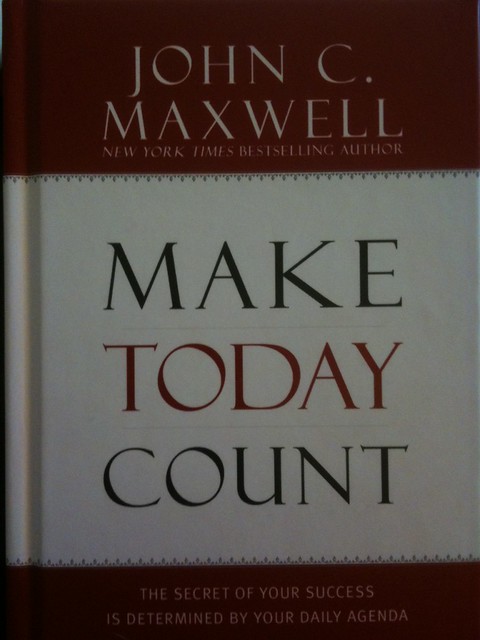
In addition to running two companies and speaking all over the world, John C. Maxwell has written books that have sold more than 75 million copies, including the excellent, Make Today Count.
You may think it's impossible for one person to do so much. And you would be right. It is impossible -- for one person.
One person could never do all that John C. Maxwell or any top achiever has done. But Maxwell has expanded what he can do by expanding what it means to do what he does.
Take book writing, for example. Here's the cover of Make Today Count ...
You may think writing a book means you have to research the topic, write a first draft, proofread it, submit it to the publisher, edit and rewrite any changes, etc.
But that's a narrow, limiting definition of "writing a book."
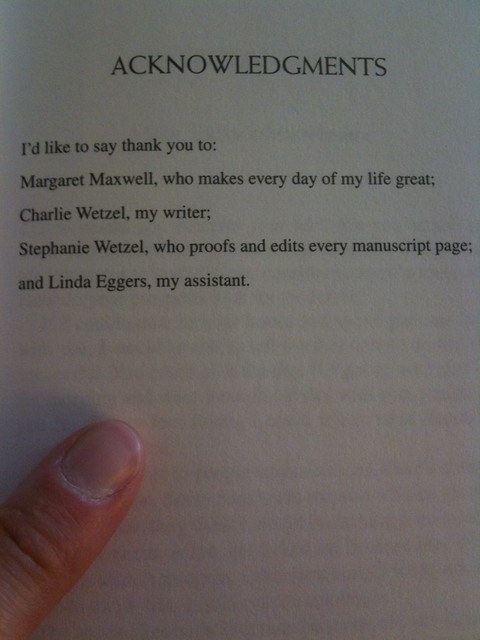
By expanding that definition, Maxwell has been able to write more than 80 books. How? Check out his Acknowledgements page for Make Today Count ...
Look carefully. Turns out, Maxwell didn't write all (or any?) of Make Today Count -- Charlie Wetzel is listed as his writer. And Stephanie Wetzel is the person "who proofs and edits every manuscript page."
By expanding the definition of what he does, John C. Maxwell can do more. A LOT more.
Now, a question: How could you do more by expanding the definition of what you do?
As a copywriter, I can do a lot of writing by outsourcing parts of it. When I call a client or industry expert to do research, for example, I record the call and send it to my transcriber. This frees me to do what I do best, which is find a Big Idea for my client's marketing message, then support that idea with facts.
So, one way to expand the definition of what you do is to expand your team.
Example: Michelangelo didn't paint the Sistine Chapel ceiling by himself. He had a team -- a small army of assistants who mixed his paints, prepared each day's plaster, and even painted small parts of the picture.
Because, no matter what you do, there are probably only 2-3 things that add the most value to your work. All the rest can and should be outsourced. That's a part of what makes 80/20 Marketing so effective, by the way.
Bio: Kevin Donlin can help you grow your business and enjoy the breakthrough results your hard work deserves. If you're interested in boosting your revenues and profits, please click here.
You may think it's impossible for one person to do so much. And you would be right. It is impossible -- for one person.
One person could never do all that John C. Maxwell or any top achiever has done. But Maxwell has expanded what he can do by expanding what it means to do what he does.
Take book writing, for example. Here's the cover of Make Today Count ...
You may think writing a book means you have to research the topic, write a first draft, proofread it, submit it to the publisher, edit and rewrite any changes, etc.
But that's a narrow, limiting definition of "writing a book."
By expanding that definition, Maxwell has been able to write more than 80 books. How? Check out his Acknowledgements page for Make Today Count ...
Look carefully. Turns out, Maxwell didn't write all (or any?) of Make Today Count -- Charlie Wetzel is listed as his writer. And Stephanie Wetzel is the person "who proofs and edits every manuscript page."
By expanding the definition of what he does, John C. Maxwell can do more. A LOT more.
Now, a question: How could you do more by expanding the definition of what you do?
As a copywriter, I can do a lot of writing by outsourcing parts of it. When I call a client or industry expert to do research, for example, I record the call and send it to my transcriber. This frees me to do what I do best, which is find a Big Idea for my client's marketing message, then support that idea with facts.
So, one way to expand the definition of what you do is to expand your team.
Example: Michelangelo didn't paint the Sistine Chapel ceiling by himself. He had a team -- a small army of assistants who mixed his paints, prepared each day's plaster, and even painted small parts of the picture.
Because, no matter what you do, there are probably only 2-3 things that add the most value to your work. All the rest can and should be outsourced. That's a part of what makes 80/20 Marketing so effective, by the way.
Bio: Kevin Donlin can help you grow your business and enjoy the breakthrough results your hard work deserves. If you're interested in boosting your revenues and profits, please click here.
Tuesday, October 4, 2011
How to Find Time to Work On Your Business
As I've written before, there are (at least) 3 small ways to boost your business in only 15 minutes a day:
1) Pick up the phone and call your #1 client. Ask how they're doing and what they're working on. Then ask if you can be of service somehow. They will tell you how to help or say, "No, thanks." Either way, they will be blown away by your generosity.
2) Mail a copy of a helpful article (magazine or newspaper) to your top 3 clients. Include a handwritten message with each that says, "Saw this and thought of you." Sign it.
3) Call to interview your last happy client. Ask how are they using your product or service, exactly? What has changed for the better, exactly? How much more time or money do they have as a result, exactly? Then ask if you can transcribe their comments to use in a "mini case study" on your web site or newsletter.
But, incredible as it may seem, some people just can't find time to work on their business instead of in it.
So, here's a proven way to recover at least 15 minutes of "lost" time in your daily schedule: Cut back on email.
And here's my story to illustrate ...
Back in 2004, I tracked how I spent each day, logging my time in 15-min. increments, as an attorney does.
What I found was shocking: I spent 6 hours per week reading and responding to email.
Not so much, you say?
Six hours add up -- to 24 hours per month ... 288 hours in a 50-week year ... 36 FULL WORKING DAYS per year.
Unacceptable.
So I resolved to check email once an hour instead of every 15 minutes (or anytime I got bored).
Yes, withdrawal was painful (there's no methadone equivalent for this). But my productivity soared.
So I took it a step further: I limited checking email to only 4 times a day. Then I cut back again. And again.
Now, I check email only twice a day, most days: at about 10:00 AM and 4:00 PM.
As a result, I spend only about 3 hours a week on email.
That's a 50% productivity gain -- an extra 18 working days recovered every year.
How do I handle urgent problems by email? There are none. Anyone with a "hair on fire" emergency that I must solve also knows my cell phone number and calls it.
How do I handle regular problems by email? They wait until 10:00 AM or 4:00 PM.
Yes, it really is that simple. Do this:
1) Block off time on your calendar to read and respond to email. I suggest 3-4 blocks of 20-30 minutes at first, so you can wean yourself and stay sane. You will still save at least 15 minutes per day in "transition time" shuttling back and forth from email to other activities.
2) Delay checking email until late morning, if possible. This closes the door to letting other people hijack your morning, which is the rudder for the rest of the day (according to my mentor, Brian Tracy).
Do these two things each day and you will save enough time to make small, profitable improvements in your business.
Bio: Kevin Donlin can help you grow your business and enjoy the breakthrough results your hard work deserves. If you're interested in boosting your revenues and profits, please click here.
1) Pick up the phone and call your #1 client. Ask how they're doing and what they're working on. Then ask if you can be of service somehow. They will tell you how to help or say, "No, thanks." Either way, they will be blown away by your generosity.
2) Mail a copy of a helpful article (magazine or newspaper) to your top 3 clients. Include a handwritten message with each that says, "Saw this and thought of you." Sign it.
3) Call to interview your last happy client. Ask how are they using your product or service, exactly? What has changed for the better, exactly? How much more time or money do they have as a result, exactly? Then ask if you can transcribe their comments to use in a "mini case study" on your web site or newsletter.
But, incredible as it may seem, some people just can't find time to work on their business instead of in it.
So, here's a proven way to recover at least 15 minutes of "lost" time in your daily schedule: Cut back on email.
And here's my story to illustrate ...
Back in 2004, I tracked how I spent each day, logging my time in 15-min. increments, as an attorney does.
What I found was shocking: I spent 6 hours per week reading and responding to email.
Not so much, you say?
Six hours add up -- to 24 hours per month ... 288 hours in a 50-week year ... 36 FULL WORKING DAYS per year.
Unacceptable.
So I resolved to check email once an hour instead of every 15 minutes (or anytime I got bored).
Yes, withdrawal was painful (there's no methadone equivalent for this). But my productivity soared.
So I took it a step further: I limited checking email to only 4 times a day. Then I cut back again. And again.
Now, I check email only twice a day, most days: at about 10:00 AM and 4:00 PM.
As a result, I spend only about 3 hours a week on email.
That's a 50% productivity gain -- an extra 18 working days recovered every year.
How do I handle urgent problems by email? There are none. Anyone with a "hair on fire" emergency that I must solve also knows my cell phone number and calls it.
How do I handle regular problems by email? They wait until 10:00 AM or 4:00 PM.
Yes, it really is that simple. Do this:
1) Block off time on your calendar to read and respond to email. I suggest 3-4 blocks of 20-30 minutes at first, so you can wean yourself and stay sane. You will still save at least 15 minutes per day in "transition time" shuttling back and forth from email to other activities.
2) Delay checking email until late morning, if possible. This closes the door to letting other people hijack your morning, which is the rudder for the rest of the day (according to my mentor, Brian Tracy).
Do these two things each day and you will save enough time to make small, profitable improvements in your business.
Bio: Kevin Donlin can help you grow your business and enjoy the breakthrough results your hard work deserves. If you're interested in boosting your revenues and profits, please click here.
Monday, September 12, 2011
Want to Improve Your Business? Do This First
"The purpose of a business is to create and keep a customer." - Peter Drucker
Exactly right, of course.
Even with $500 million in funding ... nifty new technology ... without customers, your business dies. Just ask Solyndra.
If customers are the lifeblood of your business, then marketing -- creating and keeping customers -- is the heart of your business.
Business is marketing. Marketing is your business.
So, anything you can do to improve your marketing is a good thing.
That's why I'm writing a lot these days about Kaizen Marketing, the continuous improvement of your most valuable activity -- creating and keeping customers.
Here's the first, simple step in the Kaizen Marketing process: Discovery.
Specifically, you can't improve what you don't measure. And you can't measure what you don't know. That means you must dig into your records and discover where the money is coming from.
Do this: Open QuickBooks or call your accounting person. Get a report for the top 5 sources of revenue for your business over:
I promise you this: No matter what you think your top 5 revenue streams are, you won't be 100% accurate.
Because Quicken, like your calendar, never lies.
But your instincts and hunches about what makes your business money are almost always fuzzy.
So make this a first step in the Kaizen Marketing process, which I will explain in the coming weeks.
Discover what your top 5 sources of revenue are. That's half the battle in improving them -- and growing your business inevitably, one small step at a time.
You'll find more ideas like these in my Free Report, Guaranteed Marketing.
Exactly right, of course.
Even with $500 million in funding ... nifty new technology ... without customers, your business dies. Just ask Solyndra.
If customers are the lifeblood of your business, then marketing -- creating and keeping customers -- is the heart of your business.
Business is marketing. Marketing is your business.
So, anything you can do to improve your marketing is a good thing.
That's why I'm writing a lot these days about Kaizen Marketing, the continuous improvement of your most valuable activity -- creating and keeping customers.
Here's the first, simple step in the Kaizen Marketing process: Discovery.
Specifically, you can't improve what you don't measure. And you can't measure what you don't know. That means you must dig into your records and discover where the money is coming from.
Do this: Open QuickBooks or call your accounting person. Get a report for the top 5 sources of revenue for your business over:
- this quarter
- last quarter
- this year
- last year and
- 2-5 years prior
I promise you this: No matter what you think your top 5 revenue streams are, you won't be 100% accurate.
Because Quicken, like your calendar, never lies.
But your instincts and hunches about what makes your business money are almost always fuzzy.
So make this a first step in the Kaizen Marketing process, which I will explain in the coming weeks.
Discover what your top 5 sources of revenue are. That's half the battle in improving them -- and growing your business inevitably, one small step at a time.
You'll find more ideas like these in my Free Report, Guaranteed Marketing.
Monday, August 29, 2011
How to Create a Big, Costly Problem
See that 40-foot tall tree to the right of the wood pile?
My wife hates it and wants me to cut it down.
She's been telling me so for 9 years. Since that problematic tree was about 4-feet tall.
I always thought it was a little thing. And it was. Plus, the tree is in a hidden corner of our yard.
So I ignored the problem ... until it grew too big to ignore.
Eight years later, that tree will now cost about $250 to get rid of, if I cut it down myself and rent a chipper.
If I neglect it another 9 years? It will cost about $1,000 for someone else to cut down and chip.
What's the point of all this?
There are little, "4-foot" problems in your business right now, which -- if ignored -- can grow into costly "40-foot" problems, faster than you think.
Look around. Pick one 4-foot problem in your business you have ignored for too long. Is it:
You'll find more ideas like these in my Free Report, Guaranteed Marketing.
My wife hates it and wants me to cut it down.
She's been telling me so for 9 years. Since that problematic tree was about 4-feet tall.
I always thought it was a little thing. And it was. Plus, the tree is in a hidden corner of our yard.
So I ignored the problem ... until it grew too big to ignore.
Eight years later, that tree will now cost about $250 to get rid of, if I cut it down myself and rent a chipper.
If I neglect it another 9 years? It will cost about $1,000 for someone else to cut down and chip.
What's the point of all this?
There are little, "4-foot" problems in your business right now, which -- if ignored -- can grow into costly "40-foot" problems, faster than you think.
Look around. Pick one 4-foot problem in your business you have ignored for too long. Is it:
- a non-performing employee or partner?
- the growing amount of time you spend on Facebook?
- daily tasks that keep you busy, but not productive?
- a difficult client who eats up your time?
- a cluttered office that saps your energy?
You'll find more ideas like these in my Free Report, Guaranteed Marketing.
Tuesday, June 7, 2011
Next Time, Try Human. (Or: Attack of the Killer Buzzwords)
There's a well-known company that I'm thinking about hiring for a project.
I visited their web site.
These are the first words I saw:
Neither did I, after the first, second ... or third reading (and I have 1.75 college degrees. Sheesh).
Luckily, I am determined to talk to somebody at this company, at least to find out if there's a human being on the inside.
Now. Your web site may not be this badly marred by buzzwords ... but you never know.
In fact, you yourself really can't know for certainty if you're speaking the language of your prospects. Because you are not your prospects.
So, try this: Find 5 people. Not friends or family -- find 5 new acquaintances.
Offer each person a $5 Starbucks gift card if they sit down in front of their computer, visit your web site, and answer these 3 questions:
1) What does this company do?
2) At first glance, do they look trustworthy? Why or why not?
3) Please try to order something, right up to submitting payment. What, if any, problems or questions did you have?
*) Bonus question: Visit this webs site on your mobile phone browser. What's your first impression?
I'm sure you could add to the list. Whatever questions you ask, your goal is simple: Find out if your web site is written in the language your prospects speak and understand.
You'll find more ideas like these in my Free Report, Guaranteed Marketing.
I visited their web site.
These are the first words I saw:
Many of the most successful performance marketing programs utilize a variety of extension strategies and cross-platform initiatives to reach long- and short-range targets.
Do you have any idea what they do, make, or sell?Neither did I, after the first, second ... or third reading (and I have 1.75 college degrees. Sheesh).
Luckily, I am determined to talk to somebody at this company, at least to find out if there's a human being on the inside.
Now. Your web site may not be this badly marred by buzzwords ... but you never know.
In fact, you yourself really can't know for certainty if you're speaking the language of your prospects. Because you are not your prospects.
So, try this: Find 5 people. Not friends or family -- find 5 new acquaintances.
Offer each person a $5 Starbucks gift card if they sit down in front of their computer, visit your web site, and answer these 3 questions:
1) What does this company do?
2) At first glance, do they look trustworthy? Why or why not?
3) Please try to order something, right up to submitting payment. What, if any, problems or questions did you have?
*) Bonus question: Visit this webs site on your mobile phone browser. What's your first impression?
I'm sure you could add to the list. Whatever questions you ask, your goal is simple: Find out if your web site is written in the language your prospects speak and understand.
You'll find more ideas like these in my Free Report, Guaranteed Marketing.
Labels:
continuous improvement,
copywriting,
marketing
Monday, December 20, 2010
Continuous Innovation and Drucker's Prime Directive
You’ve probably read this quote from Peter Drucker: "The function of a business is to innovate and then market that innovation."
I call it Drucker's Prime Directive.
It means that, if you’re in business, you essentially have two functions:
1. create new products and services
2. sell them
Because this blog is about marketing, I don’t usually devote too much space to topics like innovation.
Except for today ... to say that innovation can be about as complex or simple as you make it.
Innovation can be complex if you think of it as great leaps forward … the next big, BIG idea … or "Eureka!" moments that land you on the cover of Wired.
But, innovation can be simple. Accidental, even.
For example:
Lesson: To innovate in business, you need an open mind AND open eyes.
Start by looking at every “Hmm, that’s odd!” moment as a potential innovation. One that you could profit enormously from.
Examples of small, odd moments that can lead to big breakthroughs for your business:
This -- keeping your eyes open for new ideas, however small or odd -- is innovation made simple.
It's the first half of Drucker's Prime Directive: "The function of a business is to innovate and then market that innovation."
Next time, I’ll discuss the second half: How to continuously improve your marketing of those products or services you innovate.
(More ideas like these in my Free Report, Guaranteed Marketing for Service Business Owners.)
I call it Drucker's Prime Directive.
It means that, if you’re in business, you essentially have two functions:
1. create new products and services
2. sell them
Because this blog is about marketing, I don’t usually devote too much space to topics like innovation.
Except for today ... to say that innovation can be about as complex or simple as you make it.
Innovation can be complex if you think of it as great leaps forward … the next big, BIG idea … or "Eureka!" moments that land you on the cover of Wired.
But, innovation can be simple. Accidental, even.
For example:
- Spencer Silver, a researcher at 3M, worked -- and failed -- to develop a strong adhesive in 1970. Four years later, Arthur Fry, another 3M employee, was annoyed by the bookmarks he placed in his church hymnal kept falling out. Recalling the work of his colleague Silver, he applied some of the weak adhesive to his bookmarks. The little "sticky notes" worked perfectly. In 1977, Post-It Notes were brought to market, quickly becoming as indispensable as staples and Scotch tape.
- Roy J Plunkett, a DuPont research chemist, was experimenting with a coolant called TRE (tetrafluoroethylene) to establish its use for refrigeration in 1938. A cylinder of the gas failed to discharge. Instead of throwing it out, Plunkett and his assistant cut it open to investigate. They found the gas had solidified into a slippery white powder. Tests showed it to be the slipperiest substance in existence! It was also inert, with an extremely high melting point. DuPont began marketing products coated with the miracle lubricant in 1946. Millions of frying pans later, Teflon is another innovation we can't live without.
- Richard James, an engineer, was intrigued by the spring that fell off his desk in 1940 -- it seemed to walk across the floor before coming to rest. After a few modifications and some creative selling to toy executives, the Slinky was introduced in 1948. More than 250 million have been sold worldwide.
Lesson: To innovate in business, you need an open mind AND open eyes.
Start by looking at every “Hmm, that’s odd!” moment as a potential innovation. One that you could profit enormously from.
Examples of small, odd moments that can lead to big breakthroughs for your business:
- The customer who uses your product in a unplanned way -- and gets unexpectedly pleasant results. (Like the sailor who drank boiled down, “condensed” wine before it could be reconstituted with added water. Thus was born brandy.)
- The product that failed but has parts worth salvaging. (Like the online game that failed to take off, but included a tool that enabled photo sharing. The developers scrapped the game and relaunched the web site as Flickr.)
- The customers who want faster, slower, cheaper, more expensive, bigger, or smaller versions of your product. (Like the little girl who pestered her father, Edwin Land, for an instant copy of the picture he had just snapped of her in 1944. Land went on to develop the instant camera.)
- The product that produces an unplanned result that's worth selling. (Like the drug that was initially used to treat high blood pressure and angina, but unexpectedly caused other results to pop up. The developers re-purposed the drug as Viagra.)
This -- keeping your eyes open for new ideas, however small or odd -- is innovation made simple.
It's the first half of Drucker's Prime Directive: "The function of a business is to innovate and then market that innovation."
Next time, I’ll discuss the second half: How to continuously improve your marketing of those products or services you innovate.
(More ideas like these in my Free Report, Guaranteed Marketing for Service Business Owners.)
Monday, November 15, 2010
Productivity Tip: Hanging, Nekkid Body Scanners, TSA Crotch Patdowns
Samuel Johnson said, "...when a man knows he is to be hanged in a fortnight, it concentrates his mind wonderfully."
Today, with the new TSA Nekkid X-Rays and Crotch Patdowns in place, you could easily replace hanging with flying.
Because, as much as we hate the hassle of business travel, it does concentrate the mind wonderfully.
Case in point: In a few hours, I'm flying to Philadelphia to give a speech tomorrow morning on careers. Then, I fly to Minneapolis to give another speech tomorrow night, on copywriting.
And you know what?
I've done more work in two hours this morning than I typically do in 4 or 5. Because I didn't have time to read the newspaper for 30 minutes over breakfast, or check out my favorite blogs, or otherwise goof off.
With a hard deadline looming -- leaving for the airport at 1:30 -- I have to work all the time I'm working this morning. What a rare experience. And how sad.
But you've had the same experience. Think of your last business trip -- didn't you get more done in the hours before you had to leave? Sure you did. You had no choice.
Now. Wouldn't it be nice if every day were as productive as a travel day?
Well, there's nothing stopping you (or me) from setting deadlines -- even little ones, like meeting the spouse for lunch or calling a client -- to concentrate the mind and get more done.
Best part: No TSA body searches or X-rays required ... and you can keep your shoes on.
(For more ideas like these, download Guaranteed Marketing for Service Business Owners.)
Today, with the new TSA Nekkid X-Rays and Crotch Patdowns in place, you could easily replace hanging with flying.
Because, as much as we hate the hassle of business travel, it does concentrate the mind wonderfully.
Case in point: In a few hours, I'm flying to Philadelphia to give a speech tomorrow morning on careers. Then, I fly to Minneapolis to give another speech tomorrow night, on copywriting.
And you know what?
I've done more work in two hours this morning than I typically do in 4 or 5. Because I didn't have time to read the newspaper for 30 minutes over breakfast, or check out my favorite blogs, or otherwise goof off.
With a hard deadline looming -- leaving for the airport at 1:30 -- I have to work all the time I'm working this morning. What a rare experience. And how sad.
But you've had the same experience. Think of your last business trip -- didn't you get more done in the hours before you had to leave? Sure you did. You had no choice.
Now. Wouldn't it be nice if every day were as productive as a travel day?
Well, there's nothing stopping you (or me) from setting deadlines -- even little ones, like meeting the spouse for lunch or calling a client -- to concentrate the mind and get more done.
Best part: No TSA body searches or X-rays required ... and you can keep your shoes on.
(For more ideas like these, download Guaranteed Marketing for Service Business Owners.)
Wednesday, November 10, 2010
Small Questions, Small Steps, Big Profits
"The next time you're worried about something, ask yourself, 'What small thing can I do right now?' Then do it. Remember not to ask, 'What could I possibly do to make this whole thing go away?' That question does not get you into action at all."
So says Steve Chandler, author of "100 Ways to Motivate Yourself
."
This has two important implications:
1. One small action is more productive than any amount of worry, and
2. Trying to solve a big problem at once can paralyze you with confusion.
Whatever you're doing to build your business today, you can't do it all. But you can do something.
Here's a simple way to do something small today that adds up to big revenue tomorrow. Ask yourself this question:
Want an example?
About 12 years ago, I ran a business called Guaranteed Resumes. It was successful -- I was usually booked with resume-writing clients 5-10 days in advance.
Problem: I lost out on prospects in a hurry. Whenever somebody called asking if I could write their resume the same day, I had to politely decline. I was booked, you see.
After a few months of turning down business (and losing money), I asked myself a simple question: What could I do to stop losing these prospects?
The answer didn't come right away. I quickly got -- and rejected -- the idea of hiring employees. Later, I set up a joint venture with a local writer that failed.
But I kept asking myself the question: What could I do to stop losing these prospects?
Then, I got an answer.
I created a simple Web site and "staffed it" by arranging to send prospects to other resume writers across America. These writers were fast and could write resumes the same day. I processed the credit card orders, in exchange for a commission.
I named the site 1 Day Resumes (now offline) and linked to it from the main page of my Guaranteed Resumes site. Now, people in a hurry were directed to that new web site. I didn't even have to answer the phone.
The results?
An extra $21,000 in sales in one year, from almost no effort on my part -- about two hours a week managing the site and customer service.
The extra profits didn't come overnight, but they did come -- after I persisted in asking a simple question to build my business.
There's big power in small questions.
And it's worth repeating: What small, trivial thing could you do to grow your business?
You can't receive if you don't ask.
(For more ideas like these, download Guaranteed Marketing for Service Business Owners.)
So says Steve Chandler, author of "100 Ways to Motivate Yourself
This has two important implications:
1. One small action is more productive than any amount of worry, and
2. Trying to solve a big problem at once can paralyze you with confusion.
Whatever you're doing to build your business today, you can't do it all. But you can do something.
Here's a simple way to do something small today that adds up to big revenue tomorrow. Ask yourself this question:
What small, trivial thing could I do to grow my business?The results may shock you.
Want an example?
About 12 years ago, I ran a business called Guaranteed Resumes. It was successful -- I was usually booked with resume-writing clients 5-10 days in advance.
Problem: I lost out on prospects in a hurry. Whenever somebody called asking if I could write their resume the same day, I had to politely decline. I was booked, you see.
After a few months of turning down business (and losing money), I asked myself a simple question: What could I do to stop losing these prospects?
The answer didn't come right away. I quickly got -- and rejected -- the idea of hiring employees. Later, I set up a joint venture with a local writer that failed.
But I kept asking myself the question: What could I do to stop losing these prospects?
Then, I got an answer.
I created a simple Web site and "staffed it" by arranging to send prospects to other resume writers across America. These writers were fast and could write resumes the same day. I processed the credit card orders, in exchange for a commission.
I named the site 1 Day Resumes (now offline) and linked to it from the main page of my Guaranteed Resumes site. Now, people in a hurry were directed to that new web site. I didn't even have to answer the phone.
The results?
An extra $21,000 in sales in one year, from almost no effort on my part -- about two hours a week managing the site and customer service.
The extra profits didn't come overnight, but they did come -- after I persisted in asking a simple question to build my business.
There's big power in small questions.
And it's worth repeating: What small, trivial thing could you do to grow your business?
You can't receive if you don't ask.
(For more ideas like these, download Guaranteed Marketing for Service Business Owners.)
Tuesday, November 9, 2010
Never Shower Alone
Want more good ideas for your business?
Here's how to get an endless supply, by "reading" an extra 10-30 books every year --
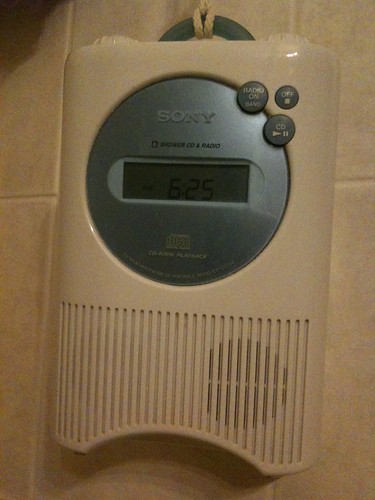
-- just listen to audiobooks in the shower. That's my trusty (waterproof) Sony CD Player above.
This morning, I "studied" 3 tracks from the audiobook, "One Small Step Can Change Your Life: The Kaizen Way to Success," by Dr. Robert Maurer.
Brian Tracy says that, if you listen to audiobooks while driving, you can create a "university on wheels" by learning new information during the hundreds of hours you spend in the car each year.
And if you believe, as I do, that we often make poor use of the 168 hours in every week, your shower is another place to turn down time into learning time.
Yes, of course, you do need some down time that's really down time -- no deep thinking about business or marketing. But that's what sleep, family meals, and weekends are for.
Now. If you think listening to audiobooks in the shower is a tad bit eccentric, you are wrong. Eccentric is writing notes to yourself in the shower.
(For more ideas like these, download Guaranteed Marketing for Service Business Owners.)
Here's how to get an endless supply, by "reading" an extra 10-30 books every year --
-- just listen to audiobooks in the shower. That's my trusty (waterproof) Sony CD Player above.
This morning, I "studied" 3 tracks from the audiobook, "One Small Step Can Change Your Life: The Kaizen Way to Success," by Dr. Robert Maurer.
Brian Tracy says that, if you listen to audiobooks while driving, you can create a "university on wheels" by learning new information during the hundreds of hours you spend in the car each year.
And if you believe, as I do, that we often make poor use of the 168 hours in every week, your shower is another place to turn down time into learning time.
Yes, of course, you do need some down time that's really down time -- no deep thinking about business or marketing. But that's what sleep, family meals, and weekends are for.
Now. If you think listening to audiobooks in the shower is a tad bit eccentric, you are wrong. Eccentric is writing notes to yourself in the shower.
(For more ideas like these, download Guaranteed Marketing for Service Business Owners.)
Monday, November 8, 2010
Pareto's 80/20 Principle in Marketing
I'm a huge fan of the Pareto principle, aka the 80/20 Rule.
Briefly defined, it's this: a minority of causes usually leads to a majority of results.
There are exceptions, of course, which is why I inserted "usually" into the definition.
Still, the 80/20 Rule works often enough that you can achieve huge breakthroughs by applying it to your business.
Example: I used the 80/20 Rule to build an entire business on one Google Adwords ad and one keyword. Let me explain ...
A few years back, I was running a range of pay-per-click ads on Google, driving traffic to merchant's web sites and earning a commission on each lead that I provided them.
Each week, I analyzed my profits. One Saturday morning, I found that one ad and one keyword, part of hundreds I was running Google, was especially profitable.
So, I focused my efforts on testing and improving that ad and keyword. Profits went up.
Then, I replicated that winning ad, using other keywords. Profits went up again.
Then, I restructured my working days, dropping almost everything to focus on that one money-making activity -- improving my Google Adwords in that one area. Profits skyrocketed.
Within 6 months, I was bringing in more than $450,000 a year in net profits. And this went on for nearly three years.
Success came for me, as it can come for you, when I took three steps in my marketing:
1) identify the small number of activities producing a large percentage of profits;
2) spend more time on those high-profit activities;
3) spend less time on other low-value activities.
That's it.
The book to read on this subject is The 80/20 Principle
, by Richard Koch.
It's so good, I've read it three times.
And, yes, there's a lesson in that, too: Probably 80% of the books in your library are so-so. It's far better to read a few excellent books several times, than to read many crappy books once, IMHO.
To finish this rant, here are excerpts I wrote out by hand after my second reading of The 80/20 Principle ...
Briefly defined, it's this: a minority of causes usually leads to a majority of results.
There are exceptions, of course, which is why I inserted "usually" into the definition.
Still, the 80/20 Rule works often enough that you can achieve huge breakthroughs by applying it to your business.
Example: I used the 80/20 Rule to build an entire business on one Google Adwords ad and one keyword. Let me explain ...
A few years back, I was running a range of pay-per-click ads on Google, driving traffic to merchant's web sites and earning a commission on each lead that I provided them.
Each week, I analyzed my profits. One Saturday morning, I found that one ad and one keyword, part of hundreds I was running Google, was especially profitable.
So, I focused my efforts on testing and improving that ad and keyword. Profits went up.
Then, I replicated that winning ad, using other keywords. Profits went up again.
Then, I restructured my working days, dropping almost everything to focus on that one money-making activity -- improving my Google Adwords in that one area. Profits skyrocketed.
Within 6 months, I was bringing in more than $450,000 a year in net profits. And this went on for nearly three years.
Success came for me, as it can come for you, when I took three steps in my marketing:
1) identify the small number of activities producing a large percentage of profits;
2) spend more time on those high-profit activities;
3) spend less time on other low-value activities.
That's it.
The book to read on this subject is The 80/20 Principle
It's so good, I've read it three times.
And, yes, there's a lesson in that, too: Probably 80% of the books in your library are so-so. It's far better to read a few excellent books several times, than to read many crappy books once, IMHO.
To finish this rant, here are excerpts I wrote out by hand after my second reading of The 80/20 Principle ...
- To engage in 80/20 Thinking, continually ask: What is the 20% that is leading to the 80%?
- Whatever you're doing 80% of the time is probably a waste of time. If you make most of your money from a small part of your activity, you should turn your business upside down and concentrate your efforts on multiplying that small part.
- If an activity succeeds beyond expectations, it's likely a 20% activity.
- The vital few give success to you. A few things are always much more important than most things.
- The biggest wins all start small. Something big always comes from something that was small to start with. Look for the "invisible" 20% of small, key causes. They are there -- find them. Unexpected successes are one clue.
- Exploit 80/20 arbitrage. Ruthlessly prune 80% activities, such as checking email, to free up time and money for 20% activities. The profit is enormous because it is highly leveraged arbitrage.
Wednesday, November 3, 2010
Marketing for Busy People
Yesterday, I wrote about marketing as a systematic process.
If I had had more time, I would have included this quote:
"If you can’t describe what you are doing as a process then you don’t know what you’re doing." – W. Edwards Deming
To recap, I suggested that your marketing system is everything you do with a person who comes into contact with your business, from their first email or phone call until the day exit the marketplace forever.
The essential elements of any marketing system include the following:
1) Lead capture. You record the name, email address, and other needed information from prospects in a database -- with your prospects' permission, of course.
2) Follow-up. You contact prospects who do not buy the first time, answering their questions and offering them information to move them along in the buying process.
3) Sales scripts. You deliver the same sales pitch to every prospect, tailored to their unique questions and objections, but as uniform as possible, to eliminate variation from tested "selling words" that have worked before.
4) Customer care. You have policies and procedures in place to maximize client satisfaction while minimizing frustration.
5) Referrals. You take the same steps with every customer to encourage and reward referrals.
Now. Here's the problem you probably face, in the words of one of my readers who owns a computer repair service:
What's the marketing solution for busy people? Here's one possibility: "The secret of getting ahead is getting started. The secret of getting started is breaking your complex overwhelming tasks into small manageable tasks, and then starting on the first one." - Mark Twain
And here's another way to attack a big problem like your marketing:
Don't worry about overhauling your entire marketing system or trying to make 21 improvements this week.
Just ask yourself small, non-threatening questions, like: What one thing could I do to improve my marketing in the next 30 minutes?
You'd be surprised at how much good you can do today, in only 30 minutes. You can:
Heh. Keep reading ...
Let's pick just one item from the list above. Let's say that, by mailing one thank-you note per day to 30 clients this month, it produces just $1 per day in new profit -- $365 more profit per year.
Yes, that's trivial.
But what if, tomorrow, you add just one email to the follow-up emails that go out to prospects who opt into your autoresponder series. That one email produces another "trivial" $1/day in profit -- $365 more per year.
What if you keep finding one more way to add $1 a day in profit to your business. And you do it for just 30 working days. What is the cumulative result?
It's $10,950 over 12 months.
Again, that figure may seem trivial. But $10,950 is enough to:
Try it and see.
Note: Here's a resource I created on the power of systematic follow-up marketing.
If I had had more time, I would have included this quote:
"If you can’t describe what you are doing as a process then you don’t know what you’re doing." – W. Edwards Deming
To recap, I suggested that your marketing system is everything you do with a person who comes into contact with your business, from their first email or phone call until the day exit the marketplace forever.
The essential elements of any marketing system include the following:
1) Lead capture. You record the name, email address, and other needed information from prospects in a database -- with your prospects' permission, of course.
2) Follow-up. You contact prospects who do not buy the first time, answering their questions and offering them information to move them along in the buying process.
3) Sales scripts. You deliver the same sales pitch to every prospect, tailored to their unique questions and objections, but as uniform as possible, to eliminate variation from tested "selling words" that have worked before.
4) Customer care. You have policies and procedures in place to maximize client satisfaction while minimizing frustration.
5) Referrals. You take the same steps with every customer to encourage and reward referrals.
Now. Here's the problem you probably face, in the words of one of my readers who owns a computer repair service:
I want VERY much to try and do something with these other resources of yours ... but I have to try and find the time.And there it is. We know that we need to work on our marketing. But we don't have the time. Other things "take priority."
I've had your earlier email flagged and on my "to-do" list for what seems months now (I'm sure it's only been a month, but it's been too long all the same) and there are just too many other things that are taking priority.
What's the marketing solution for busy people? Here's one possibility: "The secret of getting ahead is getting started. The secret of getting started is breaking your complex overwhelming tasks into small manageable tasks, and then starting on the first one." - Mark Twain
And here's another way to attack a big problem like your marketing:
When I face the desolate impossibility of writing five hundred pages, a sick sense of failure falls on me, and I know I can never do it. Then gradually, I write one page and then another. One day's work is all I can permit myself to contemplate. - John SteinbeckThat's the business solution to being too busy to market: Just get started.
Don't worry about overhauling your entire marketing system or trying to make 21 improvements this week.
Just ask yourself small, non-threatening questions, like: What one thing could I do to improve my marketing in the next 30 minutes?
You'd be surprised at how much good you can do today, in only 30 minutes. You can:
- add a Unique Selling Proposition (USP) or a special "coupon code" to your voicemail greeting
- write and mail one thank-you note to a recent client
- add one email to your follow-up autoresponder series (I use and recommend Aweber)
- pick up the phone and call one potential joint-venture partner
- email one happy client and ask if you can use their comments as a testimonial on your web site
Heh. Keep reading ...
Let's pick just one item from the list above. Let's say that, by mailing one thank-you note per day to 30 clients this month, it produces just $1 per day in new profit -- $365 more profit per year.
Yes, that's trivial.
But what if, tomorrow, you add just one email to the follow-up emails that go out to prospects who opt into your autoresponder series. That one email produces another "trivial" $1/day in profit -- $365 more per year.
What if you keep finding one more way to add $1 a day in profit to your business. And you do it for just 30 working days. What is the cumulative result?
It's $10,950 over 12 months.
Again, that figure may seem trivial. But $10,950 is enough to:
- fully fund your IRA;
- take your family to the ocean for 5 days; and
- buy a Stratocaster on Ebay
Try it and see.
Note: Here's a resource I created on the power of systematic follow-up marketing.
Tuesday, November 2, 2010
What's Your Marketing System?
Being from the Detroit area, I'm a big fan of statistician and management guru W. Edwards Deming, who basically shamed the Big 3 automakers into improving the quality of their products by first helping the Japanese to do so after World War II.
His philosophy has been summarized as follows, by Wikipedia:
So ... what's your system for marketing?
Your marketing system can be defined as everything you do with a person who comes into contact with your business, from their first email or phone call until the day exit the marketplace forever.
Here are essential elements of marketing system:
1) Lead capture. You record the name, email address, and other needed information from prospects in a database -- with your prospects' permission, of course.
2) Follow-up. You contact prospects who do not buy the first time, answering their questions and offering them information to move them along in the buying process.
3) Sales scripts. You deliver the same sales pitch to every prospect, tailored to their unique questions and objections, but as uniform as possible, to eliminate variation from tested "selling words" that have worked before.
4) Customer care. You have policies and procedures in place to maximize client satisfaction while minimizing frustration.
5) Referrals. You take the same steps with every customer to encourage and reward referrals.
Get the idea?
Unless you have a marketing system, you don't have a business. You have a hobby.
If you're unhappy with the results your marketing is producing so far this year, it may be tempting to blame the economy. Or Washington. Or penny-pinching customers who don't appreciate your brilliance.
But blaming outside forces leaves you powerless to make improvements where it counts, on the inside of your business.
Instead, the cause of low sales and miniscule profits more likely lies in your marketing system.
So blame the system. But only for about 10 seconds, because beating yourself up won't bring your sales up.
Instead, get busy improving your system, one small step at a time. That's how systematic, continual improvement in your profits happens.
(For more ideas like these, download Guaranteed Marketing for Service Business Owners.)
His philosophy has been summarized as follows, by Wikipedia:
Dr. W. Edwards Deming taught that by adopting appropriate principles of management, organizations can increase quality and simultaneously reduce costs (by reducing waste, rework, staff attrition and litigation while increasing customer loyalty). The key is to practice continual improvement and think of manufacturing as a system, not as bits and pieces.
So ... what's your system for marketing?
Your marketing system can be defined as everything you do with a person who comes into contact with your business, from their first email or phone call until the day exit the marketplace forever.
Here are essential elements of marketing system:
1) Lead capture. You record the name, email address, and other needed information from prospects in a database -- with your prospects' permission, of course.
2) Follow-up. You contact prospects who do not buy the first time, answering their questions and offering them information to move them along in the buying process.
3) Sales scripts. You deliver the same sales pitch to every prospect, tailored to their unique questions and objections, but as uniform as possible, to eliminate variation from tested "selling words" that have worked before.
4) Customer care. You have policies and procedures in place to maximize client satisfaction while minimizing frustration.
5) Referrals. You take the same steps with every customer to encourage and reward referrals.
Get the idea?
Unless you have a marketing system, you don't have a business. You have a hobby.
If you're unhappy with the results your marketing is producing so far this year, it may be tempting to blame the economy. Or Washington. Or penny-pinching customers who don't appreciate your brilliance.
But blaming outside forces leaves you powerless to make improvements where it counts, on the inside of your business.
Instead, the cause of low sales and miniscule profits more likely lies in your marketing system.
So blame the system. But only for about 10 seconds, because beating yourself up won't bring your sales up.
Instead, get busy improving your system, one small step at a time. That's how systematic, continual improvement in your profits happens.
(For more ideas like these, download Guaranteed Marketing for Service Business Owners.)
Tuesday, October 26, 2010
What Do The Texas Rangers Know About Success That You Don't?
The Texas Rangers are in The World Series this year for the first time in team history.
How did they do it?
There's no one reason. You need superior coaching, pitching, fielding, running, and hitting to make it this far.
But I found something the Rangers are doing that not only helped them reach The Series, but can help improve your business, too.
It's this: They defined a key success metric and try to achieve it every game.
What does this have to do with your business?
First, take a look at the photos below, which I had smuggled out of the Rangers' clubhouse last week (don't ask how :-)
The Texas Rangers figure -- rightly -- that you can't improve what you don't measure. So they devised 8 ways to measure what a "Positive Team At Bat" is, including a hit, base-on-balls (BB), hit-by-pitch or catcher's interference (HBP / C. Int) and so on ...
... and their goal is to have 17 "Positive Team At Bats" every game. They figure that reaching this threshold gives them a chance to win every game. So far this season, their system has worked out well.
Now, two things for you:
1) What is the key success metric for your marketing efforts?
Ideally, it's something you have total control over, such as what you do at the plate in baseball. Examples:
Whatever it is, you must find at least one way to measure success in your marketing. Otherwise, you're flying blind.
2) What is your daily goal or quota?
Again, you can't improve what you don't measure, so be sure to pick a number -- any number is better than none -- and aim for it.
Analyze your results every day and every week. Do more of what's working, less of what's not. And, sooner than you expect, you may find your business is in the Big Leagues.
This is another example of "Inside Marketing" -- improving your marketing from the inside, by making a few changes to what you're already doing.
(Kevin M. Donlin is author of the Special Report, Guaranteed Marketing for Service Business Owners.)
How did they do it?
There's no one reason. You need superior coaching, pitching, fielding, running, and hitting to make it this far.
But I found something the Rangers are doing that not only helped them reach The Series, but can help improve your business, too.
It's this: They defined a key success metric and try to achieve it every game.
What does this have to do with your business?
First, take a look at the photos below, which I had smuggled out of the Rangers' clubhouse last week (don't ask how :-)
The Texas Rangers figure -- rightly -- that you can't improve what you don't measure. So they devised 8 ways to measure what a "Positive Team At Bat" is, including a hit, base-on-balls (BB), hit-by-pitch or catcher's interference (HBP / C. Int) and so on ...
... and their goal is to have 17 "Positive Team At Bats" every game. They figure that reaching this threshold gives them a chance to win every game. So far this season, their system has worked out well.
Now, two things for you:
1) What is the key success metric for your marketing efforts?
Ideally, it's something you have total control over, such as what you do at the plate in baseball. Examples:
- Calls made to clients and/or prospects
- Handwritten thank-you notes mailed to clients
- Pay-per-click ads created or tested in Google Adwords
Whatever it is, you must find at least one way to measure success in your marketing. Otherwise, you're flying blind.
2) What is your daily goal or quota?
Again, you can't improve what you don't measure, so be sure to pick a number -- any number is better than none -- and aim for it.
Analyze your results every day and every week. Do more of what's working, less of what's not. And, sooner than you expect, you may find your business is in the Big Leagues.
This is another example of "Inside Marketing" -- improving your marketing from the inside, by making a few changes to what you're already doing.
(Kevin M. Donlin is author of the Special Report, Guaranteed Marketing for Service Business Owners.)
Subscribe to:
Posts (Atom)