Want to sell more of your product or service this week?
With about 45 minutes of effort?
It's simple. Just do more of what's working.
Let me show you …
I just analyzed my sales data for the past year in my Salesforce CRM. (You DO have a CRM, don't you?)
Total time invested: 45 minutes.
What did I find?
Findings
----------
1. Of my last 18 sales, 10 of them were repeat sales to past clients. Not surprising.
2. Of my top 5 clients who paid me the most money, all 5 were referred by people I met at marketing events. Frankly, this was surprising.
Actions
----------
1. I booked my tickets to two more marketing events, to keep meeting high-level prospects.
2. I will add qualified prospects I meet at those events to my mailing list of printed newsletters (not email spam). The follow-up by U.S. Mail is helpful for them and automatic for me.
3. I will mail a gift to key past clients within 10 days, to show my appreciation. The gifts will be helpful for them and pave the way for repeat sales, which helps us all.
Takeaways
----------
1. Where did your last 15-25 sales come from?
2. How do you know?
3. What are you doing to get more sales like them?
One last thing. If you found these ideas helpful, please request your Free Client Cloning Kit at my website
Showing posts with label sales. Show all posts
Showing posts with label sales. Show all posts
Friday, July 26, 2019


Friday, July 12, 2019
How to Grow Your Business with the Phone
One of the fastest ways to build your business is with the telephone.
Here's why. Unless you're selling something for under $100, you're going to need to talk to someone at some point before they write you a check.
And a great way to have more conversations is by calling prospects and clients. But not just any phone call will do.
Tip: Whenever you make a phone call, be useful to the other person. Never, ever call to "check in" or "loop back," or "touch base." No, no, no.
When you call prospects, give them news, tips and tools they can use to grow their business. Which, in turn, will grow yours.
To illustrate, within the last 48 hours, I've spoken to 6 current and prospective clients. Every one of them was happy to hear from me.
As a result, they're going to take future phone calls from me and more sales will result.
Why?
Because I gave them a news item and made it simple for them to insert it into their emails, web pages, etc., to make their marketing more timely. Which will make their marketing, better whether or not we ever work together on a project.
Something to think about.
One more thing …
If you found this idea helpful, claim your Free Client Cloning Kit at www.clientcloningsystems.com
Wednesday, July 3, 2019
How to Sell More With Amazon's $10-Billion No-Tech Marketing Trick
Did you know?
Amazon spends over $10 billion on digital marketing every year.
And Amazon sells everything under the sun.
Which means, no matter what you're selling, you could learn a lot from Amazon.
Case in point: Take a look at what just popped up in my Amazon Prime account today:

See what Amazon did there?
Instead of promising to save me money on future purchases (Gain) Amazon showed me that I lost $142.04 by not using their credit card last year (Pain).
Brilliant.
Now, here's why this matters to you: Amazon does nothing on a whim.
Their marketing, like everything they do, is driven 100% by data. Which tells you something. The fact that Amazon is using pain rather than gain in their credit card offer means you MUST consider doing the same in the offers you make to your prospects.
And here's the best part: No technology is needed. This marketing tactic is 100% psychological, based on the fact that we humans will run faster away from pain than we will toward gain.
Now.
Let's turn these ideas into action.
Step 1) What exactly does your ideal client miss out on every day they haven't hired you?
Example: Let's say that you're a consultant. And the prospect you just spoke to by phone wants to make sell more of her $79,999 coaching program. (No, that price is not outlandish. I recently helped a client sell $1.1 million of her coaching at that price.)
If she's getting 10 calls every week from prospects and only selling 1 of her coaching slots at $79,999, but you KNOW you can get her to at least 2 sales from those 10 phone calls every week, then she's losing $79,999 every week she hasn't hired you.
Step 2) How can you make that pain very real in your emails, web pages, sales letters and other marketing?
Example: You could include a phrase like this in your follow-up emails: "Had we started 4 weeks ago when you first contacted me ... you could have received an extra $319,996 from the same phone calls you're getting now."
Powerful, don't you think?
One more thing ...
If you own a business with clients (not customers), in the U.S. or Canada, and you're doing at least $1 million in revenue, you're invited to claim a Free Client Cloning Kit here.
Amazon spends over $10 billion on digital marketing every year.
And Amazon sells everything under the sun.
Which means, no matter what you're selling, you could learn a lot from Amazon.
Case in point: Take a look at what just popped up in my Amazon Prime account today:

See what Amazon did there?
Instead of promising to save me money on future purchases (Gain) Amazon showed me that I lost $142.04 by not using their credit card last year (Pain).
Brilliant.
Now, here's why this matters to you: Amazon does nothing on a whim.
Their marketing, like everything they do, is driven 100% by data. Which tells you something. The fact that Amazon is using pain rather than gain in their credit card offer means you MUST consider doing the same in the offers you make to your prospects.
And here's the best part: No technology is needed. This marketing tactic is 100% psychological, based on the fact that we humans will run faster away from pain than we will toward gain.
Now.
Let's turn these ideas into action.
Step 1) What exactly does your ideal client miss out on every day they haven't hired you?
Example: Let's say that you're a consultant. And the prospect you just spoke to by phone wants to make sell more of her $79,999 coaching program. (No, that price is not outlandish. I recently helped a client sell $1.1 million of her coaching at that price.)
If she's getting 10 calls every week from prospects and only selling 1 of her coaching slots at $79,999, but you KNOW you can get her to at least 2 sales from those 10 phone calls every week, then she's losing $79,999 every week she hasn't hired you.
Step 2) How can you make that pain very real in your emails, web pages, sales letters and other marketing?
Example: You could include a phrase like this in your follow-up emails: "Had we started 4 weeks ago when you first contacted me ... you could have received an extra $319,996 from the same phone calls you're getting now."
Powerful, don't you think?
One more thing ...
If you own a business with clients (not customers), in the U.S. or Canada, and you're doing at least $1 million in revenue, you're invited to claim a Free Client Cloning Kit here.
Friday, April 10, 2015
How to Beat Low-Price Competitors: A Tale of Two Pizzas

You're looking at an A+ example of how to sew seeds of doubt in the minds of prospects about low-priced competition.
This example is so powerful, it merits careful study.
Here's the story ...
I just got back from spending 5 nights at a very nice hotel in Orlando, with guests from all over the world. Fantastic place.
The color flyer in the bottom of the picture was shoved under our door almost every night. It offered two pizzas at roughly half the price of room service pizzas. Losing those sales must have annoyed the hotel.
So they did something to totally undercut the cheaper competition.
See that headline, "Not all pizzas are created equal"? That's from a sign posted on the inside of the door in our room. You can't miss the sign. I didn't.
And when I read the part that many local pizza joints are "fraudulent and engage in the criminal practice of identity and credit card theft" ... I suddenly had ZERO interest in saving a few bucks by calling out for pizza. We dined at the hotel. Every night.
Moral: Low price ain't everything.
If you face cheap competitors who are "eating your lunch," fight back. Sow seeds of doubt in the mind of your prospects. Use this headline as a template: "Not all ____ are created equal."
If you can educate buyers and tell them about potential fraud, poor quality, or other negatives -- and help them make a smart buying decision that features your business -- you can turn the tables and win more sales. Price won't matter.
Now. If your business is doing at least $100,000 in revenue, my Free Client Cloning Kit can give you a slight edge -- and then some. It's NOT another download. This is a real business-building kit you can hold in your hands. Grab yours now, while you can.

Monday, November 3, 2014
The Upsell: Key to Higher Profits and Satisfaction
What is an upsell?
Short answer: Free money. Because a certain percentage of your clients want to buy more and almost all of them can buy more. The only question is, are you willing to sell it to them?
Academic answer: Asking people to buy more during or after the sale. Also called a bump or a cross-sell.
Upsell example: Tim, a photographer in St. Paul, Minnesota, added $4,000 in extra revenue in 6 months -- on track for $8,000 extra each year -- without working any harder.
How?
He added an upsell to his wedding photo packages. In addition to low and a medium, he now offers a premium-priced package to clients. He starts every presentation with “Here’s the best package,” and then works down. No hard selling required (Tim is very laid-back).
Results: More than 20% of his clients sell themselves. And Tim will bank an extra $8,000 from the same amount of work this year -- enough to fully fund his IRA and take his family on an exquisite vacation or two, with no extra work.
Moral: If you don't have an upsell, you are leaving money on the table.
But this is NOT about greed and you are NOT an evil 1% wannabe for offering an upsell. No.
When you offer more to buyers who already have their credit card out, you deliver two benefits to them:
1) better results (by delivering more of what they need, such as faster download speeds for Internet access) and
2) better feelings (because many people want to spend more to feel good about themselves -- otherwise, we would all drive a $12,780 Nissan Versaa, the cheapest new car in America).
When you offer a high-quality upsell to clients, you help them and you help yourself. Win-win.
Meanwhile, are you an entrepreneur with clients, not customers? Are you doing at least $200,000 in revenue, and want to do better? If so ...
... I can show you more "profit hacks" like the ones you just read in this article. Get them in my next Free Video Training Session. It's for $200k entrepreneurs ONLY, please.
Grab your spot here
Can't make it to the training? My free Client Cloning Kit can help. It's not some cheapo download -- this is a real business-building kit you can hold in your hands. Grab yours now, while you can.
Short answer: Free money. Because a certain percentage of your clients want to buy more and almost all of them can buy more. The only question is, are you willing to sell it to them?
Academic answer: Asking people to buy more during or after the sale. Also called a bump or a cross-sell.
Upsell example: Tim, a photographer in St. Paul, Minnesota, added $4,000 in extra revenue in 6 months -- on track for $8,000 extra each year -- without working any harder.
How?
He added an upsell to his wedding photo packages. In addition to low and a medium, he now offers a premium-priced package to clients. He starts every presentation with “Here’s the best package,” and then works down. No hard selling required (Tim is very laid-back).
Results: More than 20% of his clients sell themselves. And Tim will bank an extra $8,000 from the same amount of work this year -- enough to fully fund his IRA and take his family on an exquisite vacation or two, with no extra work.
Moral: If you don't have an upsell, you are leaving money on the table.
But this is NOT about greed and you are NOT an evil 1% wannabe for offering an upsell. No.
When you offer more to buyers who already have their credit card out, you deliver two benefits to them:
1) better results (by delivering more of what they need, such as faster download speeds for Internet access) and
2) better feelings (because many people want to spend more to feel good about themselves -- otherwise, we would all drive a $12,780 Nissan Versaa, the cheapest new car in America).
When you offer a high-quality upsell to clients, you help them and you help yourself. Win-win.
Meanwhile, are you an entrepreneur with clients, not customers? Are you doing at least $200,000 in revenue, and want to do better? If so ...
... I can show you more "profit hacks" like the ones you just read in this article. Get them in my next Free Video Training Session. It's for $200k entrepreneurs ONLY, please.
Grab your spot here
Can't make it to the training? My free Client Cloning Kit can help. It's not some cheapo download -- this is a real business-building kit you can hold in your hands. Grab yours now, while you can.
Thursday, September 18, 2014
Screw Price Quotes and Proposals Part 3: The Delivery
In the last two posts, I've explained why you should never send another price quote or proposal.
I've showed you how to give your Un-Proposal a unique name and how to fill it with compelling content.
Now for the final, often-overlooked piece of the puzzle: The Delivery.
Fact: The most persuasive selling message in the world won’t mean anything if it’s not read with interest by the person you’re selling to. And, yet, if you send your Un-Proposal by email, it likely won’t get read or read with any interest.
Prove this for yourself. How many unread messages are clogging up your email in-box this very second? What’s that little number in red say on your smart phone -- 10 emails? 25? 50? How many emails do you actually print and read carefully? How many do you just download and ... forget?
Now, flip the script. If your prospects get your carefully written Un-Proposals by email, they almost certainly WON'T read and respond as much you want. There's simply too much competition for time and attention in their email in-box.
Fortunately, there’s a solution: Get real. Print and send a hard copy of your Un-Proposal.
Think: Is it fair to expect anyone to write you a check for thousands of dollars based on an email? Even if you’ve met or spoken to them at length, do you want to trust your next sale to email only?
A printed Un-Proposal creates a lasting impact that's not possible with email. Research by The UK's Royal Mail and Bangor University found that physical materials, like documents you can hold, "triggered greater emotional processing."
The study, Using Neuroscience to Understand the Role of Direct Mail, found that "tangible materials actually leave a deeper footprint in the brain."
To quote the study at length:
Okay, you should print your Un-Proposal, but how to deliver it?
FedEx.
Sure, you could deliver it by U.S. Mail, but it might get lumped in with all the other bills, solicitations, and junk. It might even get tossed in the trash by an over-zealous gatekeeper.
However, nobody ignores a FedEx Letter. There’s a 100% chance it will get delivered, opened, and read. Yes, you pay more for FedEx, but when you do, you’re buying 100% of your prospect’s attention and ensuring they will read your Un-Proposal -- with interest. That's a bargain. And you simply cannot do that with email.
But, nearly all of your competitors will send their ordinary price quotes or proposals by email. And compared to you, they will look ... ordinary. Good news for you, no?
That wraps up this 3-part series on naming, writing, and delivering an Un-Proposal that helps you sell more of your product or service. Let me know what you think!
Meanwhile, are you an entrepreneur with clients, not customers? Are you doing at least $200,000 in revenue, and want to do better? If so ...
... I can show you more "profit hacks" like the ones you just read in this article. Get them in my next Free Video Training Session. It's for $200k entrepreneurs ONLY, please.
Grab your spot here
Can't make that event? My FREE Client Cloning Kit can help. It's not some cheapo download -- this is a real business-building kit you can hold in your hands. Grab yours now, while you can.
I've showed you how to give your Un-Proposal a unique name and how to fill it with compelling content.
Now for the final, often-overlooked piece of the puzzle: The Delivery.
Fact: The most persuasive selling message in the world won’t mean anything if it’s not read with interest by the person you’re selling to. And, yet, if you send your Un-Proposal by email, it likely won’t get read or read with any interest.
Prove this for yourself. How many unread messages are clogging up your email in-box this very second? What’s that little number in red say on your smart phone -- 10 emails? 25? 50? How many emails do you actually print and read carefully? How many do you just download and ... forget?
Now, flip the script. If your prospects get your carefully written Un-Proposals by email, they almost certainly WON'T read and respond as much you want. There's simply too much competition for time and attention in their email in-box.
Fortunately, there’s a solution: Get real. Print and send a hard copy of your Un-Proposal.
Think: Is it fair to expect anyone to write you a check for thousands of dollars based on an email? Even if you’ve met or spoken to them at length, do you want to trust your next sale to email only?
A printed Un-Proposal creates a lasting impact that's not possible with email. Research by The UK's Royal Mail and Bangor University found that physical materials, like documents you can hold, "triggered greater emotional processing."
The study, Using Neuroscience to Understand the Role of Direct Mail, found that "tangible materials actually leave a deeper footprint in the brain."
To quote the study at length:
This research strongly suggests that greater emotional processing is facilitated by the physical material than by the virtual. The “real” experience that the physical media provides means it’s better at becoming part of memory.Get that? A printed Un-Proposal that your prospects can hold generates more emotion, has a more personal effect, and aids motivation. Bing, bang, boom. Try that with email.
It generates more emotion, which should help to develop more positive brand associations. The real experience is also internalized, which means the materials have a more personal effect, and therefore should aid motivation.
Okay, you should print your Un-Proposal, but how to deliver it?
FedEx.
Sure, you could deliver it by U.S. Mail, but it might get lumped in with all the other bills, solicitations, and junk. It might even get tossed in the trash by an over-zealous gatekeeper.
However, nobody ignores a FedEx Letter. There’s a 100% chance it will get delivered, opened, and read. Yes, you pay more for FedEx, but when you do, you’re buying 100% of your prospect’s attention and ensuring they will read your Un-Proposal -- with interest. That's a bargain. And you simply cannot do that with email.
But, nearly all of your competitors will send their ordinary price quotes or proposals by email. And compared to you, they will look ... ordinary. Good news for you, no?
That wraps up this 3-part series on naming, writing, and delivering an Un-Proposal that helps you sell more of your product or service. Let me know what you think!
Meanwhile, are you an entrepreneur with clients, not customers? Are you doing at least $200,000 in revenue, and want to do better? If so ...
... I can show you more "profit hacks" like the ones you just read in this article. Get them in my next Free Video Training Session. It's for $200k entrepreneurs ONLY, please.
Grab your spot here
Can't make that event? My FREE Client Cloning Kit can help. It's not some cheapo download -- this is a real business-building kit you can hold in your hands. Grab yours now, while you can.
Wednesday, September 17, 2014
Screw Price Quotes and Proposals Part 2: The Contents
Last time, I explained why you should never send another price quote or sales proposal. I talked about giving your Un-Proposal a name that's unique to you.
Today, let's talk about the second piece of the puzzle: The contents of your Un-Proposal.
Back in the 1990s, I used to write resumes and cover letters for friends, family, and later clients. And I set off an accidental revolution in job hunting by asking a “silly” question: What would happen if cover letters were written like sales letters?
A lot, as it turned out.
Most cover letters are like pornography: You’ll know it when you see it -- fast. But, unlike pornography, most cover letters are incredibly dull. Stilted language, few/no benefits, and a weak closing. In a word, BORING.
And, because you can’t bore people into hiring you, most cover letters are ineffective.
So I did something different. I wrote cover letters that were really sales letters: a strong opening, compelling benefits, a clear call to action, testimonials -- even a P.S. at the end.
As you can imagine, a lot of people found jobs very, very fast with my cover letters.
Now. What does this mean for you and your Un-Proposal?
This: Most price quotes and sales proposals are like most cover letters: Stilted language, few/no benefits, and a weak closing.
So, the contents of your Un-Proposal should resemble a sales letter, with all or most of these elements: strong opening, compelling benefits, a clear call to action, testimonials -- even a P.S. at the end.
Here’s an example of a strong opening, taken from one of my own Un-Proposals, that will get the attention of any prospect (and which got an order for me within days):
There’s a lot going on in those opening paragraphs, but here’s what’s key: By including the prospect’s own words, taken from my notes of our phone call, I prove that I was listening. This is huge. He’s nodding his head in agreement at every bullet point. He’s starting to trust me. He’s now more likely to buy from me. And he did.
This is copywriting 101, by the way.
It’s the kind of psychology that goes into every sales letter I write for clients. But this kind of “salesmanship in print” is missing from nearly every price quote or sales proposal I’ve ever seen. By including compelling sales copy in your Un-Proposal, however, you’ll instantly separate yourself from the competition and close more sales.
Next time, in the final installment, I’ll tell you how to boost response to your Un-Proposal into the stratosphere by delivering it differently to prospects.
Meanwhile, if you want more clients, my free Client Cloning Kit can help. It's not some cheapo download -- this is a real business-building kit you can hold in your hands. Grab yours now, while you can.
Meanwhile, are you an entrepreneur with clients, not customers? Are you doing at least $200,000 in revenue, and want to do better? If so ...
... I can show you more "profit hacks" like the ones you just read in this article. Get them in my next Free Video Training Session. It's for $200k entrepreneurs ONLY, please.
Grab your spot here
Can't make that event? My FREE Client Cloning Kit can help. It's not some cheapo download -- this is a real business-building kit you can hold in your hands. Grab yours now, while you can.
Today, let's talk about the second piece of the puzzle: The contents of your Un-Proposal.
Back in the 1990s, I used to write resumes and cover letters for friends, family, and later clients. And I set off an accidental revolution in job hunting by asking a “silly” question: What would happen if cover letters were written like sales letters?
A lot, as it turned out.
Most cover letters are like pornography: You’ll know it when you see it -- fast. But, unlike pornography, most cover letters are incredibly dull. Stilted language, few/no benefits, and a weak closing. In a word, BORING.
And, because you can’t bore people into hiring you, most cover letters are ineffective.
So I did something different. I wrote cover letters that were really sales letters: a strong opening, compelling benefits, a clear call to action, testimonials -- even a P.S. at the end.
As you can imagine, a lot of people found jobs very, very fast with my cover letters.
Now. What does this mean for you and your Un-Proposal?
This: Most price quotes and sales proposals are like most cover letters: Stilted language, few/no benefits, and a weak closing.
So, the contents of your Un-Proposal should resemble a sales letter, with all or most of these elements: strong opening, compelling benefits, a clear call to action, testimonials -- even a P.S. at the end.
Here’s an example of a strong opening, taken from one of my own Un-Proposals, that will get the attention of any prospect (and which got an order for me within days):
Frank,
Thanks again for chatting by phone today about your goals! Looking at all you’ve done already, I can help you sell more of your services from www.ABC.com.
Based on my notes from our conversation, here’s what I think you said:
- You’ve been in business for 15 years and do great work for clients, yet new business development remains a challenge for you
- You have a mailing list of about 8,000 names and physical addresses, and an email list of about 3,000 names -- both of which are valuable assets
- The busy prospects you are trying to reach are inundated with sales messages every day, so you need something powerful to cut through that clutter
- At between $150.00/month and $250.00/month, each new client brings you $1,800.00 to $3,000.00 a year, and they stay with you indefinitely
Please let me know if I missed anything!
Now, here’s an outline of my recommended project option, the timeline, the investment, and your guarantee ...
There’s a lot going on in those opening paragraphs, but here’s what’s key: By including the prospect’s own words, taken from my notes of our phone call, I prove that I was listening. This is huge. He’s nodding his head in agreement at every bullet point. He’s starting to trust me. He’s now more likely to buy from me. And he did.
This is copywriting 101, by the way.
It’s the kind of psychology that goes into every sales letter I write for clients. But this kind of “salesmanship in print” is missing from nearly every price quote or sales proposal I’ve ever seen. By including compelling sales copy in your Un-Proposal, however, you’ll instantly separate yourself from the competition and close more sales.
Next time, in the final installment, I’ll tell you how to boost response to your Un-Proposal into the stratosphere by delivering it differently to prospects.
Meanwhile, if you want more clients, my free Client Cloning Kit can help. It's not some cheapo download -- this is a real business-building kit you can hold in your hands. Grab yours now, while you can.
Meanwhile, are you an entrepreneur with clients, not customers? Are you doing at least $200,000 in revenue, and want to do better? If so ...
... I can show you more "profit hacks" like the ones you just read in this article. Get them in my next Free Video Training Session. It's for $200k entrepreneurs ONLY, please.
Grab your spot here
Can't make that event? My FREE Client Cloning Kit can help. It's not some cheapo download -- this is a real business-building kit you can hold in your hands. Grab yours now, while you can.
Wednesday, September 10, 2014
Screw Price Quotes. Screw Proposals. Send This
You may sign up new clients and customers face-to-face or by phone. If so, terrific.
But, more likely, your prospects will ask you for a written proposal or price quote, to compare to other vendors.’ Understand this: When anyone asks for a proposal, they’re asking you to help them comparison shop you. They’re asking you to commoditize yourself.
Screw that.
Never send another proposal or price quote again.
Instead, send an Un-Proposal. I’ve done it for years. The Un-Proposal lets you can bypass the tyranny of commoditization and sets your business apart. In a bag full of apples, you’re a pineapple.
The Un-Proposal has 3 key elements:
1. Name
2. Contents
3. Delivery
Today, let’s look at 1: the Name of your Un-Proposal.
What’s in a name? In sales and marketing, a lot ...
Like first impressions, for example.
If a prospect asks for a proposal and you send one, you’re instantly lumped in with the other vendors they're considering. You’ve made it easy for your prospect to compare and hard for you to stand out, other than by having the lowest price. Not good.
However, if a prospect asks for a proposal and you send a Project Blueprint, Game Plan, or Opportunity Outline, well, you can’t be lumped in with anyone. You’ve made it hard for your prospect to compare and easy for you to stand out in a way that has nothing to do with price. That’s good.
So, just as you should give your free consultation a unique name, give one to your (former) proposal or price quote, too.
Here are a few examples to get you started:
Do you think you might feel more confident and less like a commodity if you sent a Profit Game Plan?
I think you need to some brainstorming to create a name for your own Un-Proposal, that's what I think.
Next time, I'll show you how to create the contents for your Un-Proposal -- and close more sales, faster.
Meanwhile, are you an entrepreneur with clients, not customers? Are you doing at least $200,000 in revenue, and want to do better? If so ...
... I can show you more "profit hacks" like the ones you just read in this article. Get them in my next Free Video Training Session. It's for $200k entrepreneurs ONLY, please.
Grab your spot here
Can't make that event? My FREE Client Cloning Kit can help. It's not some cheapo download -- this is a real business-building kit you can hold in your hands. Grab yours now, while you can.
But, more likely, your prospects will ask you for a written proposal or price quote, to compare to other vendors.’ Understand this: When anyone asks for a proposal, they’re asking you to help them comparison shop you. They’re asking you to commoditize yourself.
Screw that.
Never send another proposal or price quote again.
Instead, send an Un-Proposal. I’ve done it for years. The Un-Proposal lets you can bypass the tyranny of commoditization and sets your business apart. In a bag full of apples, you’re a pineapple.
The Un-Proposal has 3 key elements:
1. Name
2. Contents
3. Delivery
Today, let’s look at 1: the Name of your Un-Proposal.
What’s in a name? In sales and marketing, a lot ...
Like first impressions, for example.
If a prospect asks for a proposal and you send one, you’re instantly lumped in with the other vendors they're considering. You’ve made it easy for your prospect to compare and hard for you to stand out, other than by having the lowest price. Not good.
However, if a prospect asks for a proposal and you send a Project Blueprint, Game Plan, or Opportunity Outline, well, you can’t be lumped in with anyone. You’ve made it hard for your prospect to compare and easy for you to stand out in a way that has nothing to do with price. That’s good.
So, just as you should give your free consultation a unique name, give one to your (former) proposal or price quote, too.
Here are a few examples to get you started:
- Project Blueprint
- Opportunity Outline
- Profit Game Plan
- Benefit Snapshot
- Savings Summary
- "I sent you a proposal. What do you think?"
- "I sent you a Profit Game Plan. What do you think?"
Do you think you might feel more confident and less like a commodity if you sent a Profit Game Plan?
I think you need to some brainstorming to create a name for your own Un-Proposal, that's what I think.
Next time, I'll show you how to create the contents for your Un-Proposal -- and close more sales, faster.
Meanwhile, are you an entrepreneur with clients, not customers? Are you doing at least $200,000 in revenue, and want to do better? If so ...
... I can show you more "profit hacks" like the ones you just read in this article. Get them in my next Free Video Training Session. It's for $200k entrepreneurs ONLY, please.
Grab your spot here
Can't make that event? My FREE Client Cloning Kit can help. It's not some cheapo download -- this is a real business-building kit you can hold in your hands. Grab yours now, while you can.
Monday, August 4, 2014
How to Increase Revenue 700% by "Using" Other People
Take a look at the article below, scanned from the August 2014 issue of Success magazine:

Here's the key passage:
... one of the most powerful ways to share a positive message is to recruit other people to spread it.
A colleague, Adam Grant, Ph.D., of the Wharton School of Business, looked at the effect of having a company’s leader give a motivational speech to a team of new hires at one of his call centers. With his message alone, the positive leader created a moderately good bounce in revenue for the call center -- 300 percent over the results of a control group who didn’t hear the speech. But if the team heard both the leader and a grateful “beneficiary” (in this case, an employee who had been at the call center for a while and was positively affected by the work being done there), something incredible happened.
For this group, revenue increased by 700 percent compared to trainees who heard no motivational messages. That’s not a misprint -- 700 percent.
Shawn Achor's ideas can help you in two ways:
1. If you lead a team, enlist other people to help you. As the article shows, an emotional testimonial from someone else can be more than twice as effective (700% vs. 300%) as you trying to inspire your people by yourself.
2. More broadly, if you sell to others (and we ALL do), enlist your clients and customers to help spread your message. The easiest and most-effective way to do this is with testimonials. As the article (and my 20 years of experience) shows, what others say about you is more than twice as effective (700% vs. 300%) as what you say about you.
Bottom line: One of the most powerful ways to sell yourself -- whether internally to your team or externally to your clients -- is to let others sell you, with their own stories, in their own words.
Treat testimonials just like Krugerrands. They're small, incredibly valuable things. And you can never have too many. Start collecting them today -- and using them in your business.
Meanwhile, are you an entrepreneur with clients, not customers? Are you doing at least $200,000 in revenue, and want to do better? If so ...
... I can show you more "profit hacks" like the ones you just read in this article. Get them in my next Free Video Training Session. It's for $200k entrepreneurs ONLY, please.
Grab your spot here
Can't make that event? My FREE Client Cloning Kit can help. It's not some cheapo download -- this is a real business-building kit you can hold in your hands. Grab yours now, while you can.
Tuesday, July 29, 2014
The Marketing Wheel
Who's up for another drawing by a non-artist, i.e, me?
Well, here you go then. I call this The Marketing Wheel. Take a look ...

It’s a tool for thinking. And it’s very simple (like me).
Just look at each of the 5 areas that are essential to predictable profits and growth for your business: New Leads, New Clients, Sales Revenue, Repeat Sales, and Referrals.
Next, rate how your business is doing in each area on a scale of 1 (crappy) to 5 (perfect). Mentally draw a dot next to each number.
Then, connect all 5 dots on the wheel.
Finally, ask yourself this question: Will it roll?
Yes? No? What's your answer?
Meanwhile, are you an entrepreneur with clients, not customers? Are you doing at least $200,000 in revenue, and want to do better? If so ...
... I can show you more "profit hacks" like the ones you just read in this article. Get them in my next Free Video Training Session. It's for $200k entrepreneurs ONLY, please.
Grab your spot here
Can't make that event? My FREE Client Cloning Kit can help. It's not some cheapo download -- this is a real business-building kit you can hold in your hands. Grab yours now, while you can.
Well, here you go then. I call this The Marketing Wheel. Take a look ...
It’s a tool for thinking. And it’s very simple (like me).
Just look at each of the 5 areas that are essential to predictable profits and growth for your business: New Leads, New Clients, Sales Revenue, Repeat Sales, and Referrals.
Next, rate how your business is doing in each area on a scale of 1 (crappy) to 5 (perfect). Mentally draw a dot next to each number.
Then, connect all 5 dots on the wheel.
Finally, ask yourself this question: Will it roll?
Yes? No? What's your answer?
Meanwhile, are you an entrepreneur with clients, not customers? Are you doing at least $200,000 in revenue, and want to do better? If so ...
... I can show you more "profit hacks" like the ones you just read in this article. Get them in my next Free Video Training Session. It's for $200k entrepreneurs ONLY, please.
Grab your spot here
Can't make that event? My FREE Client Cloning Kit can help. It's not some cheapo download -- this is a real business-building kit you can hold in your hands. Grab yours now, while you can.
Saturday, July 26, 2014
The Best Sales Advice - Letter from Brian Tracy
I'm a simple guy, so here's a simple article on sales ...
Last week, I wrote Brian Tracy asking him, "What's the best sales advice you ever got?" He was kind enough to send the handwritten reply below ...
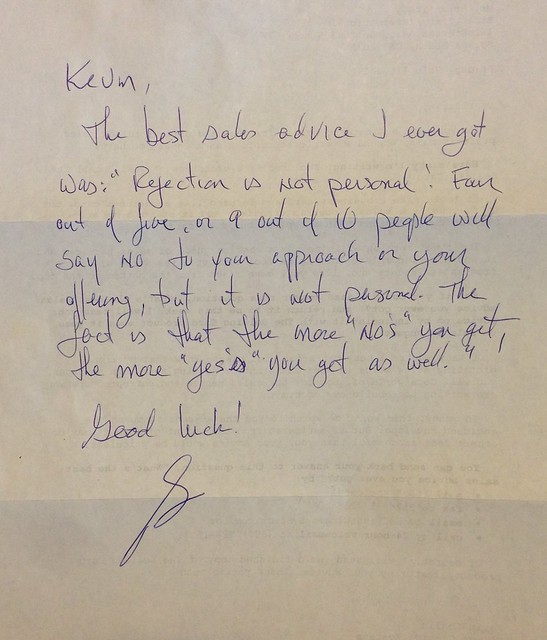
It reads:
Brian's advice is, of course, spot on. It's easy to get down when sales are slow. I've been there. You, too? But by plowing through more No's, you will invariably get more Yes's. Coming from Brian Tracy, this idea should motivate you to keep going.
And by answering my question with a handwritten note, he proved something else that he once said: The higher up you go in any organization of value, the nicer the people are.
What will you do with this sales advice from Brian?
Meanwhile, are you an entrepreneur with clients, not customers? Are you doing at least $200,000 in revenue, and want to do better? If so ...
... I can show you more "profit hacks" like the ones you just read in this article. Get them in my next Free Video Training Session. It's for $200k entrepreneurs ONLY, please.
Grab your spot here
Can't make that event? My FREE Client Cloning Kit can help. It's not some cheapo download -- this is a real business-building kit you can hold in your hands. Grab yours now, while you can.
Last week, I wrote Brian Tracy asking him, "What's the best sales advice you ever got?" He was kind enough to send the handwritten reply below ...
It reads:
Kevin,
The best sales advice I ever got was: Rejection is not personal! Four out of five, or 9 of 10 people will say No to your approach or your offering, but it is not personal. The fact is that the more "No's" you get, the more "Yes's" you get as well.
Good luck!
Brian
Brian's advice is, of course, spot on. It's easy to get down when sales are slow. I've been there. You, too? But by plowing through more No's, you will invariably get more Yes's. Coming from Brian Tracy, this idea should motivate you to keep going.
And by answering my question with a handwritten note, he proved something else that he once said: The higher up you go in any organization of value, the nicer the people are.
What will you do with this sales advice from Brian?
Meanwhile, are you an entrepreneur with clients, not customers? Are you doing at least $200,000 in revenue, and want to do better? If so ...
... I can show you more "profit hacks" like the ones you just read in this article. Get them in my next Free Video Training Session. It's for $200k entrepreneurs ONLY, please.
Grab your spot here
Can't make that event? My FREE Client Cloning Kit can help. It's not some cheapo download -- this is a real business-building kit you can hold in your hands. Grab yours now, while you can.
Thursday, September 5, 2013
The 30-Second, 6-Figure Marketing Idea
If your marketing depends on one-shot promotions, a sales letter mailed once, or a single email blast, it’s just like this little broom ...

... and you will find it very difficult to sweep up profits.
By contrast, if your marketing has at least 3 steps built into every promotion -- if you "touch" every prospect at least 3 times with your sales letters, postcards, emails, or phone calls, it's just like this broom ...

... and you will find it relatively easy to sweep up profits.
Idea: Stop with the one-shot promotions. Unless you enjoy drudgery and feast-or-famine when it comes to cash flow.
Instead, be systematic. Use multiple steps -- at least 3. And sweep up more profits in your business.
This idea is worth at least 6 figures to you ... but only if you use it.
And, if you want to put an end to "feast or famine" syndrome in your business, my free Client Cloning Kit can help. Grab your free copy now, while they last.

... and you will find it very difficult to sweep up profits.
By contrast, if your marketing has at least 3 steps built into every promotion -- if you "touch" every prospect at least 3 times with your sales letters, postcards, emails, or phone calls, it's just like this broom ...

... and you will find it relatively easy to sweep up profits.
Idea: Stop with the one-shot promotions. Unless you enjoy drudgery and feast-or-famine when it comes to cash flow.
Instead, be systematic. Use multiple steps -- at least 3. And sweep up more profits in your business.
This idea is worth at least 6 figures to you ... but only if you use it.
And, if you want to put an end to "feast or famine" syndrome in your business, my free Client Cloning Kit can help. Grab your free copy now, while they last.
Tuesday, September 3, 2013
How to Avoid Being Commoditized
Here's a guest post from my client and ace sales trainer, Terry Slattery.
Read it and reap -- sales gains, that is ...
One day, a salesman client moped into my office. He had lost his biggest customer -- who had been with him for 10 years -- over a 3-cent price difference. He pleaded, “How do I win them back?”
I said, "Answer this question: ‘What's going to happen to whom because they are not buying cinnamon from you, and how will that affect their life?’”
First, background: A new purchasing agent had called my client, saying: “I understand you've been providing us great service for 10 years. But you charge 3 cents a pound more for the same cinnamon I can get anywhere. Out of respect for our relationship, I want to give you the chance to match that lower price before I move the business.”
The salesman started talking about service and support. Then freshness and quality. But, like a broken record, the buyer kept coming back to 3 cents a pound … 3 cents a pound. And the business was lost.
Turns out, my client never mentioned his big Differentiating Value (D.V.): Time to market. This salesman, who nearly has a PhD in food science, told me, “In exchange for charging a slight premium on cinnamon, I shared my expertise with their R&D department. Without my help, they estimate it will take at least 3 weeks longer to get a product to market.”
When I asked what those 3 weeks meant in terms of money, he said, “About $80,000 in daily sales. Three weeks are $1.6 million. And they roll out about 6 products a year. All told, it’s about an opportunity cost of about $10 million.”
I asked, “Who feels that $10-million loss? It’s sure not the purchasing department.”
He thought for a moment, then said, “It’s the brand manager.” I asked him, “Do you even know their name?” “No,” he replied. And I said, “That’s fascinating because that is your real customer.”
A strange look came over my client’s face. He said, “I thought I was selling cinnamon. But what I’m really selling is 3 weeks.”
This story has a happy ending. I advised him to call the brand manager and leave a voicemail, which resulted in a rapid return call -- and my client winning back the account.
Your Takeaway: No matter what you sell, you face the curse of commoditization … unless you get absolutely clear on your D.V., then communicate it to the customer who matters -- which may be a different customer than the one you’re selling to.
To get clear on your D.V. -- and get the script for the startling voicemail message that helped my client win back that lost account, contact Terry Slattery at his website.
And, if you want to put an end to "feast or famine" syndrome in your business, my free Client Cloning Kit can help. Grab your free copy now, while they last.
Read it and reap -- sales gains, that is ...
One day, a salesman client moped into my office. He had lost his biggest customer -- who had been with him for 10 years -- over a 3-cent price difference. He pleaded, “How do I win them back?”
I said, "Answer this question: ‘What's going to happen to whom because they are not buying cinnamon from you, and how will that affect their life?’”
First, background: A new purchasing agent had called my client, saying: “I understand you've been providing us great service for 10 years. But you charge 3 cents a pound more for the same cinnamon I can get anywhere. Out of respect for our relationship, I want to give you the chance to match that lower price before I move the business.”
The salesman started talking about service and support. Then freshness and quality. But, like a broken record, the buyer kept coming back to 3 cents a pound … 3 cents a pound. And the business was lost.
Turns out, my client never mentioned his big Differentiating Value (D.V.): Time to market. This salesman, who nearly has a PhD in food science, told me, “In exchange for charging a slight premium on cinnamon, I shared my expertise with their R&D department. Without my help, they estimate it will take at least 3 weeks longer to get a product to market.”
When I asked what those 3 weeks meant in terms of money, he said, “About $80,000 in daily sales. Three weeks are $1.6 million. And they roll out about 6 products a year. All told, it’s about an opportunity cost of about $10 million.”
I asked, “Who feels that $10-million loss? It’s sure not the purchasing department.”
He thought for a moment, then said, “It’s the brand manager.” I asked him, “Do you even know their name?” “No,” he replied. And I said, “That’s fascinating because that is your real customer.”
A strange look came over my client’s face. He said, “I thought I was selling cinnamon. But what I’m really selling is 3 weeks.”
This story has a happy ending. I advised him to call the brand manager and leave a voicemail, which resulted in a rapid return call -- and my client winning back the account.
Your Takeaway: No matter what you sell, you face the curse of commoditization … unless you get absolutely clear on your D.V., then communicate it to the customer who matters -- which may be a different customer than the one you’re selling to.
To get clear on your D.V. -- and get the script for the startling voicemail message that helped my client win back that lost account, contact Terry Slattery at his website.
And, if you want to put an end to "feast or famine" syndrome in your business, my free Client Cloning Kit can help. Grab your free copy now, while they last.
Tuesday, August 27, 2013
There Is NO Business Problem That Can't Be Solved With This
"There's got to be a better way!"
Sound familiar?
If you're like me, you've said (screamed?) the following at least once about your business:
Fortunately, for almost every business I know of, there's one way to do all 3 of the above -- and a whole lot more.
What's the answer?
A sales letter.
The late, great marketing genius Gary Halbert once said, "There is no business problem that can't be solved with a really good sales letter." And he was right.
Case in point: My client, Ryan.
After the departure of his business partner, he was facing a potential loss in income ... hours spent banging the phones to sell his service ... loads of frustration.
In a word, problems.
But I solved those problems for him. With a simple sales letter.
To the tune of $250,000.
In 7 days.
How did we do it?
Read my interview with Ryan below and discover for yourself the truth in this statement: "There is no business problem that can't be solved with a really good sales letter."
Kevin: Tell us about your business. What do you do?
Ryan: I own a real estate investment company that buys houses through the mail. I’ve been doing it for about 9 years and the last 3 months have just been the most amazing turnaround that I’ve seen. It’s been pretty amazing and I have you to thank for it, but we can get into that in just a minute.
Kevin: What was going on before we started working together?
Ryan: When I first got started in the business I used to go out to people’s homes and sit in their living room and try to negotiate with them and that was a tremendous waste of time.
So I got a business partner and for the last three and a half years, when we decided to stop meeting with people in their homes, we switched to doing it all over the phone. We would send them something in the mail to get them to pick up the phone and call and we negotiated with them over the phone and tried to buy the houses that way. It was me and my business partner and we made it work. But it was very labor intensive.
Kevin: So, it was labor intensive. Now, what motivated you to seek me out to write a sales letter for you? Were you hoping to clone your selling process and turn it into a sales letter somehow?
Ryan: I recently split from my business partner, and he was the phone guy. I hate being on the phone. I’m not a good negotiator and I acknowledge and recognize that. My job in our partnership was to make the phone ring; his job was to talk on it. I know that it’s not my strength and when we parted ways I realized that I had to replace him pretty quickly and I was not going to be the one to do that.
I figured it seemed like the logical step was to replace him with a more automated process, with sales letters -- trying to do what he did over the phone through the mail.
Kevin: So you were trying to fill a really big hole in your business.
Ryan: It really was. Of course, I had my reservations, but because you came so highly recommended by Craig Simpson, I knew that if my idea was going to work, you were the guy to make it happen. And I’m really excited about the results that I’m having.
Kevin: Yes, so let’s talk about that. The big question is, have we been able to automate your selling and put some money in the bank?
Ryan: Yes, you are one of my favorite people in the world right now, because after we started testing the sales letter that you worked on, the phone started to ring, people started to call with stuff for sale, and it started to work automatically -- what we used to do with a lot of manual labor over the phone.
Seven days ago I got an offer accepted from a guy -- I did no negotiating with him. He got your package in the mail, he called and said yes, and I think we’re closing on that one tomorrow morning. I’m going to make $115,000 on that deal. That’s pretty amazing. Even I’m just in a little bit of a state of shock over that right now.
Then, yesterday was a Monday and at 8:30 in the morning I got not one but two sellers who had received your sales package last week. I didn’t have to negotiate with them on the phone, I didn’t have to talk to them, they got your package, and they were both calling to accept first thing on a Monday. I mean what a great way to start a week.
So in the last seven days I’ve got $250,000 in cash and equity that are lined up as a result of the work that we’ve done with you. So it’s money well spent.
Kevin: Fantastic. Ryan, thank you so much for sharing your story. !
Like all good stories, this one has a moral. And it's this: One really good sales letter can change your life, just like Ryan's.
One sales letter can deliver your best selling message by mail to your prospects and clients, while you do other things.
It can bring you all the leads and new clients you can handle ... get them to keep buying again and again ... bring back “lost” clients ... even give you an endless stream of referrals.
And it doesn't matter what product or service you sell. Heck, if you can buy and sell homes by mail, you can buy and sell pretty much ANYTHING by mail.
Think about it. A sales letter never calls in sick. Never takes a day off. Never asks for a raise. Never complains about commissions. And it never quits on you.
That's the power of one really good sales letter. Food for thought.
And, to learn more about how I do that for entrepreneurs across America, you should first grab my Free Client Cloning Kit, here.
Sound familiar?
If you're like me, you've said (screamed?) the following at least once about your business:
- There's got to be a better way to get more clients!
- There's got to be a better way to sell more of my products/services!
- There's got to be a better way to use my time!
Fortunately, for almost every business I know of, there's one way to do all 3 of the above -- and a whole lot more.
What's the answer?
A sales letter.
The late, great marketing genius Gary Halbert once said, "There is no business problem that can't be solved with a really good sales letter." And he was right.
Case in point: My client, Ryan.
After the departure of his business partner, he was facing a potential loss in income ... hours spent banging the phones to sell his service ... loads of frustration.
In a word, problems.
But I solved those problems for him. With a simple sales letter.
To the tune of $250,000.
In 7 days.
How did we do it?
Read my interview with Ryan below and discover for yourself the truth in this statement: "There is no business problem that can't be solved with a really good sales letter."
Kevin: Tell us about your business. What do you do?
Ryan: I own a real estate investment company that buys houses through the mail. I’ve been doing it for about 9 years and the last 3 months have just been the most amazing turnaround that I’ve seen. It’s been pretty amazing and I have you to thank for it, but we can get into that in just a minute.
Kevin: What was going on before we started working together?
Ryan: When I first got started in the business I used to go out to people’s homes and sit in their living room and try to negotiate with them and that was a tremendous waste of time.
So I got a business partner and for the last three and a half years, when we decided to stop meeting with people in their homes, we switched to doing it all over the phone. We would send them something in the mail to get them to pick up the phone and call and we negotiated with them over the phone and tried to buy the houses that way. It was me and my business partner and we made it work. But it was very labor intensive.
Kevin: So, it was labor intensive. Now, what motivated you to seek me out to write a sales letter for you? Were you hoping to clone your selling process and turn it into a sales letter somehow?
Ryan: I recently split from my business partner, and he was the phone guy. I hate being on the phone. I’m not a good negotiator and I acknowledge and recognize that. My job in our partnership was to make the phone ring; his job was to talk on it. I know that it’s not my strength and when we parted ways I realized that I had to replace him pretty quickly and I was not going to be the one to do that.
I figured it seemed like the logical step was to replace him with a more automated process, with sales letters -- trying to do what he did over the phone through the mail.
Kevin: So you were trying to fill a really big hole in your business.
Ryan: It really was. Of course, I had my reservations, but because you came so highly recommended by Craig Simpson, I knew that if my idea was going to work, you were the guy to make it happen. And I’m really excited about the results that I’m having.
Kevin: Yes, so let’s talk about that. The big question is, have we been able to automate your selling and put some money in the bank?
Ryan: Yes, you are one of my favorite people in the world right now, because after we started testing the sales letter that you worked on, the phone started to ring, people started to call with stuff for sale, and it started to work automatically -- what we used to do with a lot of manual labor over the phone.
Seven days ago I got an offer accepted from a guy -- I did no negotiating with him. He got your package in the mail, he called and said yes, and I think we’re closing on that one tomorrow morning. I’m going to make $115,000 on that deal. That’s pretty amazing. Even I’m just in a little bit of a state of shock over that right now.
Then, yesterday was a Monday and at 8:30 in the morning I got not one but two sellers who had received your sales package last week. I didn’t have to negotiate with them on the phone, I didn’t have to talk to them, they got your package, and they were both calling to accept first thing on a Monday. I mean what a great way to start a week.
So in the last seven days I’ve got $250,000 in cash and equity that are lined up as a result of the work that we’ve done with you. So it’s money well spent.
Kevin: Fantastic. Ryan, thank you so much for sharing your story. !
Like all good stories, this one has a moral. And it's this: One really good sales letter can change your life, just like Ryan's.
One sales letter can deliver your best selling message by mail to your prospects and clients, while you do other things.
It can bring you all the leads and new clients you can handle ... get them to keep buying again and again ... bring back “lost” clients ... even give you an endless stream of referrals.
And it doesn't matter what product or service you sell. Heck, if you can buy and sell homes by mail, you can buy and sell pretty much ANYTHING by mail.
Think about it. A sales letter never calls in sick. Never takes a day off. Never asks for a raise. Never complains about commissions. And it never quits on you.
That's the power of one really good sales letter. Food for thought.
And, to learn more about how I do that for entrepreneurs across America, you should first grab my Free Client Cloning Kit, here.
Monday, July 22, 2013
The Best Sale is the One Not Made
The Chinese military sage Lao Tzu never said anything about selling. But if he did, he might have said this: "The best sale is the one not made."
In other words, the easiest, most-profitable sales happen when your current clients buy from you again OR they send you a hot, pre-qualified referral.
In either case, little or no selling is required on your part. So, anything you can do to encourage repurchases and referrals is an extremely valuable activity.
Here are 3 ways to do it:
1. Surprise gifts
What do you deliver, in person or by email/snail mail, to pleasantly surprise your best clients?
Nothing? Uh-oh. Fix that. Start by mailing a simple, hand written (or at least hand-signed) thank-you note.
2. Welcome package
What can you do to make sure new clients get the most from their relationship with you?
Here's a hint: Think of all the questions new clients usually ask. Now answer them in writing. Then send that "how to" guide to clients along with their first purchase. Clients will appreciate your thoughtfulness and get better results -- two ways to ensure a repurchase or referral.
3. Something extra
Beyond any surprise gift or welcome package, what can you do for clients that will delight them?
I like to send my best clients books or book summaries every few months. Such gifts are unexpected -- and appreciated.
Don't have the time or money to mail your clients gifts? You can at least email them links to helpful articles, with the message: "Saw this, thought of you."
Bottom line: The best sale is the one not made. Anything you can do to "sell without selling" -- by fostering repurchases and referrals -- is among the very best uses of your time.
Meanwhile, if you want to put an end to "feast or famine" syndrome in your business, my free Client Cloning Kit can help. Grab your free copy now, while they last.
In other words, the easiest, most-profitable sales happen when your current clients buy from you again OR they send you a hot, pre-qualified referral.
In either case, little or no selling is required on your part. So, anything you can do to encourage repurchases and referrals is an extremely valuable activity.
Here are 3 ways to do it:
1. Surprise gifts
What do you deliver, in person or by email/snail mail, to pleasantly surprise your best clients?
Nothing? Uh-oh. Fix that. Start by mailing a simple, hand written (or at least hand-signed) thank-you note.
2. Welcome package
What can you do to make sure new clients get the most from their relationship with you?
Here's a hint: Think of all the questions new clients usually ask. Now answer them in writing. Then send that "how to" guide to clients along with their first purchase. Clients will appreciate your thoughtfulness and get better results -- two ways to ensure a repurchase or referral.
3. Something extra
Beyond any surprise gift or welcome package, what can you do for clients that will delight them?
I like to send my best clients books or book summaries every few months. Such gifts are unexpected -- and appreciated.
Don't have the time or money to mail your clients gifts? You can at least email them links to helpful articles, with the message: "Saw this, thought of you."
Bottom line: The best sale is the one not made. Anything you can do to "sell without selling" -- by fostering repurchases and referrals -- is among the very best uses of your time.
Meanwhile, if you want to put an end to "feast or famine" syndrome in your business, my free Client Cloning Kit can help. Grab your free copy now, while they last.
Wednesday, June 26, 2013
How Do I Close More Business?
Here's a question from entrepreneurs and business owners that I hear all the time: How do I close more business?
Wait, stop.
I hate the verb "close" in a selling context. It makes it seem like your job is over once the prospect gives you their credit card number or hands you a check.
Nothing could be further from the truth, of course. As any sales pro will tell you, the real work begins only after the prospect says, "Yes." You're not closing a sale, you're opening a relationship (if you have any brains).
So, let's rephrase the question: How do I earn more sales and open more relationships?
That's better. And here are 3 steps to help you do it ...
1) Use the right words
I'm a big fan of sales scripts. By scripts, I mean proven responses to objections, like: "It costs too much," or "I want to think it over."
Every multi-million dollar actor uses a script. So do multi-billion dollar credit card companies, banks, and other smart businesses whose employees have to sell by phone.
What do they know that you don't? Why keep winging it when it comes to your livelihood?
There's no good reason NOT to use a sales script, whether it's on the phone or in person.
The good news is, if you’ve ever made a sale and can write down what you said, you have the basis for a life-changing sales script. It all starts when you "can and clone" that first collection of winning words.
And I'll even give you the words to use as a basis for your first sales script. Ready? Just ask, "How were you hoping I could help you?"
Whatever comes out of your prospect's mouth in answer to that question will tell you what they want. Your job becomes very simple at that point: Tell them how you will deliver.
This is a great place to start any sales conversation -- and earn more sales.
2) Deliver overwhelming value
This is a stumbling block for loads of people. But it's easier than it seems. You simply have to find out the dollar value of the problem(s) you solve. Then, keep adding it up until the prospect feels compelled to buy.
Here's an example. Let's say you sell software that boosts efficiency. On average, you save 15 minutes every working hour for the people who use your software.
Those people earn $40,000 per year, or $20 an hour. If your software saves them 150 minutes a week, that adds up to 7,500 minutes (125 hours) saved a year, or $2,500 in annual savings ... $5,000 in two years.
You can then tell prospects, "If, for an investment of $495 today, you save $5,000 in two years, you've just earned a return on investment of 910%. You're really buying money at a discount here. And I don't think even Warren Buffett can top those numbers."
That changes the conversation, doesn't it?
3) Guarantee your results
When you make it risk-free to buy from you, more people will buy.
Guarantees have been used by mail-order companies for decades. Companies like L.L. Bean and J. Peterman are hugely successful today, but they were once small businesses. Their profits grew from a trickle into a mighty torrent because customers knew they could buy without the fear of being stuck with an item they didn’t like. Strong guarantees and quality products are an unbeatable combination.
Yet, guarantees frighten many business owners. If you’re like most, it might only take five or six big refunds or major revisions in a year to spell financial trouble. What if your clients called their friends and all started asking for refunds at once? What if word got out around that your business was an easy target for crooked people who could rip you off?
The way I see it, you already have a guarantee -- you just don’t know it.
It's like this: If a client called to complain, what would you do? Offer to redo or replace the work, probably. Because it’s better to satisfy one angry client now than to combat a lot of bad word-of-mouth later.
Especially when you consider that, thanks to social media, your clients all have audiences. And bad news travels fast. So, really, you need to satisfy your clients. And a guarantee makes it all possible.
So there you go. Three ways to earn more sales -- and open more relationships.
Meanwhile, if you want to put an end to "feast or famine" syndrome in your business, my free Client Cloning Kit can help. Grab your free copy now, while they last.
Wait, stop.
I hate the verb "close" in a selling context. It makes it seem like your job is over once the prospect gives you their credit card number or hands you a check.
Nothing could be further from the truth, of course. As any sales pro will tell you, the real work begins only after the prospect says, "Yes." You're not closing a sale, you're opening a relationship (if you have any brains).
So, let's rephrase the question: How do I earn more sales and open more relationships?
That's better. And here are 3 steps to help you do it ...
1) Use the right words
I'm a big fan of sales scripts. By scripts, I mean proven responses to objections, like: "It costs too much," or "I want to think it over."
Every multi-million dollar actor uses a script. So do multi-billion dollar credit card companies, banks, and other smart businesses whose employees have to sell by phone.
What do they know that you don't? Why keep winging it when it comes to your livelihood?
There's no good reason NOT to use a sales script, whether it's on the phone or in person.
The good news is, if you’ve ever made a sale and can write down what you said, you have the basis for a life-changing sales script. It all starts when you "can and clone" that first collection of winning words.
And I'll even give you the words to use as a basis for your first sales script. Ready? Just ask, "How were you hoping I could help you?"
Whatever comes out of your prospect's mouth in answer to that question will tell you what they want. Your job becomes very simple at that point: Tell them how you will deliver.
This is a great place to start any sales conversation -- and earn more sales.
2) Deliver overwhelming value
This is a stumbling block for loads of people. But it's easier than it seems. You simply have to find out the dollar value of the problem(s) you solve. Then, keep adding it up until the prospect feels compelled to buy.
Here's an example. Let's say you sell software that boosts efficiency. On average, you save 15 minutes every working hour for the people who use your software.
Those people earn $40,000 per year, or $20 an hour. If your software saves them 150 minutes a week, that adds up to 7,500 minutes (125 hours) saved a year, or $2,500 in annual savings ... $5,000 in two years.
You can then tell prospects, "If, for an investment of $495 today, you save $5,000 in two years, you've just earned a return on investment of 910%. You're really buying money at a discount here. And I don't think even Warren Buffett can top those numbers."
That changes the conversation, doesn't it?
3) Guarantee your results
When you make it risk-free to buy from you, more people will buy.
Guarantees have been used by mail-order companies for decades. Companies like L.L. Bean and J. Peterman are hugely successful today, but they were once small businesses. Their profits grew from a trickle into a mighty torrent because customers knew they could buy without the fear of being stuck with an item they didn’t like. Strong guarantees and quality products are an unbeatable combination.
Yet, guarantees frighten many business owners. If you’re like most, it might only take five or six big refunds or major revisions in a year to spell financial trouble. What if your clients called their friends and all started asking for refunds at once? What if word got out around that your business was an easy target for crooked people who could rip you off?
The way I see it, you already have a guarantee -- you just don’t know it.
It's like this: If a client called to complain, what would you do? Offer to redo or replace the work, probably. Because it’s better to satisfy one angry client now than to combat a lot of bad word-of-mouth later.
Especially when you consider that, thanks to social media, your clients all have audiences. And bad news travels fast. So, really, you need to satisfy your clients. And a guarantee makes it all possible.
So there you go. Three ways to earn more sales -- and open more relationships.
Meanwhile, if you want to put an end to "feast or famine" syndrome in your business, my free Client Cloning Kit can help. Grab your free copy now, while they last.
Friday, June 7, 2013
3 Ways to Get a Bunch More Sales: Part Three
Here's the third and final in a series of postings to help you grow your business faster.
To recap, we're talking about 3 ways to get a bunch more sales:
1) Raise your rates
When sales are down, the first instinct for many business owners is to lower their prices.
You, too? The temptation is strong. Resist it. Better: Do the opposite -- raise your rates when sales are slow.
Here are two quick ways to charge more:
1. Raise your level of service along with your prices. What can you add to your current offerings, to justify a higher price? More time with you on the phone or in person? Expanded options?
2. Go after clients who can pay more. Got clients who are penny-pinchers? Dump them. People who can afford to pay more are also easier to work with, by and large. Bargain shoppers can nibble you to death with endless questions and complaints, in my experience (yours too?).
In most cases, higher prices are more of a barrier in your mind than in the client's. But, as with all new ideas, test higher prices on a small scale before rolling out big.
2) Show appreciation
When you show your clients how much you appreciate them, they will return the favor with increased loyalty, repeat sales, and referrals, to name but 3 ways.
How can you do it?
3) Train people to send you referrals
First, find out which clients are sending you the most referrals
Then, find out exactly what they say when recommending your business to others. Yes, that means you pick up the phone, call them, and ask.
Then what? Capture and clone their words. That means you write a short script based on what your top-referring clients are saying when they recommend your business to others.
This is worth repeating: Write a referral script using the words your clients say about you -- NOT what you think they say or think they ought to say. Stick to reality.
Then, train your other clients to use that same, proven script. In your post-sale letters, emails, and conversations with clients, tell them ...
If your clients are NOT referring you, you have bigger issues to deal with to fix that situation ...
That's all for this week. I hope you've found this 3-part series helpful in growing your business.
Meanwhile, if you want to more clients like your best clients, my free Client Cloning Kit can help. Grab your free copy now, while they last.
To recap, we're talking about 3 ways to get a bunch more sales:
- attract more prospects,
- convert more of them to clients, and
- sell more to them
1) Raise your rates
When sales are down, the first instinct for many business owners is to lower their prices.
You, too? The temptation is strong. Resist it. Better: Do the opposite -- raise your rates when sales are slow.
Here are two quick ways to charge more:
1. Raise your level of service along with your prices. What can you add to your current offerings, to justify a higher price? More time with you on the phone or in person? Expanded options?
2. Go after clients who can pay more. Got clients who are penny-pinchers? Dump them. People who can afford to pay more are also easier to work with, by and large. Bargain shoppers can nibble you to death with endless questions and complaints, in my experience (yours too?).
In most cases, higher prices are more of a barrier in your mind than in the client's. But, as with all new ideas, test higher prices on a small scale before rolling out big.
2) Show appreciation
When you show your clients how much you appreciate them, they will return the favor with increased loyalty, repeat sales, and referrals, to name but 3 ways.
How can you do it?
- Write and mail thank-you notes
- Hold a free client appreciation event, at a restaurant or JV partner's location
- Send Thanksgiving cards (everyone sends Christmas cards -- they mean nothing)
- Mail a monthly "client's only" newsletter
3) Train people to send you referrals
First, find out which clients are sending you the most referrals
Then, find out exactly what they say when recommending your business to others. Yes, that means you pick up the phone, call them, and ask.
Then what? Capture and clone their words. That means you write a short script based on what your top-referring clients are saying when they recommend your business to others.
This is worth repeating: Write a referral script using the words your clients say about you -- NOT what you think they say or think they ought to say. Stick to reality.
Then, train your other clients to use that same, proven script. In your post-sale letters, emails, and conversations with clients, tell them ...
Do you like us? Please tell your friends! Here's what to say: "I found this bank where the loan officer actually knows my name and understands my business. And she gave me some great tips on marketing to help build my business, too. You should call Suzy Smith and tell her I sent you."If your clients are already referring you, find out what they're saying, and train the rest of your clients to say the same thing.
If your clients are NOT referring you, you have bigger issues to deal with to fix that situation ...
That's all for this week. I hope you've found this 3-part series helpful in growing your business.
Meanwhile, if you want to more clients like your best clients, my free Client Cloning Kit can help. Grab your free copy now, while they last.
Wednesday, June 5, 2013
3 Ways to Get a Bunch More Sales: Part Two
Here's the second in a series of postings to help you grow your business faster.
To recap, we're talking about 3 ways to get a bunch more sale:
If you want to convert more prospects, 3 of the easiest and most effective methods are:
1. Change the game by changing the words
Look around. Most of your competitors' websites and advertisements probably offer Free Consultations, Free Information, and Price Quotes. You may be tempted to fall in line and do the same. Don't.
Because, if you want be noticed by more people, you have to stand out. That means you have to be different in some way. Let all your competitors look like apples. You can be the only coconut in town.
One of the easiest ways to do it is to use different words to describe what you do.
Example: Instead of a Free Consultation, offer a Free Gap Analysis, a No-Cost Strategy Session, etc.
Instead of Free Information, offer a Free Client Cloning Kit, a Free Savings Guide, etc.
Instead of Price Quotes, send prospects Project Briefs, New Revenue Outlines, etc.
Best part: You don't have to change what you do to change the game and be different. Just change the words.
2. Be useful
Few prospects will buy from you on the the first contact. They usually want to learn more about you, your industry, and their options before buying. That means you have to follow up with them.
You can be a pest, like most of your competitors, who email or call to say, "I'm just following up ... just checking in ... just seeing if you had any questions." Bleh.
Instead, do this: Be useful to prospects.
I first learned this idea in 2009, in Dan Sullivan's Strategic Coach program.
According to Sullivan, if you can bring confidence and clarity to people in your network, by researching their needs and then offering something useful -- product news, information about their customers, access to your contacts, expertise, etc. -- people will make time to talk to you. Because they will see you as an oasis in today's desert of awful economic news.
As a result, people will take your calls, read your emails, meet you for coffee ... and be more likely to do business with you.
3. Follow a sales script
By script, I mean proven responses to tough objections, like: "I can't afford it," or "I want to think about it."
At this point, you may be rolling your eyes. "I don't want to sound like a telemarketer," you think. Or, "I have to be flexible with every caller," or "Scripts don't work anymore."
Baloney. You're already using scripts -- right now.
Anytime a prospect asks you, "How much does it cost?" or "What's your guarantee?" and you reply with an answer you've used before, that's a sales script.
Why keep winging it? Why not plan and practice your words? There's no valid reason NOT to use a proven sales script, whether it's on the phone with a prospect or in person.
The good news is, if you’ve ever made a sale and can write down what you said, you have the basis for a million-dollar book of scripts. It all starts when you "can and clone" that first collection of winning words.
If you're worried about sounding stiff, here's a simple solution: practice your scripts, just like an actor.
And I'll even give you the words to use as a basis for your first sales script: How were you hoping I could help you?
Ask that question at the start of every sales call and watch your sales increase. Because it prompts prospects to cut to the chase and tell you what attracted them to your business in the first place. This is a great place to start any sales conversation -- and convert more prospects.
Stay tuned for part 3 of this 3-part series tomorrow, when I’ll show you how to sell more to the clients you already have.
Meanwhile, if you want to more clients like your best clients, my free Client Cloning Kit can help. Grab your free copy now, while they last.
To recap, we're talking about 3 ways to get a bunch more sale:
- attract more prospects,
- convert more of them to clients, and
- sell more to them
If you want to convert more prospects, 3 of the easiest and most effective methods are:
1. Change the game by changing the words
Look around. Most of your competitors' websites and advertisements probably offer Free Consultations, Free Information, and Price Quotes. You may be tempted to fall in line and do the same. Don't.
Because, if you want be noticed by more people, you have to stand out. That means you have to be different in some way. Let all your competitors look like apples. You can be the only coconut in town.
One of the easiest ways to do it is to use different words to describe what you do.
Example: Instead of a Free Consultation, offer a Free Gap Analysis, a No-Cost Strategy Session, etc.
Instead of Free Information, offer a Free Client Cloning Kit, a Free Savings Guide, etc.
Instead of Price Quotes, send prospects Project Briefs, New Revenue Outlines, etc.
Best part: You don't have to change what you do to change the game and be different. Just change the words.
2. Be useful
Few prospects will buy from you on the the first contact. They usually want to learn more about you, your industry, and their options before buying. That means you have to follow up with them.
You can be a pest, like most of your competitors, who email or call to say, "I'm just following up ... just checking in ... just seeing if you had any questions." Bleh.
Instead, do this: Be useful to prospects.
I first learned this idea in 2009, in Dan Sullivan's Strategic Coach program.
According to Sullivan, if you can bring confidence and clarity to people in your network, by researching their needs and then offering something useful -- product news, information about their customers, access to your contacts, expertise, etc. -- people will make time to talk to you. Because they will see you as an oasis in today's desert of awful economic news.
As a result, people will take your calls, read your emails, meet you for coffee ... and be more likely to do business with you.
3. Follow a sales script
By script, I mean proven responses to tough objections, like: "I can't afford it," or "I want to think about it."
At this point, you may be rolling your eyes. "I don't want to sound like a telemarketer," you think. Or, "I have to be flexible with every caller," or "Scripts don't work anymore."
Baloney. You're already using scripts -- right now.
Anytime a prospect asks you, "How much does it cost?" or "What's your guarantee?" and you reply with an answer you've used before, that's a sales script.
Why keep winging it? Why not plan and practice your words? There's no valid reason NOT to use a proven sales script, whether it's on the phone with a prospect or in person.
The good news is, if you’ve ever made a sale and can write down what you said, you have the basis for a million-dollar book of scripts. It all starts when you "can and clone" that first collection of winning words.
If you're worried about sounding stiff, here's a simple solution: practice your scripts, just like an actor.
And I'll even give you the words to use as a basis for your first sales script: How were you hoping I could help you?
Ask that question at the start of every sales call and watch your sales increase. Because it prompts prospects to cut to the chase and tell you what attracted them to your business in the first place. This is a great place to start any sales conversation -- and convert more prospects.
Stay tuned for part 3 of this 3-part series tomorrow, when I’ll show you how to sell more to the clients you already have.
Meanwhile, if you want to more clients like your best clients, my free Client Cloning Kit can help. Grab your free copy now, while they last.
Thursday, March 7, 2013
How to Love Marketing, Sales, and Cold Calling
Do you hate marketing?
How about selling?
Or networking?
If you answered "Yes" at all, you really meant NO.
That's because what you really hate is how bad you feel when people reject you.
When it comes to building your business, "we hate the feeling that we may experience if we don't get the positive outcome that we're looking for," according to author and coach John Assaraf.
Assaraf tells of a mentor handing him a sheet of paper when he first started in real estate sales. That paper had 100 boxes on it; within each box was the figure $15.
Assaraf was told, "Every time you speak to someone when you're prospecting and they say, 'No,' you just made 15 bucks. Can you live with that?"
The rationale was this: To make a sale and earn a $1,500 commission required about 100 conversations with prospects. And it worked. Brilliantly. Assaraf says he started to associate making calls with earning $15 per conversation.
He re-framed selling so that he no longer took rejection personally. As a result, he felt better about prospecting ... he made more calls ... made more sales -- and earned a ton of money.
So, why not try this yourself and re-frame your marketing and sales?
Do this ...
1) Determine how much an average sale is worth to you. Let's say, $3,000
2) Determine how many contacts you need to make a sale. Let's say, 30 emails, conversations or other touches.
3) Divide your average sale by required contacts. So, $3,000 divided by 30 = $100. This number is how much every "No" is worth, because each "No" brings you closer to the one "Yes" you need for a sale.
4) Now, for extra motivation, create a spreadsheet with 30 boxes, each of which has $100 inside. Print it, check off a box every time you hear "No" ... and see what happens.
Meanwhile, if you want to put an end to "feast-or-famine" syndrome in your business, my free Client Cloning Kit can help. Grab your Free Kit here, while they last.
How about selling?
Or networking?
If you answered "Yes" at all, you really meant NO.
That's because what you really hate is how bad you feel when people reject you.
When it comes to building your business, "we hate the feeling that we may experience if we don't get the positive outcome that we're looking for," according to author and coach John Assaraf.
Assaraf tells of a mentor handing him a sheet of paper when he first started in real estate sales. That paper had 100 boxes on it; within each box was the figure $15.
Assaraf was told, "Every time you speak to someone when you're prospecting and they say, 'No,' you just made 15 bucks. Can you live with that?"
The rationale was this: To make a sale and earn a $1,500 commission required about 100 conversations with prospects. And it worked. Brilliantly. Assaraf says he started to associate making calls with earning $15 per conversation.
He re-framed selling so that he no longer took rejection personally. As a result, he felt better about prospecting ... he made more calls ... made more sales -- and earned a ton of money.
So, why not try this yourself and re-frame your marketing and sales?
Do this ...
1) Determine how much an average sale is worth to you. Let's say, $3,000
2) Determine how many contacts you need to make a sale. Let's say, 30 emails, conversations or other touches.
3) Divide your average sale by required contacts. So, $3,000 divided by 30 = $100. This number is how much every "No" is worth, because each "No" brings you closer to the one "Yes" you need for a sale.
4) Now, for extra motivation, create a spreadsheet with 30 boxes, each of which has $100 inside. Print it, check off a box every time you hear "No" ... and see what happens.
Meanwhile, if you want to put an end to "feast-or-famine" syndrome in your business, my free Client Cloning Kit can help. Grab your Free Kit here, while they last.
Wednesday, January 2, 2013
See and Sell - What Opportunties Are YOU Overlooking?
Do you own a wristwatch?
If so, you've probably looked at it hundreds of times, right?
It's always there, every day, right in front of your face.
Okay. Without looking, draw a quick picture of the watch face.
Why?
Because there's a big difference between looking and seeing.
You may LOOK at your watch several times a day, but you probably don't SEE it in any detail.
Now. Just like a wristwatch on your hand, there are opportunities in your business -- right in front of your face. You may look at them every day, but do you see them?
Take time this week to really SEE what's going on in your business:
Meanwhile ... if you want to put an end to "feast-or-famine" syndrome in your business, my free Client Cloning Kit can help you. Grab your copy here, while they last.
If so, you've probably looked at it hundreds of times, right?
It's always there, every day, right in front of your face.
Okay. Without looking, draw a quick picture of the watch face.
- What color is it?
- What kind of numbers -- Roman numerals or something else?
- Is there a date? If so, where?
Why?
Because there's a big difference between looking and seeing.
You may LOOK at your watch several times a day, but you probably don't SEE it in any detail.
Now. Just like a wristwatch on your hand, there are opportunities in your business -- right in front of your face. You may look at them every day, but do you see them?
Take time this week to really SEE what's going on in your business:
- Are there prospects who dropped off the face of the earth last year who might still need what you're selling? Why not review your database and SEE for yourself?
- Are there clients who've purchased once or twice from you, who would benefit from more? Why not email 3 clients and SEE for yourself?
- Can you bundle two or more products/services together and offer them at a special price? Why not promote this new bundle on your web site or newsletter and SEE for yourself?
- Etc. etc. etc.
Meanwhile ... if you want to put an end to "feast-or-famine" syndrome in your business, my free Client Cloning Kit can help you. Grab your copy here, while they last.
Subscribe to:
Posts (Atom)