Do you own a business?
If so, be careful.
Because your business may be bossing you around ... and costing you money.
Here's the story ...
I once overheard a discussion about strategy and tactics, between a boss and an employee. It went like this:
Boss: "Me strategy. You tactics. Me say. You do."
Employee: "Okay, boss."
Now, look at your calendar for last week. How much boss work did you do? And how much employee work?
If you own a business, you get paid the big bucks for doing boss work. Everything else is employee work ... which pays less.
You need to decide what's going to happen, who's going to do it, and by when. That's strategy -- boss work.
Answering email, updating your website, paying bills, those are tactics -- employee work.
And every minute you spend on that, you're under-paying yourself.
In the book, It's a Brand New Game, by Michael Patterson, Richard Branson says: "Try and find people to take over 99 percent of what you do, which will then free you up to think about the bigger picture."
So: You do boss work, strategy. Let employees do tactics.
If you found these ideas helpful, claim your Free Client Cloning Kit here.
Showing posts with label innovation. Show all posts
Tuesday, September 17, 2019
Are You the Boss of Your Business?
Labels:
innovation,
marketing strategies,
productivity
Monday, September 9, 2019
How to Grow Your Business by Listening
Alfred Fuller went from semi-literate farm boy to multi-millionaire in just over 10 years.
It all began in 1906. With a $375 investment, he started the Fuller Brush Company in Hartford, CT, selling brushes door to door.
You can learn a lot from his story, which you'll find in the book, The Supersalesmen. On page 28 it says:
"Almost entirely, the ideas that resulted in the steady growth of his business came from customers. Alfred Fuller's genius lay in his ability to elicit information about cleaning problems from the women of Hartford and then to solve the problems they posed, giving the ladies one new product after another."
By 1919, Fuller Brush sales were over $1 million -- that's $14,334,848 in today's dollars.
Bottom line: Your clients can make you rich. All you have to do is listen to what their problems are. Then give them solutions.
And if you found these ideas helpful, please request your Free Client Cloning Kit at my website
Labels:
back-end selling,
customer retention,
innovation,
marketing
How to Get New Money-Making Ideas
Eugene Schwartz, the copywriting legend almost nobody knows, said, "You don't need to have great ideas if you hear great ideas."
Among his many blockbusters was the sales letter that launched Boardroom Publications.
He interviewed his client, and simply took notes for 4 hours straight. The resulting sales letter was 70-80% the client’s own words. Here's the headline to that sales letter, which birth to a $100-million dollar business: "How to Get the Heart of 370 Business Magazines in Just 30 Minutes a Month."
Best part: Schwartz didn't even create it. He heard it, then wrote it down.
Here’s another example: My client Ryan.
I wrote a 12-page sales letter for him a few years ago that was mostly his own words.
Here's the headline I wrote for him, a mashup of several things he said over the phone: “Discover How to Set Yourself Free From Rental Property Headaches And Get The Money You Deserve.”
Ryan quickly raked in close to $1 million from that letter.
And his success was predictable. Because I simply heard his great ideas. The wrote them down.
You can do the same.
One last thing. If you found these ideas helpful, please request your Free Client Cloning Kit at my website
https://www.clientcloningsystems.com/
Among his many blockbusters was the sales letter that launched Boardroom Publications.
He interviewed his client, and simply took notes for 4 hours straight. The resulting sales letter was 70-80% the client’s own words. Here's the headline to that sales letter, which birth to a $100-million dollar business: "How to Get the Heart of 370 Business Magazines in Just 30 Minutes a Month."
Best part: Schwartz didn't even create it. He heard it, then wrote it down.
Here’s another example: My client Ryan.
I wrote a 12-page sales letter for him a few years ago that was mostly his own words.
Here's the headline I wrote for him, a mashup of several things he said over the phone: “Discover How to Set Yourself Free From Rental Property Headaches And Get The Money You Deserve.”
Ryan quickly raked in close to $1 million from that letter.
And his success was predictable. Because I simply heard his great ideas. The wrote them down.
You can do the same.
One last thing. If you found these ideas helpful, please request your Free Client Cloning Kit at my website
https://www.clientcloningsystems.com/
Tuesday, July 2, 2013
Addition by Subtraction: Are You Choking Your Profits?
Many of the biggest breakthroughs in businesses have come from subtraction.
Examples:
That's the good news.
The bad news? In your business, YOU are a limiting factor -- right now.
Here's why: Any process that requires your time or your physical presence is a limiting factor. Because in any workweek, there are only so many suits you can sew, pictures you can paint, cakes you can bake.
If you are "doing the thing" in your business, you are a choke point.
So answer this key question: How could you subtract yourself from your business and scale up to serve more people, more profitably?
Example: If you provide a service, the logical "subtraction" is to turn what you do into a product. Top consultants, like Seth Godin and Tom Peters, do this all the time -- they write books.
Stated differently: What could you write, film, record, or otherwise put in a box that would remove your from your business processes and let you scale up?
The answer to that question is your shortcut to growth.
Meanwhile, if you want to put an end to "feast or famine" syndrome in your business, my free Client Cloning Kit can help. Grab your free copy now, while they last.
Examples:
- Subtract bank tellers from a bank and you get ATM machines
- Subtract travel from out-of-town meetings and you get GoToMeeting.com
- Subtract stamps from mail and you get email
That's the good news.
The bad news? In your business, YOU are a limiting factor -- right now.
Here's why: Any process that requires your time or your physical presence is a limiting factor. Because in any workweek, there are only so many suits you can sew, pictures you can paint, cakes you can bake.
If you are "doing the thing" in your business, you are a choke point.
So answer this key question: How could you subtract yourself from your business and scale up to serve more people, more profitably?
Example: If you provide a service, the logical "subtraction" is to turn what you do into a product. Top consultants, like Seth Godin and Tom Peters, do this all the time -- they write books.
Stated differently: What could you write, film, record, or otherwise put in a box that would remove your from your business processes and let you scale up?
The answer to that question is your shortcut to growth.
Meanwhile, if you want to put an end to "feast or famine" syndrome in your business, my free Client Cloning Kit can help. Grab your free copy now, while they last.
Friday, June 28, 2013
Remarkable Marketing via Remarkable Delivery
There are lots of ways to be remarkable -- to cause your clients to remark about you to others, and feed your business via word of mouth advertising.
One way is to follow this advice from Walt Disney: “What ever you do, do it well. Do it so well that when people see you do it they will want to come back and see you do it again and they will want to bring others and show them how well you do what you do.”
But apart from doing what you do remarkably well, you can deliver it remarkably well.
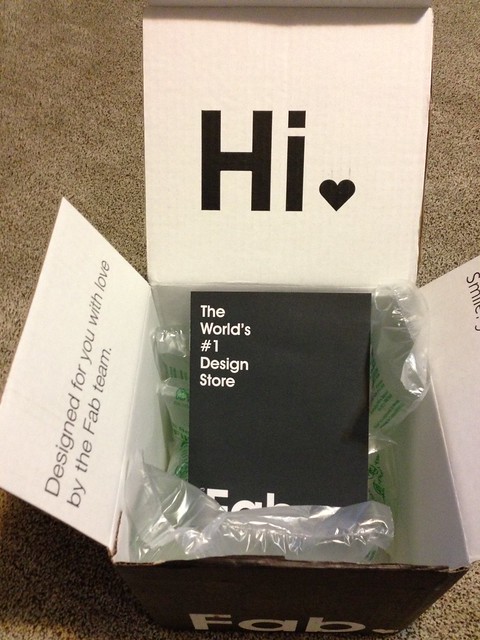
Case in point: this box from Fab.
It contained a birthday gift from my wife. The gift itself (a waterproof shower notepad) is remarkable. But I was in a good mood even before using it, thanks to this box, with the surprising messages and mini-catalog included.
So, it's a fine thing to do what you do remarkably well. I aim for that daily. I'm sure you do, too.
But if you're not remarkable yet, or you're looking for an extra advantage, try delivering what you do remarkably well.
Meanwhile, if you want to put an end to "feast or famine" syndrome in your business, my free Client Cloning Kit can help. Grab your free copy now, while they last.
One way is to follow this advice from Walt Disney: “What ever you do, do it well. Do it so well that when people see you do it they will want to come back and see you do it again and they will want to bring others and show them how well you do what you do.”
But apart from doing what you do remarkably well, you can deliver it remarkably well.
Case in point: this box from Fab.
It contained a birthday gift from my wife. The gift itself (a waterproof shower notepad) is remarkable. But I was in a good mood even before using it, thanks to this box, with the surprising messages and mini-catalog included.
So, it's a fine thing to do what you do remarkably well. I aim for that daily. I'm sure you do, too.
But if you're not remarkable yet, or you're looking for an extra advantage, try delivering what you do remarkably well.
Meanwhile, if you want to put an end to "feast or famine" syndrome in your business, my free Client Cloning Kit can help. Grab your free copy now, while they last.
Monday, June 24, 2013
Positively More Profits
Here’s how to apply Harvard research and $8,000 worth of advice in a way that’s free, fun, and very profitable ...
Shawn Achor, Harvard Professor of Positive Psychology and Author of The Happiness Advantage, writes that, every time our brain records a success, we move the goalposts ... which is a recipe for frustration. according to Achor:
Get that? You can double the impact a positive experience has on your brain and get happier. No drugs or technology needed.
I’ve verified that a happy brain is a profitable brain -- and I paid $8,000 to do it.
When I was a client in Dan Sullivan’s Strategic Coach program, participants like me gladly paid an $8,000 annual membership to fly to Toronto 4 times a year, sit in a room, and plan the next quarter of growth for our companies.
And the first exercise we did at every meeting was what Dan called a Positive Focus. It worked like this: We wrote down 5 things that were going well in our business. Then we shared those “wins” with the other entrepreneurs at our table. By putting our brains in a positive mood, this set the stage for a productive day full of profitable insights. Every time.
No matter what's going on in the world, you can control your attitude and make it nearly 100% positive, if you follow this advice.
That little trick, frankly, is worth the $8,000 fee, plus airfare, hotel, and other costs, that I paid to learn it from Dan Sullivan.
Why? Think about it.
What was the last really good idea you had for your business -- the last new thing you did that produced a new client, created a new product, or led to a new referral? Over the lifetime of your business, will that good idea turn out to be worth $8,000 or more? Chances are, the answer is yes. (If not, start thinking bigger!)
Here's the thing: You almost certainly were NOT depressed or down about life when you got your last valuable idea. You were probably relaxed -- even happy. You may have been driving, enjoying a walk, or taking a shower.
In any case, the bottom line is this: A happy, positive mind is a profitable mind. An unhappy, negative mind is not.
To jumpstart your mind and grow your business, spend just two minutes at the start of each day writing down 5 positive experiences from the last 24 hours. The results will positively shock you.
Meanwhile, if you want to put an end to "feast or famine" syndrome in your business, my free Client Cloning Kit can help. Grab your free copy now, while they last.
Shawn Achor, Harvard Professor of Positive Psychology and Author of The Happiness Advantage, writes that, every time our brain records a success, we move the goalposts ... which is a recipe for frustration. according to Achor:
“Get good grades? Then you need to get into a better school so you can get a better job. Hit your sales target? They raise your sales target. Maybe once we retire rich, we can be happy. Thus, happiness remains elusive.Achor suggests that every day, you take two minutes to “log and describe in detail the most meaningful experience of the past 24 hours. Research shows this doubles the impact of the experience on your brain and increases your happiness.”
“Our brains work the opposite way. A positive brain has a unique advantage over a negative or stressed one. Intelligence improves, sales rise 37 percent and productivity increases 31 percent. In fact, a happy brain improves every business and educational outcome, and many of our health outcomes like longevity and fatigue.
“But embedded within this research is this revelation: You can train your brain to raise your level of happiness. Even one quick, daily positive exercise for as little as three weeks can make an impact on your happiness.”
Get that? You can double the impact a positive experience has on your brain and get happier. No drugs or technology needed.
I’ve verified that a happy brain is a profitable brain -- and I paid $8,000 to do it.
When I was a client in Dan Sullivan’s Strategic Coach program, participants like me gladly paid an $8,000 annual membership to fly to Toronto 4 times a year, sit in a room, and plan the next quarter of growth for our companies.
And the first exercise we did at every meeting was what Dan called a Positive Focus. It worked like this: We wrote down 5 things that were going well in our business. Then we shared those “wins” with the other entrepreneurs at our table. By putting our brains in a positive mood, this set the stage for a productive day full of profitable insights. Every time.
No matter what's going on in the world, you can control your attitude and make it nearly 100% positive, if you follow this advice.
That little trick, frankly, is worth the $8,000 fee, plus airfare, hotel, and other costs, that I paid to learn it from Dan Sullivan.
Why? Think about it.
What was the last really good idea you had for your business -- the last new thing you did that produced a new client, created a new product, or led to a new referral? Over the lifetime of your business, will that good idea turn out to be worth $8,000 or more? Chances are, the answer is yes. (If not, start thinking bigger!)
Here's the thing: You almost certainly were NOT depressed or down about life when you got your last valuable idea. You were probably relaxed -- even happy. You may have been driving, enjoying a walk, or taking a shower.
In any case, the bottom line is this: A happy, positive mind is a profitable mind. An unhappy, negative mind is not.
To jumpstart your mind and grow your business, spend just two minutes at the start of each day writing down 5 positive experiences from the last 24 hours. The results will positively shock you.
Meanwhile, if you want to put an end to "feast or famine" syndrome in your business, my free Client Cloning Kit can help. Grab your free copy now, while they last.
Tuesday, June 18, 2013
More with Less is More
Many of the most game-changing, profitable innovations in business involve doing more with less. A removal of something. Addition by subtraction.
Examples: less time (Domino's Pizza), less hassle (Google), less money (Wal-Mart), less frustration (FedEx), etc.
When you can remove unwanted things, and make life simpler and easier for people, they will reward you by becoming your customers.
The classic example is anything from Apple vs. anything from Microsoft.
Think of Apple Pages vs. Microsoft Word ... an iPod vs. a Zune ... a MacBook vs. a Windows laptop ... you get the idea. With an Apple product, you push the button and it works. With Microsoft, you must find the button, then push it, then download a driver, then scan for viruses, then ... wait, what was I doing?
So, the next time you're tempted to "innovate" and create a new, whiz-bang product or service with all the bells and whistles, stop. Think less. It could be worth more to you. A lot more.
Meanwhile, if you want to more clients like your best clients, my free Client Cloning Kit can help. Grab your free copy now, while they last.
Examples: less time (Domino's Pizza), less hassle (Google), less money (Wal-Mart), less frustration (FedEx), etc.
When you can remove unwanted things, and make life simpler and easier for people, they will reward you by becoming your customers.
The classic example is anything from Apple vs. anything from Microsoft.
Think of Apple Pages vs. Microsoft Word ... an iPod vs. a Zune ... a MacBook vs. a Windows laptop ... you get the idea. With an Apple product, you push the button and it works. With Microsoft, you must find the button, then push it, then download a driver, then scan for viruses, then ... wait, what was I doing?
So, the next time you're tempted to "innovate" and create a new, whiz-bang product or service with all the bells and whistles, stop. Think less. It could be worth more to you. A lot more.
Meanwhile, if you want to more clients like your best clients, my free Client Cloning Kit can help. Grab your free copy now, while they last.
Monday, November 12, 2012
The Strange Profit-Boosting Idea from Ikea
I like Ikea. So does my family.
We go there several times a year to ... eat.
Oh, and we also spend $100 or so on the way out the door.
Let me explain ...
You know Ikea as a quirky, cool, low-cost furniture store.
But I hate shopping, for furniture -- or pretty much anything.
So I know Ikea as a quirky, cool, low-cost restaurant. I love their smoked salmon and Swedish apple pie with coffee for Sunday brunch. Yum.
And when I take the family there to eat, we have to walk past approximately 10,000 household items for sale on the way to the exit. The chances that we'll spend $100 or more are approximately 100%.
Ikea is smart. Back in 1960, they added an unrelated product -- food -- to their retail store, and found that "visitors stay in the store longer and buy more."
Like my family and me.
Question: What unrelated product or service could you add to your current offerings to make clients stay with you longer and buy more?
I won't give you any ideas. Instead, brainstorm 5-10 on your own and give your marketing muscles a workout.
Meanwhile ... if you want to put an end to "feast-or-famine" syndrome in your business, a free Client Cloning Kit can help. Grab your copy here.
We go there several times a year to ... eat.
Oh, and we also spend $100 or so on the way out the door.
Let me explain ...
You know Ikea as a quirky, cool, low-cost furniture store.
But I hate shopping, for furniture -- or pretty much anything.
So I know Ikea as a quirky, cool, low-cost restaurant. I love their smoked salmon and Swedish apple pie with coffee for Sunday brunch. Yum.
And when I take the family there to eat, we have to walk past approximately 10,000 household items for sale on the way to the exit. The chances that we'll spend $100 or more are approximately 100%.
Ikea is smart. Back in 1960, they added an unrelated product -- food -- to their retail store, and found that "visitors stay in the store longer and buy more."
Like my family and me.
Question: What unrelated product or service could you add to your current offerings to make clients stay with you longer and buy more?
I won't give you any ideas. Instead, brainstorm 5-10 on your own and give your marketing muscles a workout.
Meanwhile ... if you want to put an end to "feast-or-famine" syndrome in your business, a free Client Cloning Kit can help. Grab your copy here.
Tuesday, September 25, 2012
The $120,000 Brainstorming Technique
The other day, I got an idea worth at least $100,000.
Want to know what it is?
I can't tell you.
What the idea is, I mean. Because it's so lucrative and easy to do that my competitors would copy it before 5:00 today.
But ... though I can't tell you WHAT the six-figure idea is, I'm happy to tell you HOW I got it.
Who knows? It might be worth six figures to you, too.
Still want to know what it is?
It's this: The next time you get stuck trying to solve a problem, pick up a pen.
Here's the story ...
Last Thursday morning, I was sitting in the lobby at Victory Auto in Chanhassen, waiting for my car to get a tuneup. (Victory Auto does AWESOME work at great prices, by the way -- free plug for those guys :-)
Anyway, I had been brainstorming on my laptop for solutions to a vexing problem. For more than 30 minutes, I was pounding away at the keyboard. Idea after idea came flowing out ... all of them crappy.
Eric, the manager, walked up and said that my car was done. So I closed up my laptop and got ready to leave.
Two minutes later, Eric came back to apologize -- my car would take another 15 minutes to fix.
"No problem," I said. "I can still do my work."
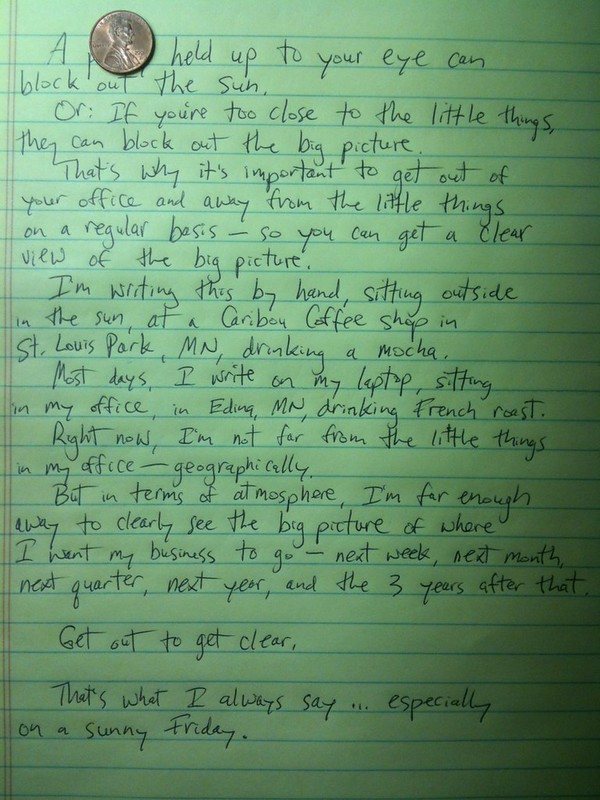
Not wanting to fire up the laptop again, I grabbed a scratch pad of paper, like the one in the picture above.
I started brainstorming solutions to the same problem, but this time on paper -- doodling, scribbling, and jotting down ideas with a pen.
In 15 minutes, I had sketched out a new business unit worth about $120,000 a year. That was Thursday.
I opened that business unit on Friday morning and had my first conversation with a prospect on Friday afternoon.
The first order came in on Monday.
So, yeah, it's a pretty good idea. That's why the picture above is not of the actual doodle sheet with the actual idea. (It's now in a safe deposit box in my closet.)
But you can have the process behind that six-figure idea free and clear. The process is this: To get different ideas, move different muscles.
If you keep using the same muscles to think -- your fingers tapping the same way on the same keyboard -- you may keep getting the same ideas.
Instead, grab a pen and paper, and move different muscles -- by writing out your ideas longhand. You know, like back in grade school, when everybody told you how creative you were. You still are creative, but life in a cubicle or chained to a desk may have caused some of those creative muscles to atrophy.
Get away from the desk. Grab a pen and paper. Move different muscles. Get different ideas.
Meanwhile ... if you want to put an end to "feast-or-famine" syndrome in your business, grab your free Client Cloning Kit here.
Tuesday, September 11, 2012
Monday, August 6, 2012
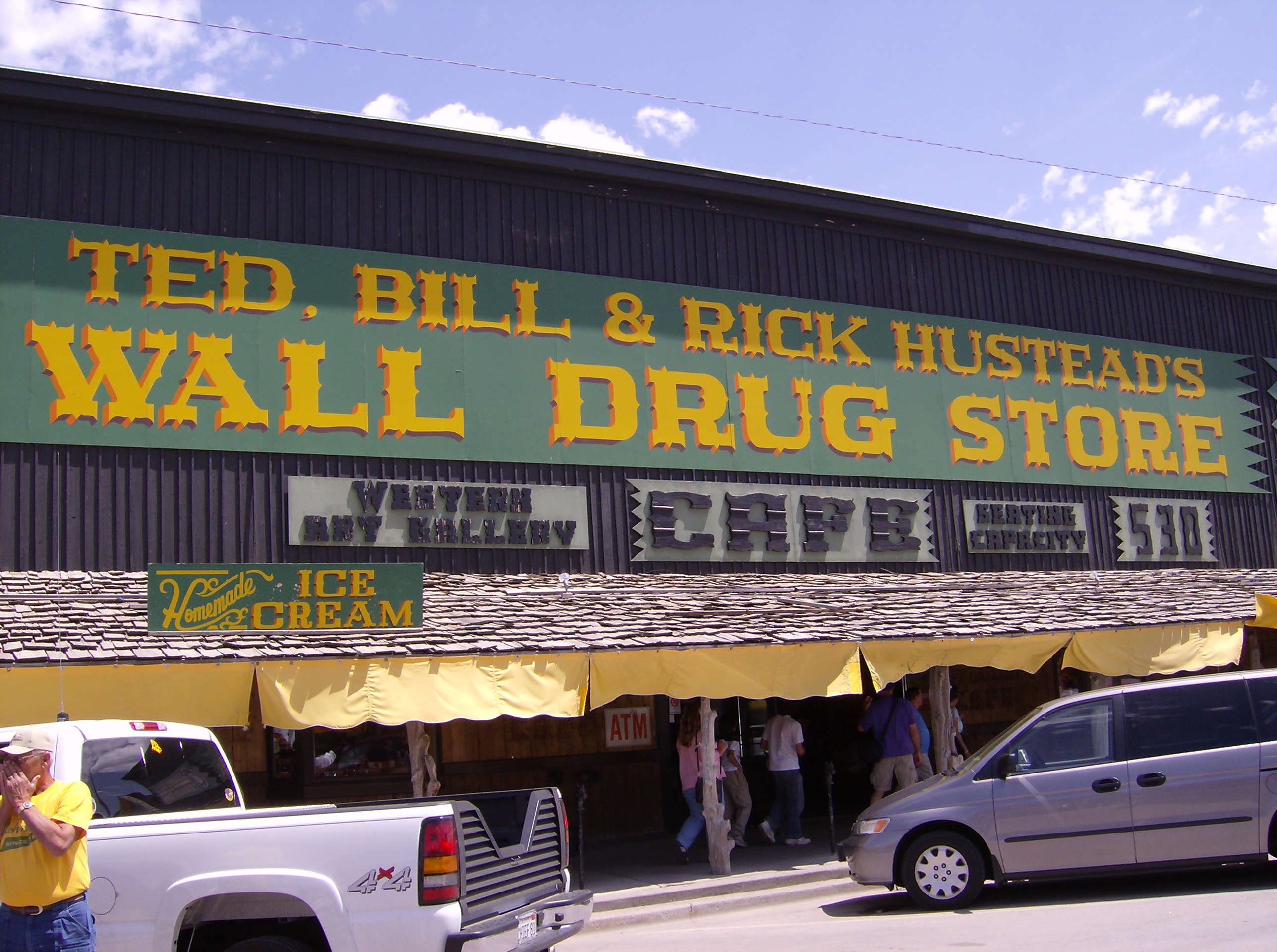
Free Can Save Your Business: The Marketing Genius of Wall Drug
While on vacation with my family last week to camp in the Black Hills of South Dakota, I saw billboards along I-90 for Wall Drug.
A lot of billboards ...
According to one source, Wall Drug spends an estimated $400,000 on billboard signs every year, with over 500 miles of them along Interstate 90 from Minnesota to Montana.
You may think those signs are kitschy and a bit annoying. They are.
But did you know the fascinating back story of Wall Drug?
Today it's described by The New York Times as "a sprawling tourist attraction of international renown [that] takes in more than $10 million a year and draws some two million annual visitors to a remote town."
But it began in 1931 as a small, struggling drug store, in the depths of the Depression.
What saved Wall Drug and helped turn it into the $10-million success it is today?
Free ice water.
According to owner Ted Hustead's story in Guideposts magazine:
The day after Ted Hustead died in 1999, the governor of South Dakota lauded him as "a guy that figured out that free ice water could turn you into a phenomenal success in the middle of a semi-arid desert way out in the middle of someplace."
So, what's the bottom line here?
This: No matter how bad things may seem in your business, you may be one idea from the breakthrough you need to thrive. You may be sitting on that idea right now, as the Husteads were with ice and water.
Perhaps all you need do is give something away to attract and endear yourself to your ideal customers, as the Husteads did.
In any case, if you're reading this, you have more advantages, resources, and tools at your disposal than the Husteads could have ever dreamed of. They turned "certain" defeat into a multi-million dollar success with just one good idea and persistent marketing.
Why not you, too?
Resource: Speaking of free, if you want to put an end to "feast-or-famine" syndrome in your business, the free Client Cloning Kit can help. Grab your copy here.
A lot of billboards ...
According to one source, Wall Drug spends an estimated $400,000 on billboard signs every year, with over 500 miles of them along Interstate 90 from Minnesota to Montana.
You may think those signs are kitschy and a bit annoying. They are.
But did you know the fascinating back story of Wall Drug?
Today it's described by The New York Times as "a sprawling tourist attraction of international renown [that] takes in more than $10 million a year and draws some two million annual visitors to a remote town."
But it began in 1931 as a small, struggling drug store, in the depths of the Depression.
What saved Wall Drug and helped turn it into the $10-million success it is today?
Free ice water.
According to owner Ted Hustead's story in Guideposts magazine:
By the time the summer of 1936 came around, our business hadn't grown much at all. Our five-year trial would be up in December. What would we do then? Along with nine-year-old Billy, Dorothy and I now had a one-month-old daughter, Mary Elizabeth. What hardships was I putting them in store for?Nowadays, that struggling drug store looks like this:
One hot Sunday in July, though, a great change swept us up. It started quietly, in the deadening heat of an early afternoon, when Dorothy said to me, "You don't need me here, Ted. I'm going to put Billy and the baby down for a nap and maybe take one myself."
I minded the empty store. I swatted flies with a rolled-up newspaper. I stood in the door, and no matter where I looked, there was no shade, because the sun was so high and fierce.
An hour later Dorothy came back.
"Too hot to sleep?" I asked.
"No, it wasn't the heat that kept me awake," Dorothy said. "It was all the cars going by on Route 16A. The jalopies just about shook the house to pieces."
"That's too bad," I said.
"No, because you know what, Ted? I think I finally saw how we can get all those travelers to come to our store."
"And how's that?" I asked.
"Well, now what is it that those travelers really want after driving across that hot prairie? They're thirsty. They want water. Ice cold water! Now we've got plenty of ice and water. Why don't we put up signs on the highway telling people to come here for free ice water? Listen, I even made up a few lines for the sign:
"Get a soda . . . Get a root beer . . . turn next corner . . . Just as near . . . To Highway 16 & 14. . . Free Ice Water. . . Wall Drug."
It wasn't Wordsworth, but I was willing to give it a try. During the next few days a high school boy and I put together some signs. We modeled them after the old Burma Shave highway signs. Each phrase of Dorothy's little poem went on a 12 by 36 inch board. We'd space the boards out so the people could read them as they drove.
The next weekend the boy and I went out to the highway and put up our signs for free ice water. I must admit that I felt somewhat silly doing it, but by the time I got back to the store, people had already begun showing up for their ice water. Dorothy was running all around to keep up. I pitched in alongside her.
"Five glasses of ice water, please," a father called out.
"May I have a glass for Grandma?" a boy asked. "She's in the car."
We ran through our supply of cracked ice. I began chiseling more off the block.
"Say, good sir," one traveler said in a Scottish brogue, "we're going all the way to Yellowstone Park. Would you mind filling this jug with your water?"
"Hey this free ice water is a great idea," said a salesman, sidling up onto a stool. "How about selling me an ice cream cone?"
For hours we poured gallons of ice water, made ice cream cones and gave highway directions. When the travelers started on their way again, refreshed and ready for new adventures, they gave us hearty thanks.
When the day was done, Dorothy and I were pooped. We sat in front of the store, watching the sun set, feeling a cool breeze come in off the prairie. In the summer twilight, Wall looked radiant. It looked like a good place to call home.
"Well, Ted, " Dorothy said to me, "I guess the ice water signs worked."
They surely did work, and we've never really been lonely for customers since then. The next summer we had to hire eight girls to help us ....
The day after Ted Hustead died in 1999, the governor of South Dakota lauded him as "a guy that figured out that free ice water could turn you into a phenomenal success in the middle of a semi-arid desert way out in the middle of someplace."
So, what's the bottom line here?
This: No matter how bad things may seem in your business, you may be one idea from the breakthrough you need to thrive. You may be sitting on that idea right now, as the Husteads were with ice and water.
Perhaps all you need do is give something away to attract and endear yourself to your ideal customers, as the Husteads did.
In any case, if you're reading this, you have more advantages, resources, and tools at your disposal than the Husteads could have ever dreamed of. They turned "certain" defeat into a multi-million dollar success with just one good idea and persistent marketing.
Why not you, too?
Resource: Speaking of free, if you want to put an end to "feast-or-famine" syndrome in your business, the free Client Cloning Kit can help. Grab your copy here.
Labels:
innovation,
marketing,
marketing strategies,
sampling
Saturday, May 5, 2012
Want to See the Big Picture? Get Out
Tuesday, March 20, 2012
How to Create a Remarkable Experience
Want more revenues, more profits, and less competition?
Then you want to create an experience for your clients.
Sales and growth advisor Karen Jackson writes:
Your clients are too smart to be swayed by "experiences." Or not smart enough. Or too busy. Or too price conscious.
But are your clients people? Then experiences matter.
And is your product or service more complex than a popscicle? Then you can create a profitable, remarkable experience around it.
No joke. Popsicles are the ultimate commodity. Any 5-year-old can make and sell them. All you need are frozen juice and some sticks.
Yet ... you can make a popsicle that's remarkable -- an experience. One that inspires brand loyalty and word-of-mouth advertising.
How?
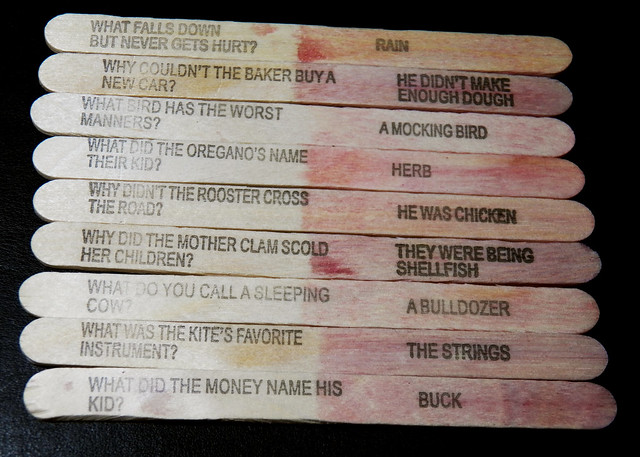
Add jokes. Like these ...
Cost to the manufacturer? Probably less than $0.01 in printing per stick. (And I don't think they pay any royalties for those jokes.)
But what's the effect of those little jokes? Big. They add an extra smile to a tasty treat. The jokes create an experience that's remarkable.
Here's proof: Last Thursday afternoon, my teenage daughter remarked, "We had popsicles after lacrosse practice, but they weren't so great. I wish we had those ones with jokes on the sticks."
That's the definition of remarkable -- people remarking about you. It's what you want your customers to do.
And you don't need a nine-figure marketing budget like Starbucks or a factory stamping out jokes on sticks to create an experience that makes your business remarkable.
Just add a smile to your clients' day today.
Bio: Kevin Donlin can help you grow your business and enjoy the breakthrough results your hard work deserves. If you're interested in boosting your revenues and profits, please click here.
Then you want to create an experience for your clients.
Sales and growth advisor Karen Jackson writes:
"... people (whether in the form of a consumer or a business) buy from those companies that make their experience delightful. It’s obvious that there’s no lack of coffee shops, but few coffee shops create a delightful experience.Now. You may be skeptical ...
"Enter Starbucks with all the ingredients to delight: well-trained & friendly staff, wi-fi, music, comfy chairs, a beautiful display case with fresh food, consistent quality. Customers came, they stayed, they returned, they told their friends."
Your clients are too smart to be swayed by "experiences." Or not smart enough. Or too busy. Or too price conscious.
But are your clients people? Then experiences matter.
And is your product or service more complex than a popscicle? Then you can create a profitable, remarkable experience around it.
No joke. Popsicles are the ultimate commodity. Any 5-year-old can make and sell them. All you need are frozen juice and some sticks.
Yet ... you can make a popsicle that's remarkable -- an experience. One that inspires brand loyalty and word-of-mouth advertising.
How?
Add jokes. Like these ...
Cost to the manufacturer? Probably less than $0.01 in printing per stick. (And I don't think they pay any royalties for those jokes.)
But what's the effect of those little jokes? Big. They add an extra smile to a tasty treat. The jokes create an experience that's remarkable.
Here's proof: Last Thursday afternoon, my teenage daughter remarked, "We had popsicles after lacrosse practice, but they weren't so great. I wish we had those ones with jokes on the sticks."
That's the definition of remarkable -- people remarking about you. It's what you want your customers to do.
And you don't need a nine-figure marketing budget like Starbucks or a factory stamping out jokes on sticks to create an experience that makes your business remarkable.
Just add a smile to your clients' day today.
Bio: Kevin Donlin can help you grow your business and enjoy the breakthrough results your hard work deserves. If you're interested in boosting your revenues and profits, please click here.
Thursday, December 22, 2011
Everything I Know About Creativity
Have you seen this book?
It's called, Everything Obama Knows About The Economy ...
... and it's 150 pages of blank text.
Get it?
Apparently, a lot of people got it.
Because, at the time of this writing, Everything Obama Knows About The Economy is getting a pantload of media attention -- and it's sold out on Amazon.
Now. Admit it. Love Obama or loathe him, don't you wish you had thought of this idea first?
Well, the "author," Jimmy Moncrief, didn't.
It turns out that this clever idea of selling a blank book is simply a new take on an old idea, dating back at least to 1995 ...
... when Everything Men Know About Women was published.
It, too, is an empty book.
And these two books illustrate everything I know about creativity, which is this: There are no really new ideas. Only new combinations of old ideas.
The blank book itself is, after all, just a "written" version of that kindergarten prank, the empty gift box.
So, when it comes to creating new ideas for your business, don't rack your brain too hard. Instead, look around for new combinations of old ideas.
Here are 3 examples that I've written about elsewhere:
1. Drive-thru windows at a restaurant
Introduced by In ‘n’ Out Burger, in 1948.
Where did the idea originate? The City Center Bank, Kansas City, MO, opened the first drive-thru window in 1928. By borrowing an old idea from banking, In ‘n’ Out Burger produced a breakthrough in fast food.
2. Chuck E. Cheese's restaurant
Founded by Nolan Bushnell in 1977.
Where did the idea of combining video games and food originate? Before opening a restaurant, Nolan Bushnell founded another company in 1972 -- Atari. So he didn't have far to look for inspiration.
3. Lady Jane’s Haircuts for Men
Founded in 2004, Lady Jane’s employs attractive female stylists to cut hair, surrounded by sports memorabilia on the walls and ESPN on plasma screen TVs.
I can’t prove it, but I'll bet you a haircut that Lady Jane’s is a new combination of two older ideas: Great Clips and Hooters.
What do you think?
Bio: Kevin Donlin can help you grow your business and enjoy the breakthrough results your hard work deserves. If you're interested in boosting your revenues and profits, please click here.
It's called, Everything Obama Knows About The Economy ...
... and it's 150 pages of blank text.
Get it?
Apparently, a lot of people got it.
Because, at the time of this writing, Everything Obama Knows About The Economy is getting a pantload of media attention -- and it's sold out on Amazon.
Now. Admit it. Love Obama or loathe him, don't you wish you had thought of this idea first?
Well, the "author," Jimmy Moncrief, didn't.
It turns out that this clever idea of selling a blank book is simply a new take on an old idea, dating back at least to 1995 ...
... when Everything Men Know About Women was published.
It, too, is an empty book.
And these two books illustrate everything I know about creativity, which is this: There are no really new ideas. Only new combinations of old ideas.
The blank book itself is, after all, just a "written" version of that kindergarten prank, the empty gift box.
So, when it comes to creating new ideas for your business, don't rack your brain too hard. Instead, look around for new combinations of old ideas.
Here are 3 examples that I've written about elsewhere:
1. Drive-thru windows at a restaurant
Introduced by In ‘n’ Out Burger, in 1948.
Where did the idea originate? The City Center Bank, Kansas City, MO, opened the first drive-thru window in 1928. By borrowing an old idea from banking, In ‘n’ Out Burger produced a breakthrough in fast food.
2. Chuck E. Cheese's restaurant
Founded by Nolan Bushnell in 1977.
Where did the idea of combining video games and food originate? Before opening a restaurant, Nolan Bushnell founded another company in 1972 -- Atari. So he didn't have far to look for inspiration.
3. Lady Jane’s Haircuts for Men
Founded in 2004, Lady Jane’s employs attractive female stylists to cut hair, surrounded by sports memorabilia on the walls and ESPN on plasma screen TVs.
I can’t prove it, but I'll bet you a haircut that Lady Jane’s is a new combination of two older ideas: Great Clips and Hooters.
What do you think?
Bio: Kevin Donlin can help you grow your business and enjoy the breakthrough results your hard work deserves. If you're interested in boosting your revenues and profits, please click here.
Friday, August 26, 2011
3 Small Ways to Boost Your Business in 15 Minutes
"The secret of getting ahead is getting started. The secret of getting started is breaking your complex overwhelming tasks into small manageable tasks, and then starting on the first one." - Mark Twain
If you're not happy with your marketing, the task of meeting your revenue goals may seem complex.
It may even overwhelm you to the point that you take little or no action. "What's the use?" you may think.
But Twain, who earned a fortune from his work, was exactly right: The secret of getting ahead is getting started.
What small, manageable marketing task could you get started on, right now? Now, as in NOW, before your next bathroom break?
Here's a list of 3 small marketing tasks to get you started ...
1) Pick up the phone and call your #1 client.
Ask how they're doing and what they're working on. Then ask if you can be of service somehow.
2) Mail a copy of a helpful article (magazine or newspaper) to your top 3 clients.
Include a handwritten message with each that says, "Saw this and thought of you." Sign it.
3) Call to interview your last happy client.
Ask how things have changed since whatever you did for them: How are they using your product or service, exactly? What has changed for the better, exactly? How much more time or money do they have as a result, exactly?
Ask if you can transcribe their comments to use -- with their name, city, and state -- in a "mini case study" on your web site or in your email newsletter.
Note: Doing any or all of the above tasks won't earn you a million bucks -- today.
But each will surprise and delight your clients. Each will give you a surge of endorphins. And completing any of these tasks will put you in motion toward your goals. (Are you moving now? In any direction?)
As Jim Collins and Jerry Porras, wrote in Built To Last:
Small tasks and little things can put you on the path to big results.
You'll find more ideas like these in my Free Report, Guaranteed Marketing.
If you're not happy with your marketing, the task of meeting your revenue goals may seem complex.
It may even overwhelm you to the point that you take little or no action. "What's the use?" you may think.
But Twain, who earned a fortune from his work, was exactly right: The secret of getting ahead is getting started.
What small, manageable marketing task could you get started on, right now? Now, as in NOW, before your next bathroom break?
Here's a list of 3 small marketing tasks to get you started ...
1) Pick up the phone and call your #1 client.
Ask how they're doing and what they're working on. Then ask if you can be of service somehow.
2) Mail a copy of a helpful article (magazine or newspaper) to your top 3 clients.
Include a handwritten message with each that says, "Saw this and thought of you." Sign it.
3) Call to interview your last happy client.
Ask how things have changed since whatever you did for them: How are they using your product or service, exactly? What has changed for the better, exactly? How much more time or money do they have as a result, exactly?
Ask if you can transcribe their comments to use -- with their name, city, and state -- in a "mini case study" on your web site or in your email newsletter.
Note: Doing any or all of the above tasks won't earn you a million bucks -- today.
But each will surprise and delight your clients. Each will give you a surge of endorphins. And completing any of these tasks will put you in motion toward your goals. (Are you moving now? In any direction?)
As Jim Collins and Jerry Porras, wrote in Built To Last:
With mottoes like Make A Little, Sell A Little and Take Small Steps, 3M understood that big things often evolve from little things. But since you can't tell ahead of time which little things will turn into big things, you have to try lots of little things, keep the ones that work, and discard the ones that don't...
Small tasks and little things can put you on the path to big results.
You'll find more ideas like these in my Free Report, Guaranteed Marketing.
Friday, August 12, 2011
Funnel Vision: Marketing Innovation Made Simple
Have you ever wondered where new ideas come from?
It may seem odd, but I believe there are really no new ideas -- only new combinations of old ideas.
The more creatively you assemble new combinations of old ideas, the bigger the breakthroughs you can produce. And this process of searching for material to create new combinations is called Funnel Vision.
Funnel vision is how one man turned cockle burrs, those annoying prickly things that stick to your pants when you walk in the woods, into velcro, a business innovation worth hundreds of millions of dollars.
Here are 3 examples of Funnel Vision in business. What marketing lessons can you draw from them?
1. Drive-thru window at a restaurant
First used by In 'n' Out Burger, in 1948.
Where did the idea originate? The City Center Bank, Kansas City, MO, opened the first drive-thru window in 1928.
By borrowing an idea from banking, In 'n' Out Burger produced a breakthrough in fast food.
2. Chuck E. Cheese's restaurant
Founded by Nolan Bushnell in 1977.
Where did the idea of combining games and food originate? Turns out, Nolan Bushnell founded another company in 1972 -- Atari. So he didn't have far to look for inspiration.
3. Lady Jane's Haircuts for Men
Founded in 2004, Lady Jane's employs attractive female stylists to cut hair, surrounded by sports memorabilia on the walls and ESPN on plasma screen TVs.
I can't prove it -- and this may land me in hot water -- but Lady Jane's is an obvious combination of Great Clips and Hooters.
So here's the point of all this: Stop looking for creative new ideas. Start looking for creative combinations of old ideas. That's Funnel Vision.
It may not be as sexy as pure creative brainstorming, but it can be profitable. And Funnel Vision can produce an endless stream of innovations for you, as it has for many others.
You'll find more ideas like these in my Free Report, Guaranteed Marketing.
It may seem odd, but I believe there are really no new ideas -- only new combinations of old ideas.
The more creatively you assemble new combinations of old ideas, the bigger the breakthroughs you can produce. And this process of searching for material to create new combinations is called Funnel Vision.
Funnel vision is how one man turned cockle burrs, those annoying prickly things that stick to your pants when you walk in the woods, into velcro, a business innovation worth hundreds of millions of dollars.
Here are 3 examples of Funnel Vision in business. What marketing lessons can you draw from them?
1. Drive-thru window at a restaurant
First used by In 'n' Out Burger, in 1948.
Where did the idea originate? The City Center Bank, Kansas City, MO, opened the first drive-thru window in 1928.
By borrowing an idea from banking, In 'n' Out Burger produced a breakthrough in fast food.
2. Chuck E. Cheese's restaurant
Founded by Nolan Bushnell in 1977.
Where did the idea of combining games and food originate? Turns out, Nolan Bushnell founded another company in 1972 -- Atari. So he didn't have far to look for inspiration.
3. Lady Jane's Haircuts for Men
Founded in 2004, Lady Jane's employs attractive female stylists to cut hair, surrounded by sports memorabilia on the walls and ESPN on plasma screen TVs.
I can't prove it -- and this may land me in hot water -- but Lady Jane's is an obvious combination of Great Clips and Hooters.
So here's the point of all this: Stop looking for creative new ideas. Start looking for creative combinations of old ideas. That's Funnel Vision.
It may not be as sexy as pure creative brainstorming, but it can be profitable. And Funnel Vision can produce an endless stream of innovations for you, as it has for many others.
You'll find more ideas like these in my Free Report, Guaranteed Marketing.
Monday, July 25, 2011
How to Strangle Clients for Fun and Money
According to Investopedia, a strangle is "an options strategy where the investor holds a position in both a call and put with different strike prices but with the same maturity and underlying asset."
In other words, a strangle position lets you make money whether the price goes up or down, like buying and selling the same stock.
It's a contradictory idea that savvy investors use to make money.
Now.
What contradictory ideas could you explore to make money in your business?
For example: How could you buy and sell your clients?
Well, you could "buy" clients by offering cash bounties to anyone who sends you a new client. I've done it for nearly 15 years.
And you could "sell" clients by doing joint ventures. Find a business you trust, one that offers something useful that you don't provide. Then, endorse that business to your clients in exchange for a share of revenue. I've done this for years, too.
Don't get me wrong. It is NOT okay (or legal) to "sell" your clients' personal data or "sell them out" by endorsing a piece of crap just to make a buck.
However, there's no limit to your success when you "buy" and "sell" clients effectively. It lets you enjoy both sides of the equation, just like a "strangle" in stock options.
What other contradictory ideas could you explore? What can you:
You'll find more ideas like these in my Free Report, Guaranteed Marketing.
In other words, a strangle position lets you make money whether the price goes up or down, like buying and selling the same stock.
It's a contradictory idea that savvy investors use to make money.
Now.
What contradictory ideas could you explore to make money in your business?
For example: How could you buy and sell your clients?
Well, you could "buy" clients by offering cash bounties to anyone who sends you a new client. I've done it for nearly 15 years.
And you could "sell" clients by doing joint ventures. Find a business you trust, one that offers something useful that you don't provide. Then, endorse that business to your clients in exchange for a share of revenue. I've done this for years, too.
Don't get me wrong. It is NOT okay (or legal) to "sell" your clients' personal data or "sell them out" by endorsing a piece of crap just to make a buck.
However, there's no limit to your success when you "buy" and "sell" clients effectively. It lets you enjoy both sides of the equation, just like a "strangle" in stock options.
What other contradictory ideas could you explore? What can you:
- give away and charge for?
- build and take down?
- repair and replace?
You'll find more ideas like these in my Free Report, Guaranteed Marketing.
Tuesday, July 12, 2011
Creative Ignorance -- a Good Thing?
You can't say a lot of good about ignorance.
Except when you're trying to solve a problem.
Example: Alexander Graham Bell invented the telephone -- because he didn't know any better.
Here's the story ...
In 1863, a German inventor, Hermann von Helmholtz, wrote a paper: "On the Sensations of Tone as a Physiological Basis for the Theory of Music."
Bell, reading a bad translation of the German, thought Von Helmholtz had invented a way to send vowel sounds over an electric wire.
But Von Helmholtz had only developed a theory, not a device.
So Bell pressed on -- blissfully ignorant -- with his own painstaking experiments to transmit human speech by wire.
He later said, according to Wikipedia, "I thought that Helmhotz had done it ... and that my failure was due only to my ignorance of electricity. It was a valuable blunder ... If I had been able to read German in those days, I might never have commenced my experiments!"
Now. What's considered "hard" or even "impossible" in your business?
How would you do solve that problem if you didn't know any better?
Write down the first 3-5 ideas that come to mind. And prepare to be surprised at the insights you get.
Note well: "creative ignorance" may not help you invent anything as earth-shattering as the telephone.
But, if you break an "impossible" problem into smaller parts, and attack each one as if you knew you couldn't fail ... you might just set your marketplace on its ear.
You'll find more ideas like these in my Free Report, Guaranteed Marketing.
Except when you're trying to solve a problem.
Example: Alexander Graham Bell invented the telephone -- because he didn't know any better.
| Alexander Graham Bell |
In 1863, a German inventor, Hermann von Helmholtz, wrote a paper: "On the Sensations of Tone as a Physiological Basis for the Theory of Music."
Bell, reading a bad translation of the German, thought Von Helmholtz had invented a way to send vowel sounds over an electric wire.
But Von Helmholtz had only developed a theory, not a device.
So Bell pressed on -- blissfully ignorant -- with his own painstaking experiments to transmit human speech by wire.
He later said, according to Wikipedia, "I thought that Helmhotz had done it ... and that my failure was due only to my ignorance of electricity. It was a valuable blunder ... If I had been able to read German in those days, I might never have commenced my experiments!"
Now. What's considered "hard" or even "impossible" in your business?
How would you do solve that problem if you didn't know any better?
Write down the first 3-5 ideas that come to mind. And prepare to be surprised at the insights you get.
Note well: "creative ignorance" may not help you invent anything as earth-shattering as the telephone.
But, if you break an "impossible" problem into smaller parts, and attack each one as if you knew you couldn't fail ... you might just set your marketplace on its ear.
You'll find more ideas like these in my Free Report, Guaranteed Marketing.
Tuesday, June 28, 2011
Stop Managing Your Time. Start Managing This
"Time isn't money. Time is everything." - Dr. Bernie Siegel
I used to love that quote.
And I still do.
But I don't agree 100% with it anymore ...
Yes, time is precious and limited to only 24 hours a day.
And, yes, how you use your time determines your results in business and in life.
Yet ... while we all get an equal amount of hours in a day, not all hours are created equal.
Some of us are morning people and perform at our peak before noon. Others are afternoon or evening people, and have more energy later in the day.
Which means that not every hour has equal value.
So, why not take advantage of your natural tendencies and schedule important tasks for when you have the most energy? This is like riding a horse in the direction it wants to go.
If you don't know when your hours of peak performance are, find out. Carry a voice recorder (your smart phone has one) or small notebook and record those times of day when you feel energized, as well as times when you feel sluggish.
Then, schedule your most-important activities during your peak-performance times.
You will find that when you manage your energy effectively, the hours take care of themselves -- you will get more done and build your business faster as a result.
Stop managing your time. Start managing your energy.
You'll find more ideas like these in my Free Report, Guaranteed Marketing.
I used to love that quote.
And I still do.
But I don't agree 100% with it anymore ...
Yes, time is precious and limited to only 24 hours a day.
And, yes, how you use your time determines your results in business and in life.
Yet ... while we all get an equal amount of hours in a day, not all hours are created equal.
Some of us are morning people and perform at our peak before noon. Others are afternoon or evening people, and have more energy later in the day.
Which means that not every hour has equal value.
So, why not take advantage of your natural tendencies and schedule important tasks for when you have the most energy? This is like riding a horse in the direction it wants to go.
If you don't know when your hours of peak performance are, find out. Carry a voice recorder (your smart phone has one) or small notebook and record those times of day when you feel energized, as well as times when you feel sluggish.
Then, schedule your most-important activities during your peak-performance times.
You will find that when you manage your energy effectively, the hours take care of themselves -- you will get more done and build your business faster as a result.
Stop managing your time. Start managing your energy.
You'll find more ideas like these in my Free Report, Guaranteed Marketing.
Monday, June 20, 2011
Funnel Vision Marketing: Free Toy Inside!
The other dog foods at Cub Foods were categorized by:- price (cheap to expensive),
- size (small to large), and
- ingredients (organic to super double organic).
Hard to sort through those dozens of choices.
But this was the only dog food with a Free Toy Inside. It was in a category of one.
Very easy to sort through one choice.
This is a fine example of Funnel Vision, a concept I learned from Jay Abraham.
Funnel Vision (the opposite of tunnel vision) simply means looking outside your industry for new ideas.
Like a dog food maker looking to breakfast cereals for the "new" idea of including a free toy ... while the competition beat each other up over ingredients or price.
Because, really, there are no new ideas -- only new combinations of old ideas.
So, where will your next marketing breakthrough come from? To find it faster, look outside your industry and use Funnel Vision.
You'll find more ideas like these in my Free Report, Guaranteed Marketing.
Subscribe to:
Posts (Atom)