Showing posts with label client service. Show all posts

Friday, July 12, 2019

How to Grow Your Business with the Phone


One of the fastest ways to build your business is with the telephone.

Here's why. Unless you're selling something for under $100, you're going to need to talk to someone at some point before they write you a check.

And a great way to have more conversations is by calling prospects and clients. But not just any phone call will do.

Tip: Whenever you make a phone call, be useful to the other person. Never, ever call to "check in" or "loop back," or "touch base." No, no, no.

When you call prospects, give them news, tips and tools they can use to grow their business. Which, in turn, will grow yours.

To illustrate, within the last 48 hours, I've spoken to 6 current and prospective clients. Every one of them was happy to hear from me.

As a result, they're going to take future phone calls from me and more sales will result.

Why?

Because I gave them a news item and made it simple for them to insert it into their emails, web pages, etc., to make their marketing more timely. Which will make their marketing, better whether or not we ever work together on a project.

Something to think about.

One more thing …

If you found this idea helpful, claim your Free Client Cloning Kit at www.clientcloningsystems.com

Monday, July 8, 2019

4 Marketing Lessons From The $105-Million Man

At $105 million per year, who has the highest salary in baseball?

Scott Boras. 


Wait, what? Yes, that’s right. While Bryce Harper and Manny Machado each have contracts worth over $300 million, and Stephen Strasburg tops all annual player salaries, with $38.3 million …

... the man who takes home the most money every year in baseball is an agent.
Scott Boras rakes in $105 million annually from $1.88 billion in contracts for about 175 MLB players.
Scott Boras (photo credit: MissChatter on Flickr)
Here’s a look at how he taps into the real money in his industry, with marketing lessons you can profit from in your industry. 

First, specialize. Boras negotiates only baseball contracts. As a result, he and his 75 employees -- many of whom are former MLB players -- have mastered the intricacies of negotiating 9-figure deals for clients.

Second, serve. Players describe Boras as a guy with their best interest at heart, like his first client, Bill Caudill, who said: “From day one, I knew I could trust Scott.” The Boras Corporation employs attorneys, sports psychologists, financial experts and others -- all to serve their clients’ wide-ranging needs.


Third, make it personal. According to an article on Managerskills.org, “Boras understands that the most important part of his job is maintaining human relationships [with] clients, talking to them about their injuries, their lives, their relationships, and their kids.” Which proves the old saying that nobody cares how much you know, until they know how much you care.


Finally, work hard and smart. Raised on a dairy farm, Boras works long, hard hours. More importantly, he works smart. As a former minor leaguer, he knows baseball. As a former attorney, he knows negotiating. He got two of his first clients by selling himself as the only ex-lawyer and ex-pro player they would find as an agent -- a unique selling proposition that has proven, shall we say, lucrative.

So, there it is. A shortlist of tactics one man has used to tap the real money in his industry. I hope you use them to do the same in yours.


One more thing ...

If you want more clients like your best clients, claim a Free Client Cloning Kit here.

Thursday, March 3, 2016

The Marketing Power of a Public Promise


I just got back from a week in Japan.

One of the first things I saw when I got off the airplane at Haneda airport was a sign in the men’s bathroom that said, “Today’s janitor is Yamashita Mayumi.” Take a look ...


There's a phone number to call to let them know what you think about the cleanliness of the bathroom.

And guess what? That bathroom was spotless. The counter next to the sink was cleaner than my dining room table. I could have eaten lunch off it.

Why? Because there were serious consequences for Mayumi if she wasn’t doing her job.

That's the power of a public promise.

Now. How can you use this idea in your marketing?

A simple way is to put your direct phone number on all the correspondence that leaves your business -- emails, invoices, receipts, anything going out to customers or clients. Include a message that says, “If you have questions or concerns, here's my phone number. Call it, even on weekends.”

Here's how Keith Lee, president of American Retail Supply, does it. On his company website and in his correspondence is this message:

"Every person at American Retail Supply is empowered to Make You Happy. If at any time you feel we have failed to Make You Happy, or if you ever have a question or concern, please call us right away at 800-426-5708.

"If you're still not happy, please call me on my direct line at 253-859-7310."


And guess what? If Keith gets a call on his direct line, somebody's butt is on the line. Because a call to him means one of his employees failed to make a customer happy. According to Keith, this almost never happens.

Again, the power of a public promise. 

So think: How can you make a public promise to your customers or clients?

Try it. Then see if your sales don’t take off as a result.

By the way, a public promise costs you nothing to implement. It's a little thing that can deliver big profits for your business. That makes it a perfect Marketing Multiplier.

And if you own a service business, you can get a box of 11 Marketing Multipliers delivered, at no cost, if you hurry. Visit www.MarketingMultipliers.com

Wednesday, November 4, 2015

My Free Delta Upgrade

I got a free upgrade today on Delta flight 2009 from Minneapolis to Denver.

Now, when you think "Delta" you don't normally think "free upgrade" in the same sentence ... or even the same day.

But I did indeed receive a free upgrade today, courtesy of the captain.

Can you guess what it was?

First, here's what the captain did after the doors closed. He walked out of the cockpit, took the microphone from the flight attendant, and said the following:
  • "Hello, I'm Captain David Rausch. I don't want to bug you later so here are all the announcements now. Do I have your attention? (Us: Silence.) Do I have your attention?? (Us: "Yes, captain!") Good ...
  • "First of all, thank you for joining us this evening and putting up with the TSA monkey business to get here
  • "I love to fly, and I'll get you there safely because I never text and fly
  • "We'll hit a few bumps over the Rockies. Nothing dangerous, just a little annoying. I'll do my best to keep it smooth
  • "Finally, there are a couple military members on board so let's thank them for their service."
At that point, the whole plane broke into applause (for the military members) and smiles (for the captain).

It wasn't Tonight Show-level material, but Captain Rausch's monologue was still remarkable (at least for Delta). Simply by showing a little personality, he transformed the dull, robotic announcements that every passenger instinctively ignores into an experience. At no cost to Delta.

That's the free upgrade I received -- an experience. It made me sit down and write this out as soon as I got to my hotel room.

Here's Captain Rausch. He kindly agreed to let me snap his picture, after I first shook his hand.

Maybe pilots with personality who stand up and introduce themselves before a flight are common on Southwest, or Virgin, but this is a first for me in 30 years of flying Northwest/Delta. Bravo.

By the way, service is a little thing that can lead to big profits for your business. That makes it a Marketing Multiplier.

There's a box of 11 Marketing Multipliers waiting for you now. And you can try them Free -- click here.

Tuesday, July 28, 2015

The $10,000 Rice Krispies Treat

That's not a misprint.

It is possible to create a Rice Krispies Treat worth $10,000 to your business -- or more.

In fact, I'll show you a picture of one such incredibly valuable confection. 

Here it is:

The $10,000 Rice Krispies Treat

Now, let me explain ...

Last week, I was in Austin, TX at the brand-new Westin Austin Downtown hotel. My client, Bill Gough (president of BGI Systems) was hosting a meeting for some of his clients.

Bill told me that, frankly, he was leery of holding a high-priced event at a hotel just 3 days after it opened, as was the case at this Westin. But the hotel manager assured him that our stay would be PERFECT.

Well, that turned out to be wrong. Our stay was not perfect.

It was, in fact, BEYOND perfect.

I won't go into details about the quality of the food, the rooftop pool, or the service -- those were all pretty much perfect.

But hotel employees are like baseball umpires. If you do your job perfectly, nobody notices. To stand out, you either have to piss people off or blow them away.

The staff at the Westin Austin Downtown blew us away. And they did it, not with whiz-bang technology or a 9-course meal, but with ... a Rice Krispies treat.

Here's the story: The hotel served Rice Krispies treats at lunch. One of Bill Gough's employees mentioned that the hotel treats were good, but that he missed his wife's, because she bakes them with Fruity Pebbles.

That night, after our meeting, he returned to his room. About 5 minutes later, there was a knock at the door. A bellman delivered what you see pictured above. Someone in the kitchen had created a special Rice Krispies treat covered in Fruit Loops and frosting.

Here's what the note says:

"We hope you are enjoying your stay at the Westin Austin Downtown. We remember you saying that you liked rice crispy treats with Fruity Pebbles, and wanted to give you a sense of home while you were away.

"Although it does not have Fruity Pebbles, we still want you to enjoy this variety. Please let us know if there is anything else we can do for you during your stay."

I wish I could read the name of whoever wrote that note! Instead, I'll just have to credit the entire staff at the Westin Austin Downtown with being customer service geniuses. And it could only have sprung from a culture that encouraged its employees to delight the customer first and worry about rules later.

(Quick: Imagine the IRS or Social Security Administration doing anything like this. Impossible. Finding delightful service in a bureaucratic culture is like finding roses growing on Uranus.)

Anyway, this incident is worth at least $10,000 to the Westin Austin Downtown.

Think about it.

Ten grand might buy a full page ad in the Austin Daily Herald. But could $10,000 buy 25 raving fans who tell everyone how great you are? No, not without drugs or prostitutes. But that's what this treat did among our group -- we spent 20 minutes talking about it the next day and I haven't shut up since I got home.

And that's not counting the future stays the 25 of us will make at other Westins ... or the seminars my client Bill Gough will hold at other Westins ... or the viral marketing this happy little incident will likely set off.

No. If you add up the potential revenue that will roll into the Westin Austin Downtown and other Westin properties, it's actually far beyond $10,000.

Your Takeaway as a Business Owner: Incredible service that delights your clients and turns them into referral-generating fans need NOT cost a bundle. No expensive technology, big ad budget, or patents are needed.

Delivering incredible service only requires ... attention. Just pay attention to what your clients and prospects are saying. Whether it's on the phone, by email, or in person, WATCH and LISTEN. Look for an opportunity to delight people by doing the unexpected.

Key: Nobody ever booked a hotel room for the Rice Krispies treats. But a Rice Krispies treat that's customized for one customer ... because of an offhand remark ... then delivered to their room with a long, personal note ... well, that's a BIG DEAL, as you have seen.

Cost to the Westin in labor and supplies: About $10.

Value to the Westin in advertising, good will, and future stays: About $10,000. (That's a return on investment of 99,900%.)

You might want to go and do likewise.

Service that surprises and delights your clients is what I call a Marketing Multiplier -- a small action that can deliver big profits.

Marketing Multipliers are simple. They cost little or nothing. And you can implement them today.

If you own a business, there's a box of 11 Marketing Multipliers waiting to be shipped to you. You can try it Free. Click here now.


http://www.marketingmultipliers.com/

Tuesday, March 11, 2014

The Extraordinarily Happy Client Email

Check out this email from a very happy client ...


I have a great job.

Not only do I MAKE my clients enough money to jet off to Cancun at will, but I SAVE them money by continually sharing best practices with them, like the FedEx tip I gave this client. He'll put an extra $1,600 back in his pocket ... enough to buy muy cerveza y vino in Cancun :-)

Funny: Nowhere in my job description does it say, "Find ways for clients to save money." That's not something you would ordinarily expect a marketing strategist and copywriter to do.

But ordinary sucks. It's not extraordinary. Or interesting. And it doesn't pay well.

So, if you want to make the leap from ordinary to extraordinary -- and create income and job security to match -- start finding ways to make or save your clients more money than they pay you.

Meanwhile, if you want to put an end to "feast or famine" syndrome in your business, my free Client Cloning Kit can help. It's not some cheapo download -- this is a real business-building kit you can hold in your hands.
 
Grab your free copy now, while they last.

Thursday, January 2, 2014

You Can Recession-Proof Your Business If You Do This One Thing: How to Grow Your Business With Gratitude (Day 13 of 15)

First, here's WHY I'm writing today's thank-you note to a vendor ...

That incredibly delicious box of chocolates was dropped off on New Year's Eve by my ace printer, Jim Beckman from Full Throttle Print.

Almost every business depends on referrals, but few businesses deserve them to the extent that Jim's does. He's more like a concierge than a printer -- I've never heard him say "No" to a request in the 3 years I've been using him to print business cards, newsletters, flyers, and sales letters for me.

The fact that he delivers at no charge is just icing on the cake. And the nice gift of chocolates? Wow. That's icing on the ... chocolate. Or something.

Anyway, why I will never use another local printer as long as Jim is in business. And I will continue to refer my local clients to him.

That's why I was so happy to write the thank-you note below to Jim ...

Bottom line: You can recession-proof your business (heck, you can Obama-proof it) by delivering service that surprises and delights your clients. They will buy more and refer others to you. It's just that simple.

Because, in a world where nearly everything can be copied or done for $1 an hour in China, there's one thing no competitor can copy: your service. Make sure yours is memorable -- for all the right reasons -- and you will have clients for life. Like Jim does.

Meanwhile, if you want to put an end to "feast or famine" syndrome in your business, my free Client Cloning Kit can help. It's not some cheapo download -- this is a real business-building kit you can hold in your hands.


Grab your free copy now, while they last.


Monday, December 30, 2013

Want More Clients? Thank Them! How to Grow Your Business With Gratitude (Day 11 of 15)

Here's everyone's favorite thank-you note to write: a "thank you" for the order.

See below ...


Wait. If everyone loves to write a thank-you note to a client after the sale, why do so few people do it?

Lots of good reasons: "not enough time" ... "couldn't find a stamp" ... "email is just as good as snail mail" ...

Wait, sorry. Those are all fake, bonehead, lazy, STUPID reasons.

Truth is, there is NO good reason not to invest 2 minutes and 46 cents in doing something tangible to thank your clients for trusting you with their money. No. Good. Reason.

And if you're thanking a client for a repeat purchase (as I do all the time), it pays to invest a bit more in your thank-you note. In this case, I invested in two $5 Starbucks cards -- the universal currency of business -- as a way to show a little extra appreciation.

Remember: You get more of any behavior that you reinforce. Want more people buying from you? Reinforce that behavior. A thank-you note does that every time.

Meanwhile, if you want to put an end to "feast or famine" syndrome in your business, my free Client Cloning Kit can help. It's not some cheapo download -- this is a real business-building kit you can hold in your hands. 


Grab your free copy now, while they last.


Tuesday, October 22, 2013

Client Service: The Ultimate Marketing Weapon?

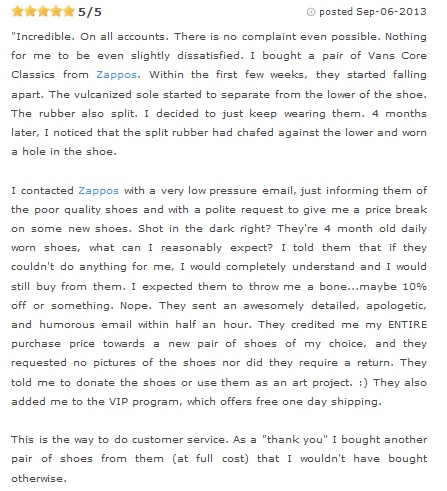
Want to see a customer service manual that's worth $1.2 billion and is updated every day? Just plug "Zappos review" into your favorite search engine, read, and emulate.

Here's just one example that I found online today ...


Your takeaway: You canNOT buy or create advertising any better than the testimonial above. When you deliver outrageous service that not only delights but delightfully surprises your clients, you've got a recipe for explosive growth.

Good news: You don't have to delight your clients with what you actually sell to delight your clients.

Read that sentence again. I'll wait.

You see, Zappos sells shoes. But the 5-star raving testimonial above (one of thousands like it you can find online) is not about shoes. It's about the delightful surprise this customer experienced when receiving a rapid, hassle-free refund.

And before you gripe about refunds, know that this one resulted in:
  1. valuable free publicity (here and elsewhere)
  2. a second purchase at full price
  3. a customer for life
 Any business can do that. Including yours.

So, the only thing stopping you from delivering the same kind of billion-dollar service as Zappos is ... you.

And, yes, the way Zappos treats customers is worth $1.2 billion. Because it was legendary service like the example above that made Zappos worth the $1.2 billion that Amazon paid for it in 2009.

Meanwhile, if you want to smooth out the bumps in your cash flow, by getting more clients like your best clients, my free Client Cloning Kit can help. Grab your free copy now, while they last. 

Friday, April 19, 2013

How to Make Selling Unnecessary (Food for Thought)

Peter Drucker said, "The aim of marketing is to make selling unnecessary."

In that light, anything you do to solve your clients' problems and make them happy is marketing. Because doing so makes it more likely that your clients will either buy from you again or refer others to you. In either case -- a repeat sale or referral -- selling is largely unnecessary.

Case in point: My insurance agent, Marty Bothwell.

Last week, he solved a problem with a device I had installed on my car. He took the time and effort to call me, apologize for the problem, and get the vendor to fix it.

Good work, Marty. I'm happy about that.

But then he invested more time and expense in sending me a handwritten note of thanks for my patience ... with two $10 restaurant gift cards enclosed.

Fantastic work, Marty. I'm delighted about that.

As a result I'm telling everyone I know -- starting here, on my blog, and continuing on to every conversation I have in the coming weeks whenever insurance pops up.

Marty is going to get repeat business and referrals from me. And no selling is necessary for him. Because he's such a smart marketer.

Food for thought, eh? (Literally -- I'm off to Green Mill for lunch, on Marty :-)


Meanwhile, if you want to more clients like your best clients, my free Client Cloning Kit can help. Grab your free copy now, while they last.

Tuesday, February 19, 2013

How to Give Bad News to Clients

Free coffee cake = Bad news forgiven
Have you ever been let down by a vendor? 

Of course you have.

Vendor screw-ups are like death and the Detroit Lions missing the playoffs -- they're gonna happen.

Last Sunday, my wife and I were let down by a vendor. But they recovered so well that we gave them extra money.

Here's the story ...

We sat down for brunch at The Grand Cafe in Minneapolis and waited for our order to arrive.

And waited. And waited ...

After a few minutes, our waiter rushed over to apologize and take responsibility. "We're missing our regular Sunday morning cook, so everything is behind. I'm really sorry. Here's a piece of coffee cake on the house, while you wait."

A few minutes later, he returned. "We're still behind, so I'm going to take your coffees off the bill. I'm very sorry about this!"

Our brunch eventually arrived and it was delicious. 

And here's the thing: Because our waiter got out in front of the problem and "owned" the slow service, we really didn't mind. In fact, I gave him a nice tip.

The lesson is this: If you've got bad news to deliver, do it quickly, with a smile, over-communicate to keep your client in the loop, and throw in a freebie to thank them for their patience.

You can own the problem, or be owned. Pick one :-)

Meanwhile ... if you want to put an end to "feast-or-famine" syndrome in your business, my free Client Cloning Kit can help you. Grab your copy here, while they last.

Wednesday, September 19, 2012

Service: Keystone for Growth?

What makes some entrepreneurs wealthy and successful, while others struggle to survive?

In a word, habits.

Forget what the economy is doing -- up or down, that's not the determining factor. There were plenty of successful people in the Great Depression, and plenty of failures in the recent boom years.

Your success stems from what you think and what you do. And most of what you think and do stems from your habits.

Psychologists estimate that approximately 95% of the thoughts you have today are the same ones you had yesterday. Yikes.

And as much as 45 percent of our actions each day are habitual. We run on autopilot for much of the day, day after day, week after week, month after month ....

That's the power of habit.

To get better results in your business, you need better habits.

But not all habits are created equal.

In the book, The Power of Habit, Charles Duhigg offers powerful reasons why some habits are more important than others.

These so-called keystone habits "have the power to start a chain reaction, shifting other patterns as they move through our lives," writes Duhigg.
Keystone habits influence how we work, eat, play, live, spend, and communicate. Keystone habits start a process that, over time, transforms everything.

This, then, is the answer of where to start: focus on keystone habits, those patterns that, when they start to shift, dislodge and remake other habits.
Get that? Keystone habits can change other habits -- and change your life.

Now. If you're looking to grow a service business, sales career, or other entrepreneurial venture, what keystone habit(s) should you adopt?

You might think sales or innovation. And you might be right.

But sales skills take months or years to sharpen. And innovation can be a tough slog.

Here's an idea: Why not make service a keystone habit for growth?

Service has propelled businesses like Nordstrom, Southwest Airlines, Disney, Starbucks, and Zappos to outrageous levels of success.

Zappos, in particular, has profited wildly from making service as a keystone habit. Zappos is literally "Powered by Service" -- it's their corporate motto. And #1 in their list of 10 core values is this: "Deliver Wow through service."

Stories of Zappos customer service are more than the stuff of corporate legend. They are a big reason why Zappos, which sells the ultimate commodity -- shoes! -- reached $1 billion in sales in only 8 years, before being bought by Amazon in 2009.

So, to sum up: Your habits make or break you, in business and in life.

Keystone habits, like keystones in bridges, are little things that support bigger things. The right keystone habit could support massive growth in your business. And you might want to make service a keystone habit in your business -- it's free to deliver and makes everything better.

Meanwhile ... if you want to put an end to "feast-or-famine" syndrome in your business, grab your free Client Cloning Kit here.  

Tuesday, May 8, 2012

Your Weakest Connection?

As I first learned in the book Linchpin, Ed Sutt made small changes to an everyday item and, in the process, invented a revolutionary device that will save countless lives.

You see, Ed Sutt invented a better nail.

And yes, this has PLENTY to do with building your business.

Here's the story, from Popular Science:

In 1995 a Clemson University graduate student named Ed Sutt took off for a spur-of-the-moment trip to the Caribbean. But beaches and rum drinks weren’t on the agenda for this civil engineer. Hurricane Marilyn had just torn through St. Thomas, and Sutt was part of a team examining how and why 80 percent of the island’s homes and businesses had collapsed in the storm’s 95mph winds.

   “The destruction was so complete in places that it was almost surreal,” Sutt recalls. “There were troops in the streets and military helicopters hovering overhead.” As Sutt moved through the wreckage of roofless and toppled-over houses, he was struck by the sense that much of the destruction could have been avoided. “In house after house,” he says, “I noticed that it wasn’t the wood that had failed -- it was the nails that held the wood together.”

Get that?

A house is as strong as its weakest nail, just as a chain is as strong as its weakest link. Weak connections lead to catastrophic failures.

Now.

Think about your business. Does it ever feel like you're facing hurricane-force winds?

If so, you may fear that your business is failing.

But ... perhaps, it's not your business that's failing. Perhaps it's what's holding your business together that's failing. And that would be relationships.

Relationships hold a business together, just as nails hold a house together.

The more personal relationships you have -- with clients, vendors, partners, bloggers, followers, church/temple/mosque members, et al -- the stronger and more resistant to headwinds your business will be.

Think: Where are your relationships weakest? In your:

  • networking?
  • strategic partnerships?
  • follow-up with prospects?
  • client service?

Your weakest relationships could lead to a catastrophic failure in your business.

You might want to nail them down.

Bio: Kevin Donlin can help you grow your business and enjoy the results your hard work deserves. To learn how to boost your revenues and profits faster, please click here.

Saturday, April 28, 2012

How to be Remarkable: Phone Call from Seth Godin

Books have been written by better writers than I about how to deliver a remarkable experience that your clients tell others about.

One of those writers is Seth Godin.

In his book, Purple Cow, and in his blog, Seth's message is pretty simple: To be remarkable, do something worth making a remark about.

Want an example?

Listen to a remarkable voice mail I received on Friday, April 18, 2008 ...


If your speakers aren't turned up, here's a transcript:

"Kevin, it's Seth Godin. Thanks for your super-nice note. Just wanted to let you know I got it. Have a great weekend." 

That was Seth, calling to thank me for a letter I mailed him, in which I thanked him for a remarkable presentation he made at an event I attended.


Here's what I wrote to him:

Dear Seth,

I want to thank you for your presentation last Wed. at Jay Abraham's Reunion Reunion.

Your ideas were both inspirational and practical -- an ultra-rare combination.

I especially liked what you said about curiosity -- how it is essential to success and how a fundamentalist looks at the world to see how it fits what they believe, while a curious person looks and changes what they believe, as needed.

I am now paying a little more attention to how I look at the world.

Thanks again and kind regards,


Kevin Donlin

P.S. -- I'm sending you this "paper email" to make absolutely, positively sure of getting through your spam filter :-)

Turns out, my writing and mailing an out-of-the-ordinary note was remarkable enough to Seth that he called to say, "Thank you" in return.

Now, I'm remarking about Seth's remarkable action here on my blog.

See how this works?

Best part: You can start your own remarkable virtuous circle by doing something for a client today that's worth making a remark about.

Why not start by writing or saying, "Thank you"?

Bio: Kevin Donlin can help you grow your business and enjoy the breakthrough results your hard work deserves. If you're interested in boosting your revenues and profits, please click here.

Thursday, September 29, 2011

The Last 30 Seconds

At a seminar in Minneapolis last year, Seth Godin said: "People judge their entire colonoscopy experience based on what they remember from the last 30 seconds."

If you can envision a colonoscopy, I think you will agree with Seth.

Now, envision your business.

No matter what you do, it's exactly like a colonoscopy.

Let me explain ...

A few years ago, I took my car in for an oil change. The service guys did a great job -- it was fast, friendly, and the price was right.

Below is a picture that represents my experience up to that point ...


They finished and brought my car around. I got in and found a big, fresh stain on the passenger seat.

I motioned the technician over asked him: "Hey, can you tell me what this is about?"

He looked at the stain and said, "Oh, yeah," like he'd just remembered. "You shouldn't put a can of STP in your glove box in the summer. It can overheat and burst open. I guess that's what happened."

I said, "Well, did it levitate out of the glove box and hover over the seat before exploding?"

He had no answer, of course. One of his guys must have been going through my glove box -- why, I don't know -- and spilled the STP can on the seat.

No apology, no attempt to fix it. They thought I would drive away and not notice.

So, based on the last 30 seconds of my experience, here is my lasting mental picture of that company ...


How many people do you think I told about this? EVERYONE.

I made it my hobby for the next 6 weeks to tell any English speaker within 3 feet: "You don't want to go to Hick & Brothers Auto Shop because they'll screw you over!"

Now, think: What are the last 30 seconds of your clients' experience with you?

It it:

  • a phone call?
  • an email?
  • a letter or box in the mail?
  • your technician wiping his feet and closing the door on the way out?

Whatever those last 30 seconds are, they pretty much define:

  1. what your clients think about you
  2. what your clients say about you

Worth obsessing about, no?

You'll find more ideas like these in my Free Report, Guaranteed Marketing. 

Tuesday, September 13, 2011

Zig, Zagat, and the $125-Million Payday

"You can have everything you want in life, if you help enough other people get what they want" - Zig Ziglar

While the unofficial Google motto may be "Don't be evil," Zig's words are their real recipe for success.

To whit, Google has been spanking Yahoo for years simply because Google helps more people get what they want.

And you can, too. Read on to learn how ...

First, Exhibit A: Carol Bartz, the latest CEO firing at Yahoo.

According to The Wall Street Journal:

It's a simple rule of any market. The more information that is created, the more the value is reduced. And despite attempts to woo spending with bigger, bolder and more targeted ads, services that help consumers navigate that content, namely search, remain the big money makers online.

"People tell me that content is king, but that is not true at all," says Rishad Tobaccowala, chief strategy and innovation officer at Vivaki, the digital-media unit of Publicis Groupe SA. "Most people make money pointing to content, not creating, curating or collecting content."

Summary: Yahoo did not help enough people get what they wanted. So Yahoo did not get what they wanted. And Bartz got booted.

Now, Exhibit B: Zagat, the restaurant review service that sprang from humble beginnings 30 years ago. Google bought it for a reported $125 million.

According to The New York Times:

People are “wondering where they should go, where they should spend their time, so to be able to offer accurate information is important, and that’s why we’ve been getting focused on reviews,” said Google VP Marissa Mayer.

Summary: Zagat helped many people get what they wanted. So Zagat got what they wanted. Specifically, the founders, Nina and Tim Zagat, got a $125-million payday (more or less) and can now have everything they want in life.

Now, you may not get bought by Google. But you can still have everything you want ... if you help enough people get what they want.

Start with the most important people in your business life: Your clients.

What do they want? And how are you helping them get it?

By the way, this is a much broader question than, "What can I sell my clients?"

The real question is: "What can I help my clients get?"

Answer it enough times for enough clients, and they will help you get everything you want in life. Just as Zig said -- and Zagat proved.


You'll find more ideas like these in my Free Report, Guaranteed Marketing.

Tuesday, September 6, 2011

How to Make Clients Stick to You

You know that I preach writing and mailing thank-you letters to anyone who matters in your business life: clients, prospects, vendors, and referral partners, to name a few.

In his excellent book, You, Inc., Harry Beckwith writes: "Handwritten thank-you notes feel like gifts because you took the time to find the paper and envelope, write the note, affix the stamp, and gift-wrap your note in its package."

Well, here's a terrific twist on thank-you notes as "gifts," borrowed from one of my marketing heroes, Joe Polish.

It's called a "stick letter."

First, recall one of the reasons you mail thank-you notes to clients: To make them feel good about doing business with you. Because, if ignored, a client can quickly come down with a case of buyer's remorse.

Especially in today's economy, your clients may question their purchase and think:

  • Did I pay too much? 
  • Should I have shopped around more?
  • Do I really need that?
  • Is that product/service really worth the money?
  • Did I make a mistake?
  • Etc. -- all of it bad


So here's a Big Question: How do you eliminate or minimize buyer's remorse and possible refunds?

The answer, according to Joe Polish (and my own experience) is to send a "stick letter."

A stick letter is simply a letter to make the sale "stick." In other words, ensure that the buyer of your product or service is happy enough to keep and use it.

Best part: For a tiny investment of time and money, you can not only reduce refunds, you can delight your clients, and stimulate referrals. That's a triple play.

What does a stick letter look like?

I'm glad you asked. Here's an example of what I mail to my copywriting clients ...


Here's what that stick letter says:

As you can see, I've attached a $1 bill to this letter.

It's my way of getting your FULL attention as I say, "Thank you!" once more for your business ...

... and it represents the first of many dollars you can expect to receive from the web pages, emails, and other materials I write for you.

Here's to a long and prosperous relationship!

Kevin Donlin

By the way, the dollar bill is called a "grabber" in direct-mail parlance. It's an attention grabber that forces the recipient to read the letter and find out why you sent them money.

Mailing a stick letter to clients within 3-5 business days of their purchase -- even the same day -- is one of the best ways I know to reduce or eliminate refunds, ensure happy clients, and build your business. Win-win-win.

There's really only one way to do this wrong: Mail a fake letter. Fake as in you don't mean what you say. Clients can smell fakery like a dead skunk, so don't write a single word in any stick letter that you don't mean 100%.

And, if attaching a dollar bill offends your sensibilities, attach something else ... like a gift certificate good for an "emergency consultation" or some surprise extra service.

Meanwhile, the potential upside of sending a stick letter -- in terms of client delight, follow-on sales, and referrals -- is HUGE.

Sure, you've probably never heard of anyone in your industry doing anything like this. And that's exactly why you should try it.

Bio: Kevin Donlin can help you grow your business and enjoy the breakthrough results your hard work deserves. If you're interested in boosting your revenues and profits, please click here.

Wednesday, August 17, 2011

How to Work Entirely from Referrals

How would you like to get all the business you can handle, from referrals only?

I know a woman like that. She's served more than 800 clients and doesn't spend a penny on advertising. Her business is entirely referral-driven.

Her name is Allison Kraus. She's referable because she's remarkable. You can be, too.

First, two definitions ...

1) To be referable means people tell others about you.

2) To be remarkable means you are worth talking (remarking) about.

See the relationship? Before people will talk about you and refer others, you must be worth talking about. You must be remarkable.

Now, back to Allison and her company, Minnesota Health Coverage. She's a sort of health insurance broker, helping people in Minnesota select the best, most cost-effective plan from the maze of choices.

Full disclosure: I'm a client. And she saved me about $225 a month on insurance -- enough to fully fund my IRA -- so you can also call me a happy client.

Anyway, Allison shops around for the best health insurance plan at the best price. And she doesn't charge you, the client, anything -- her fee is paid by the insurance company. Even when you figure in her modest commission, you still save loads of time and money with Allison. In my case, I save about $2,700 a year.

That's worth telling people about. That's remarkable. And that's why Allison is so referable.

Now. You may not have a value proposition (yet) as compelling as Allison's. So you may not get as many referrals as you would like.

If so, you have two choices:

1) Find and articulate the value of what you do in a way that's compelling.

Example: Among the things I write for clients are autoresponder emails -- a series of 5 or more emails sent by a service like Aweber to people who request information about your company.

I wrote a series of 6 autoresponder emails for one client that produced $3,771 in found money -- orders that never would have happened otherwise. Over the two-year shelf life of this system, my emails should produce more than $14,000, for an ROI of more than 20-1.

By themselves, autoresponder emails are not compelling. But by articulating their value ($3,771 in found money ... $14,000 in two years ... 20-1 ROI) they become so.


2) Deliver remarkable service to clients. This is a shorter idea, but no less powerful than 1).

Examples abound of wildly successful companies who sell commodities but deliver remarkable service -- Zappos, The Ritz Carlton, Nordstrom, etc.

There's nothing stopping you from serving clients faster and better than the competition. Never think of client service as a chore. Remarkable client service is nothing less than the foundation of a business that runs on referrals.


So, here's the formula: To be referable, be remarkable.

You'll find more ideas like these in my Free Report, Guaranteed Marketing. 

Wednesday, June 1, 2011

Heroic Service: The Ultimate Differentiator

In business, you must differentiate or die.

To succeed, your product or service must stand out in a crowded marketplace. Otherwise, you go unnoticed and starve.

How do some of the most successful companies differentiate?

Think of Zappos. They sell a commodity -- shoes. So it's not their product that's special. And their prices aren't low -- you'd pay less at Wal-Mart.

What differentiates Zappos? The same thing that differentiates Nordstrom, The Ritz Carlton, L.L. Bean, and many other successful companies -- service.

Specifically, heroic service that prompts repeat and referral sales.

Few people talk about the shoes from Zappos or the ties at Nordstrom. But everyone talks about the service.

Small business example: my printer -- Jim Beckman, at Full Throttle Print & Imaging in Chanhassen, MN -- got a panicky call for an order of business cards at 7:00 on a Friday night ... and he delivered it to the client's home the next morning, Saturday.

That's heroic service. And it gets people talking.

Client and others -- like me -- have told that story again and again, like the stories of the FedEx employee who chartered a plane to deliver a wedding dress, or the Nordstrom employee who refunded a set of snow tires (which Nordstrom doesn't sell).

If you must differentiate or die, and you don't have the best products/services or the lowest prices, that leaves service at the one area where you can gain a competitive edge.

You can start today, too, by delivering service that delights and surprises clients.

Service may be the fastest and most profitable way for you to differentiate. It sure beats the alternative.

You'll find more ideas like these in my Free Report, Guaranteed Marketing.