Tuesday, October 22, 2013

Client Service: The Ultimate Marketing Weapon?

Want to see a customer service manual that's worth $1.2 billion and is updated every day? Just plug "Zappos review" into your favorite search engine, read, and emulate.

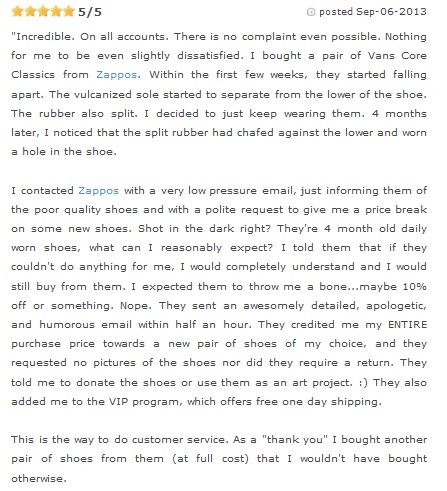
Here's just one example that I found online today ...


Your takeaway: You canNOT buy or create advertising any better than the testimonial above. When you deliver outrageous service that not only delights but delightfully surprises your clients, you've got a recipe for explosive growth.

Good news: You don't have to delight your clients with what you actually sell to delight your clients.

Read that sentence again. I'll wait.

You see, Zappos sells shoes. But the 5-star raving testimonial above (one of thousands like it you can find online) is not about shoes. It's about the delightful surprise this customer experienced when receiving a rapid, hassle-free refund.

And before you gripe about refunds, know that this one resulted in:
  1. valuable free publicity (here and elsewhere)
  2. a second purchase at full price
  3. a customer for life
 Any business can do that. Including yours.

So, the only thing stopping you from delivering the same kind of billion-dollar service as Zappos is ... you.

And, yes, the way Zappos treats customers is worth $1.2 billion. Because it was legendary service like the example above that made Zappos worth the $1.2 billion that Amazon paid for it in 2009.

Meanwhile, if you want to smooth out the bumps in your cash flow, by getting more clients like your best clients, my free Client Cloning Kit can help. Grab your free copy now, while they last

Wednesday, October 16, 2013

The Instant Newsletter Solution

Last week I spoke to a gathering of local entrepreneurs.

After my talk, I handed out a survey and got back 25 of them. Their answers to my questions were insightful (I love surveys!), but one was especially interesting.

To my survey question, "Do you send a newsletter to your clients?" the answers were:


Translation: 40% of respondents send NO newsletter to their clients. Bad. Very bad.

Only 8% send a newsletter by U.S. Mail, while 32% send one by email, and 12% send a newsletter by U.S. Mail and email (the best option -- online + offline = synergy).

Why do you need a newsletter?

For every month that you don’t communicate with clients, their value drops about 10%, according to research by The Direct Mail Association.

Erik Van Vooren, of the Direct Marketing Know-How Institute in Belgium, puts it this way:
"Suppose your company lost 10% of your inventory last month? You would panic. You'd get together your staff, lock the doors and figure out exactly where that inventory went. However, the same company can lose 10% of their customers without even noticing."
So, think of a monthly newsletter as a systematic way to plug the leaks and lock the doors in your business, to keep your clients (and profits) from escaping.

If you’re not sending a newsletter of any kind to clients, try the following, in order:

1) Find one useful article online this week. Email it to one client, with a short summary of the article and a note, telling them why you think it’s helpful.

2) Do the same thing next week for another client.

3) Combine the two emails. Write a short introduction. Presto! Instant ezine issue #1 for your business.

4) Print the ezine and mail it. Presto! Instant printed newsletter issue #1.

By the way, I don’t write newsletters, so this is not a pitch for my services. It’s just me urging you to do the right thing. If you do need a newsletter done for you, the BEST in the business is Shaun Buck over at The Newsletter Pro.

Meanwhile, if you want to put an end to "feast or famine" syndrome in your business, my free Client Cloning Kit can help. It's not some cheapo download -- this is a real business-building kit you can hold in your hands. Grab your free copy now, while they last.

Monday, October 7, 2013

Thank-You Marketing: Get Real

Writing and mailing thank-you notes to your prospects and clients can help make your business 100% referral-driven. It's done that for my business, in less than 3 years.

In fact, I now refer to this simple, powerful concept as "Thank-You Marketing."

And yet, I still get asked the same question: Should I thank people by email or with a card in the mail?

Answer: How would you send your mother a birthday message, by email or paper mail? How about your spouse -- would you give him or her an anniversary card by email or on paper?

Treat your clients the same as any other VIP. Only a real thank-you note, on paper and mailed with a stamp, counts for anything.

In fact, mailing a real thank-you note to someone creates a lasting impression that's simply NOT possible with an email. And there's science to back this up.

Research by The UK's Royal Mail and Bangor University found that tangible materials, like a letter you can hold in your hands, "triggered greater emotional processing."

The study, Using Neuroscience to Understand the Role of Direct Mail, found that "tangible materials actually leave a deeper footprint in the brain."

To quote the study at length:
This research strongly suggests that greater emotional processing is facilitated by the physical material than by the virtual. The “real” experience that the physical media provides means it’s better at becoming part of memory.

It generates more emotion, which should help to develop more positive brand associations. The real experience is also internalized, which means the materials have a more personal effect, and therefore should aid motivation.
Bottom line: a thank-you note they can hold is literally more real and emotionally compelling to the recipient than an email they can only see onscreen.

(Of course, this idea goes well beyond thank-you notes. A printed sales letter is "more real" and more emotionally involving than the same sales message sent by email, text, or social media. But those are topics for another day.)

Now, do you still want to send that "thank you" by email?

Meanwhile, if you want to put an end to "feast or famine" syndrome in your business, my free Client Cloning Kit can help. It's not some cheapo download -- this is a real business-building kit you can hold in your hands. Grab your free copy now, while they last.

Wednesday, October 2, 2013

The Client Cloning Blueprint


What's this?  

The Client Cloning Blueprint.

It shows you how to get more clients like your best clients. Without advertising.

You'll be hearing a LOT more from me on this in the coming weeks ...

... but for now, if you want to put an end to "feast or famine" syndrome in your business, my free Client Cloning Kit can help. It's not some cheapo download -- this is a real business-building kit you can hold in your hands. Grab your free copy now, while they last.

Thursday, September 26, 2013

7 Ways to Manage Your Email (Before it Manages You)

Email is a great way to communicate and can save you time ... when used wisely.

It can also drive you insane.

I hear over and over again from clients how their inbox drives their day because they’re constantly reacting to the latest “ding” announcing the arrival of an email. They’re fearful of missing something important and let their inbox dictate what they will work on today.

If you find yourself in the same boat, here are 7 tips on how you can manage your email -- and stay sane -- taken from my book, Take Back Your Time: 101 Simple Tips To Shrink Your Work-Week and Conquer the Chaos in Your Life.

1. Schedule a block or two of time during the day to review and answer email, your volume of email will dictate frequency and how long to read email. I schedule a 45-minute session to review email in the morning and an hour session mid-day. Communicate that to your audience in your email signature to set expectations with them.

Here is the exact verbiage from my email signature: “Note: I set aside 7:15 a.m. - 8:00 a.m. CT and 1:00 p.m. - 1:30 p.m. CT every day to read and respond to emails. As time permits I also glance through my emails throughout the day. If you require urgent assistance (please ensure it is urgent) that cannot wait until 7:15 a.m. CT or 1 p.m. CT, please contact me via phone at xxx-xxx-xxxx. Thank you for understanding this move to more efficiency and effectiveness. It helps me accomplish more to serve you better.”

2. Write meaningful subject lines (for example, don’t reply to a random email with a completely unrelated topic) and change the subject line if the email has become a chain of emails and the topic has now shifted.

3. When replying “thank you” or writing a very brief email (one sentence), put the thank you or brief sentence in the subject with EOM (End Of Message) at the end. People will know that is the end of the message and there is no need to open your email. I would suggest adding EOM to your key in your email signature mentioned in tip 1 above.

4. Think of key people whose emails you want to stand out in your Inbox. Create rules to color code emails that come in from those individuals. For example, blue from your boss and green from key customers. Then you can quickly scan through your emails to find those that are most critical to respond to quickly.

5. If you are having difficultly composing an email, it usually suggests that a higher order of communication, such as a telephone call or face-to-face meeting, is necessary. Abandon your email and either call the recipient or set up a meeting with them.

6. If you need someone to answer a question right away, don’t send an email hoping she’ll see it instantly and promptly respond to you. Just call her.

7. Move emails directly from your Inbox to your calendar and schedule a block of time to complete the request in the email. This saves you time as you won’t need to add it to a task list and you’ll remember at an appropriate time in the future to complete the request.

What's your favorite way to manage email?

A guest article by Shari McGuire, founder of ShrinkYourWorkWeek.com and author of Take Back Your Time: 101 Simple Tips To Shrink Your Work-Week and Conquer the Chaos in Your Life.
Thursday, September 5, 2013

The 30-Second, 6-Figure Marketing Idea

If your marketing depends on one-shot promotions, a sales letter mailed once, or a single email blast, it’s just like this little broom ... 


... and you will find it very difficult to sweep up profits.

By contrast, if your marketing has at least 3 steps built into every promotion -- if you "touch" every prospect at least 3 times with your sales letters, postcards, emails, or phone calls, it's just like this broom ... 


... and you will find it relatively easy to sweep up profits.

Idea: Stop with the one-shot promotions. Unless you enjoy drudgery and feast-or-famine when it comes to cash flow.

Instead, be systematic. Use multiple steps -- at least 3. And sweep up more profits in your business.

This idea is worth at least 6 figures to you ... but only if you use it.

And, if you want to put an end to "feast or famine" syndrome in your business, my free Client Cloning Kit can help. Grab your free copy now, while they last

Tuesday, September 3, 2013

How to Avoid Being Commoditized

Here's a guest post from my client and ace sales trainer, Terry Slattery.

Read it and reap -- sales gains, that is ...

One day, a salesman client moped into my office. He had lost his biggest customer -- who had been with him for 10 years -- over a 3-cent price difference. He pleaded, “How do I win them back?”

I said, "Answer this question: ‘What's going to happen to whom because they are not buying cinnamon from you, and how will that affect their life?’”

First, background: A new purchasing agent had called my client, saying: “I understand you've been providing us great service for 10 years. But you charge 3 cents a pound more for the same cinnamon I can get anywhere. Out of respect for our relationship, I want to give you the chance to match that lower price before I move the business.”

The salesman started talking about service and support. Then freshness and quality. But, like a broken record, the buyer kept coming back to 3 cents a pound … 3 cents a pound. And the business was lost.

Turns out, my client never mentioned his big Differentiating Value (D.V.): Time to market. This salesman, who nearly has a PhD in food science, told me, “In exchange for charging a slight premium on cinnamon, I shared my expertise with their R&D department. Without my help, they estimate it will take at least 3 weeks longer to get a product to market.”

When I asked what those 3 weeks meant in terms of money, he said, “About $80,000 in daily sales. Three weeks are $1.6 million. And they roll out about 6 products a year. All told, it’s about an opportunity cost of about $10 million.”

I asked, “Who feels that $10-million loss? It’s sure not the purchasing department.”

He thought for a moment, then said, “It’s the brand manager.” I asked him, “Do you even know their name?” “No,” he replied. And I said, “That’s fascinating because that is your real customer.”

A strange look came over my client’s face. He said, “I thought I was selling cinnamon. But what I’m really selling is 3 weeks.”

This story has a happy ending. I advised him to call the brand manager and leave a voicemail, which resulted in a rapid return call -- and my client winning back the account.

Your Takeaway: No matter what you sell, you face the curse of commoditization … unless you get absolutely clear on your D.V., then communicate it to the customer who matters -- which may be a different customer than the one you’re selling to.

To get clear on your D.V. -- and get the script for the startling voicemail message that helped my client win back that lost account, contact Terry Slattery at his website.

And, if you want to put an end to "feast or famine" syndrome in your business, my free Client Cloning Kit can help. Grab your free copy now, while they last.