When measuring your marketing, numbers don't lie.
But which numbers matter?
Watch to learn the difference between response rates and return on investment, to name two.
Tip: First, figure out how much a client is worth to you over their buying lifetime. When you know your lifetime client value (LCV).
Meanwhile ... if you want to put an end to "feast-or-famine" syndrome in your business, a free Client Cloning Kit can help. Grab your copy here.
Monday, December 17, 2012


Thursday, December 13, 2012
What Does Success Look Like For You?
Every artist works from a vision, whether real (in the form of a picture or model) or imaginary (a vision in their head).
 Example: Albert Einstein.
You may not think of him as an artist, but Einstein thought in visual images first and developed the math to support his ideas later.
In fact, he developed his theory of special relativity to support the image he had of himself riding a beam of light across the universe.
Da Vinci, Thomas Edison, Steve Jobs, Michelangelo (for whom Einstein had a lifelong fascination) -- all had clear pictures in mind (or on the wall) of what they were trying to build.
Pictures first, achievement later. That's how greatness is often created.
In the book, Discover Your Genius, Michael Gelb writes:
Visual imagery. Pictures.
Now, quick -- think of your business. What do you see in your mind's eye? Do you have a clear picture of what it will look like when it's perfect? If not, how will you know you've succeeded?
Better yet, what picture of your business success do you see on the wall?
Yes, you read that right. Is there a picture of your business model literally hanging on your wall where you can see and be inspired by it as you work to create your masterpiece?
Here's a picture of my business model, which hangs right above the keyboard I'm typing this on. (Mose of the details are redacted -- sorry. They're too valuable to share right now.)
Anytime I get fatigued or mentally lost during the day, I simply look at the picture of my business model and I think, "Oh, yeah. That's what I'm doing!" And back to work I go.
Anyway, do you see my point?
Until you can see in your minds eye where your clients are or see your business model on paper you will not be clear, you will not be motivated, not be fully successful.
Here's a peek into my private world ...
 This picture, showing the growth of Zappos, is one I've made copies of and posted on every mirror on the lower level of my house.
And I carry it around in my pocket. Not for luck either, although I have far exceeded my revenue goals for the last 3 months since I started doing this religiously.
I used to carry a similar picture around a few years ago and it helped me get a new home ... and $2.1 million in extra revenue for one of my businesses.
What the heck happened? Why did I ever stop carrying around that "pocket vision" of success?
It's because I didn't have a system set up to support me each day and stay on track.
So I set out to invent that support system. And after nearly 8 years and $100,000 of my own money, I succeeded.
Nowadays, success for me has become almost automatic. When I set goals, I achieve them almost every time. The cool part is that the system I created for my business takes just 14 minutes a day to execute.
If you're in the Twin Cities and it's not too late, you can learn more here
You may not think of him as an artist, but Einstein thought in visual images first and developed the math to support his ideas later.
In fact, he developed his theory of special relativity to support the image he had of himself riding a beam of light across the universe.
Da Vinci, Thomas Edison, Steve Jobs, Michelangelo (for whom Einstein had a lifelong fascination) -- all had clear pictures in mind (or on the wall) of what they were trying to build.
Pictures first, achievement later. That's how greatness is often created.
In the book, Discover Your Genius, Michael Gelb writes:
In a landmark survey of the working methods of great scientists and mathematicians, Dr. Jacques Hadmard found that their thinking process was characterized not by language or standard mathematical symbols, but rather by visual imagery.
Visual imagery. Pictures.
Now, quick -- think of your business. What do you see in your mind's eye? Do you have a clear picture of what it will look like when it's perfect? If not, how will you know you've succeeded?
Better yet, what picture of your business success do you see on the wall?
Yes, you read that right. Is there a picture of your business model literally hanging on your wall where you can see and be inspired by it as you work to create your masterpiece?
Here's a picture of my business model, which hangs right above the keyboard I'm typing this on. (Mose of the details are redacted -- sorry. They're too valuable to share right now.)
Anytime I get fatigued or mentally lost during the day, I simply look at the picture of my business model and I think, "Oh, yeah. That's what I'm doing!" And back to work I go.
Anyway, do you see my point?
Until you can see in your minds eye where your clients are or see your business model on paper you will not be clear, you will not be motivated, not be fully successful.
Here's a peek into my private world ...

And I carry it around in my pocket. Not for luck either, although I have far exceeded my revenue goals for the last 3 months since I started doing this religiously.
I used to carry a similar picture around a few years ago and it helped me get a new home ... and $2.1 million in extra revenue for one of my businesses.
What the heck happened? Why did I ever stop carrying around that "pocket vision" of success?
It's because I didn't have a system set up to support me each day and stay on track.
So I set out to invent that support system. And after nearly 8 years and $100,000 of my own money, I succeeded.
Nowadays, success for me has become almost automatic. When I set goals, I achieve them almost every time. The cool part is that the system I created for my business takes just 14 minutes a day to execute.
If you're in the Twin Cities and it's not too late, you can learn more here
Monday, December 3, 2012
From Mental Fog to Creative Clarity
Yesterday, it was foggy all day here in the Twin Cities.
Below is a shot I took about a block from my house ...
 Now, here's the thing: It's never foggy all day in the Twin Cities. Especially in December.
So this made for a very unusual day, especially when driving. I had to tune out distractions and focus on the road, or risk a crash.
But this had an unexpected benefit. By really observing where I was driving, I had to be fully present and mindful -- it was an accidental zen thing. No stray thoughts, worrying about the future, or replaying past events. Just driving.
What was the benefit?
Research cited in the book, The Laws of Subtraction shows that familiarity can stifle creativity.
By intensely focusing on the new, unusual driving conditions, my mind was jolted out of its normal thought patterns. Not surprisingly, it handed me several solutions later on to problems I had been trying to solve for days.
This happens to you all the time when you travel. Think about it: When you drive or fly to new places (or back home, if you live across the country), you pay more attention to your surroundings, which lets your mind break free of old thought patterns.
So, here's what I learned from the fog: You can wait for weird weather or a vacation to jolt you out of your mental ruts ...
... or you can take action and pay closer attention to your surroundings the next time you walk or drive across town. Doing so can boost your creativity and problem-solving powers, faster and cheaper than a trip across the country.
Meanwhile ... if you want to put an end to "feast-or-famine" syndrome in your business, a free Client Cloning Kit can help. Grab your copy here.
Below is a shot I took about a block from my house ...
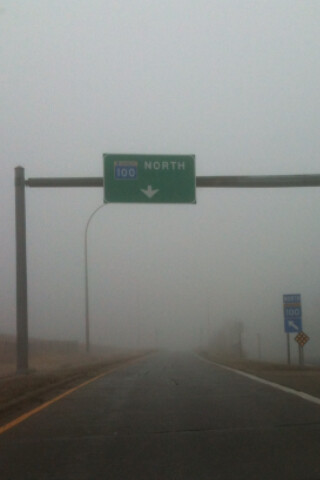
So this made for a very unusual day, especially when driving. I had to tune out distractions and focus on the road, or risk a crash.
But this had an unexpected benefit. By really observing where I was driving, I had to be fully present and mindful -- it was an accidental zen thing. No stray thoughts, worrying about the future, or replaying past events. Just driving.
What was the benefit?
Research cited in the book, The Laws of Subtraction shows that familiarity can stifle creativity.
By intensely focusing on the new, unusual driving conditions, my mind was jolted out of its normal thought patterns. Not surprisingly, it handed me several solutions later on to problems I had been trying to solve for days.
This happens to you all the time when you travel. Think about it: When you drive or fly to new places (or back home, if you live across the country), you pay more attention to your surroundings, which lets your mind break free of old thought patterns.
So, here's what I learned from the fog: You can wait for weird weather or a vacation to jolt you out of your mental ruts ...
... or you can take action and pay closer attention to your surroundings the next time you walk or drive across town. Doing so can boost your creativity and problem-solving powers, faster and cheaper than a trip across the country.
Meanwhile ... if you want to put an end to "feast-or-famine" syndrome in your business, a free Client Cloning Kit can help. Grab your copy here.
Monday, November 26, 2012
Free Shopping at the Belief Store
Here's a riff on a great idea I got from Brian Tracy that could change your life -- or at least a few of your beliefs ...
It starts with a simple question: Your beliefs are important, wouldn't you agree?
What you believe to be true, important, precious, good, evil -- these beliefs of yours have value. Otherwise, you wouldn't cling to them so strongly.
So, it's easy to imagine that your beliefs are important and valuable. But what if you had to pay money for new beliefs? Can you imagine that?
What if there were a Belief Store where you could buy new beliefs to install in your brain, just like buying music at iTunes to install on your smart phone.
If you had to pay big bucks for beliefs, wouldn't you shop and choose carefully?
Imagine downloading the most-valuable new belief you could afford, with the power to change your life. A belief like this one, perhaps:
That's just one example of a powerful belief that could put you on the fast track to growth. There are an infinite number, of course.
But here's the exciting part: Your beliefs, which bring you everything in this world, cost you nothing. They are yours to take or leave, free of charge.
So ... your beliefs are too important to take for granted. Treat them as incredibly valuable, powerful, and essential building blocks to your success. Because they are. (And did I mention they're free?)
Meanwhile ... if you want to put an end to "feast-or-famine" syndrome in your business, a free Client Cloning Kit can help. Grab your copy here.
It starts with a simple question: Your beliefs are important, wouldn't you agree?
What you believe to be true, important, precious, good, evil -- these beliefs of yours have value. Otherwise, you wouldn't cling to them so strongly.
So, it's easy to imagine that your beliefs are important and valuable. But what if you had to pay money for new beliefs? Can you imagine that?
What if there were a Belief Store where you could buy new beliefs to install in your brain, just like buying music at iTunes to install on your smart phone.
If you had to pay big bucks for beliefs, wouldn't you shop and choose carefully?
Imagine downloading the most-valuable new belief you could afford, with the power to change your life. A belief like this one, perhaps:
"I believe that I'm going to be a BIG success in this world, and that everything that happens to me -- good or bad -- is something I can learn from and build on to reach my goals."
That's just one example of a powerful belief that could put you on the fast track to growth. There are an infinite number, of course.
But here's the exciting part: Your beliefs, which bring you everything in this world, cost you nothing. They are yours to take or leave, free of charge.
So ... your beliefs are too important to take for granted. Treat them as incredibly valuable, powerful, and essential building blocks to your success. Because they are. (And did I mention they're free?)
Meanwhile ... if you want to put an end to "feast-or-famine" syndrome in your business, a free Client Cloning Kit can help. Grab your copy here.
Wednesday, November 14, 2012
How to Win Your Freedom
Imagine a prisoner digging his way out of a cell with a spoon.
Think of how hard he's willing to work.
Day after day, week after week, month after month. He toils in stubborn silence.
Why?
Because he wants his freedom. And he'll work night and day to get it.
Now. Are you willing to work night and day at what you do?
If not, it's probably because you're not as motivated as that prisoner digging for his freedom.
So, try this thought experiment: If you were working to win your freedom, how much harder would you work than you do now?
Plenty harder, I'll bet.
Well, think of your work like this: Done correctly, it should win your financial freedom. You should be able to sell your business or sock enough away so that -- sooner than later -- you no longer have to work unless you want to.
You will be free, financially.
NOW hard are you willing to work?
Meanwhile ... if you want to put an end to "feast-or-famine" syndrome in your business, a free Client Cloning Kit can help. Grab your copy here.
Think of how hard he's willing to work.
Day after day, week after week, month after month. He toils in stubborn silence.
Why?
Because he wants his freedom. And he'll work night and day to get it.
Now. Are you willing to work night and day at what you do?
If not, it's probably because you're not as motivated as that prisoner digging for his freedom.
So, try this thought experiment: If you were working to win your freedom, how much harder would you work than you do now?
Plenty harder, I'll bet.
Well, think of your work like this: Done correctly, it should win your financial freedom. You should be able to sell your business or sock enough away so that -- sooner than later -- you no longer have to work unless you want to.
You will be free, financially.
NOW hard are you willing to work?
Meanwhile ... if you want to put an end to "feast-or-famine" syndrome in your business, a free Client Cloning Kit can help. Grab your copy here.
Monday, November 12, 2012
The Strange Profit-Boosting Idea from Ikea
I like Ikea. So does my family.
We go there several times a year to ... eat.

Oh, and we also spend $100 or so on the way out the door.
Let me explain ...
You know Ikea as a quirky, cool, low-cost furniture store.
But I hate shopping, for furniture -- or pretty much anything.
So I know Ikea as a quirky, cool, low-cost restaurant. I love their smoked salmon and Swedish apple pie with coffee for Sunday brunch. Yum.
And when I take the family there to eat, we have to walk past approximately 10,000 household items for sale on the way to the exit. The chances that we'll spend $100 or more are approximately 100%.
Ikea is smart. Back in 1960, they added an unrelated product -- food -- to their retail store, and found that "visitors stay in the store longer and buy more."
Like my family and me.
Question: What unrelated product or service could you add to your current offerings to make clients stay with you longer and buy more?
I won't give you any ideas. Instead, brainstorm 5-10 on your own and give your marketing muscles a workout.
Meanwhile ... if you want to put an end to "feast-or-famine" syndrome in your business, a free Client Cloning Kit can help. Grab your copy here.
We go there several times a year to ... eat.

Oh, and we also spend $100 or so on the way out the door.
Let me explain ...
You know Ikea as a quirky, cool, low-cost furniture store.
But I hate shopping, for furniture -- or pretty much anything.
So I know Ikea as a quirky, cool, low-cost restaurant. I love their smoked salmon and Swedish apple pie with coffee for Sunday brunch. Yum.
And when I take the family there to eat, we have to walk past approximately 10,000 household items for sale on the way to the exit. The chances that we'll spend $100 or more are approximately 100%.
Ikea is smart. Back in 1960, they added an unrelated product -- food -- to their retail store, and found that "visitors stay in the store longer and buy more."
Like my family and me.
Question: What unrelated product or service could you add to your current offerings to make clients stay with you longer and buy more?
I won't give you any ideas. Instead, brainstorm 5-10 on your own and give your marketing muscles a workout.
Meanwhile ... if you want to put an end to "feast-or-famine" syndrome in your business, a free Client Cloning Kit can help. Grab your copy here.
Monday, November 5, 2012
What Do You Believe? Why Do You Do What You Do?
I'm three years late to this party, but I just watched an outstanding video from Simon Sinek that he gave at TED in 2009.
Here are my takeaways from Sinek's talk, titled, "How Great Leaders Inspire Action:"
There's more to Sinek's talk. Much more. Watch the whole thing here.
Meanwhile, Sinek inspired me to ask two questions of myself. Here's what I came up with:
1) What do I believe?
2) Why do I do what I do?
To free entrepreneurs from money worries, by writing promotions that increase their revenues. This lets them do more of what they love every day. Which increases prosperity and freedom for everyone.
That's what I believe. And that's why I do what I do.
Tomorrow is Election Day, a day that will affect the fate of our country for generations. I know it's common to say "This is the most important election of my lifetime," but ... this is the most important election of my lifetime. So the two questions above could not have come at a better time for me.
Regardless of who wins tomorrow, I'll be here working at 7:30 on Wednesday morning. That's what entrepreneurs do.
Now, do your part. Ask yourself:
Here are my takeaways from Sinek's talk, titled, "How Great Leaders Inspire Action:"
- Start with Why. Why do you what you do? This inspires you, your partners, your vendors, and your clients.
- Martin Luther King had a dream, not a plan. (Which do you have?)
- Work from the inside out. The Wright Bros. had a dream of changing the world; they succeeded. Professor Langley, their main competitor, had a goal of getting rich; he failed. (Again, dream or plan -- which do you have?)
- People do things and take actions to prove what they believe already. (What do your clients believe? How do you know?)
- Don't tell people what to do. Tell them what you believe. The ones who agree will take your cause and make it their own, and tell others, and create structures to make it happen. (What do you believe?)
There's more to Sinek's talk. Much more. Watch the whole thing here.
Meanwhile, Sinek inspired me to ask two questions of myself. Here's what I came up with:
1) What do I believe?
- I believe entrepreneurs embody everything that's right with America and the world
- I believe entrepreneurs drive our American economy, by creating value and jobs where before there were none. They are literally miracle workers in this regard
- I believe entrepreneurs deserve the freedom to make their own decisions, and succeed or fail on their own -- free from red tape and bureaucracy
- I believe in one word that sums up my entire philosophy: Freedom
2) Why do I do what I do?
To free entrepreneurs from money worries, by writing promotions that increase their revenues. This lets them do more of what they love every day. Which increases prosperity and freedom for everyone.
That's what I believe. And that's why I do what I do.
Tomorrow is Election Day, a day that will affect the fate of our country for generations. I know it's common to say "This is the most important election of my lifetime," but ... this is the most important election of my lifetime. So the two questions above could not have come at a better time for me.
Regardless of who wins tomorrow, I'll be here working at 7:30 on Wednesday morning. That's what entrepreneurs do.
Now, do your part. Ask yourself:
- What do you believe?
- And why do you do what you do?
Subscribe to:
Posts (Atom)