Thursday, January 27, 2011

How to Make Your Offer Irresistible

Back when I wrote resumes for a living in the 1990s, I used to have a very easy time selling to people. 

Here's why: I made them an offer they couldn't resist.

That's because every one of my competitors were all saying variations of this: "We guarantee results, or we'll rewrite your resume." Which is like saying: "We'll make you happy or ... we'll keep trying to make you happy."


Meanwhile, I used to say this: "Your resume will get results. Or it's FREE."

That was saying something. It was an offer most people could not resist. Which is how I sold to more people than my competitors (and ended up hiring two of them to work for me, part-time).

So. If you want to sell more of your services to more people, faster and easier, you can do it by making them an offer they can't resist.

To illustrate, here's an offer I recently got in the mail, which I found irresistible:
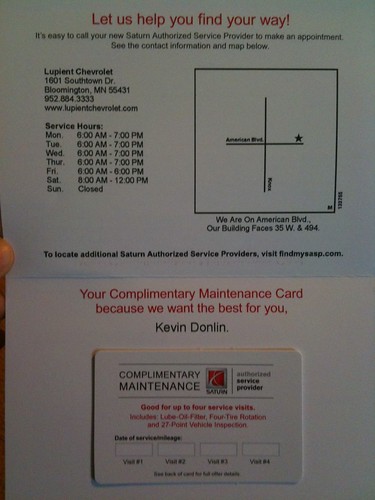

Background: I own a Saturn. Back when Saturn went out of business, a local Chevrolet firm took over the service contracts from the former Saturn dealer. So I got several letters in the mail, asking me to come in and give the Chevy guys a try.

I ignored every letter.

Because none was half as compelling as the offer above, which has what I call "The 4 Rs of Irresistible Offers." The offer is:
  1. Riveting
  2. Relevant
  3. Realistic
  4. Risk-free
1) Riveting. You can't beat 4 free maintenance visits with a stick.

Application: Your offer should be so riveting that clients and prospects will feel like they're ripping you off. I almost feel that way about this offer. Almost.

Because, even though I know there's a cost to them of offering 4 free service visits, once they get me into their building, they can find lots of things wrong with my car to fix above and beyond the free service -- after they win my trust. They will no doubt make money on this long-term ... IF they earn my trust.

2) Relevant. They address me by name and know that I still own the car. Plus, they're a 10-minute drive from my house. So they've demonstrated knowledge of me and my life. This offer is relevant.

Application: How relevant are your offers to your prospects and clients? Are you speaking directly to them and their needs?

3) Realistic. They aren't promising anything incredible -- just a free oil change, tire rotation, and vehicle inspection.

Application: How realistic are your offers? You can actually repel buyers with outlandish offers, like $500 in free gasoline or a free iPad. When in doubt, ask 3-5 clients whose judgment you trust. If they don't roll their eyes, your offer is likely realistic enough to roll out to a bigger audience.

4) Risk-free. Very important. This offer costs me nothing. Sure, I fully expect them to charge me a couple of bucks for tax, etc., but I will still come out ahead.

Making offers risk-free by offering a money-back guarantee is one thing I counsel all of my copywriting clients to do.

Sure, you may refund 2-3% of buyers. But if your sales double as a result of your guarantee, do you really care? In other words, would you rather have 100% of $100,000 ... or 95% of $200,000? A risk-free offer can get you that larger figure.

Make your next offer Riveting, Relevant, Realistic, and Risk-free. When you do, you will be making an irresistible offer.

And you will realize this great truth: The whole point of your marketing is to make selling superfluous.


You'll find more ideas like these in my Free Report, Guaranteed Marketing.

Tuesday, January 25, 2011

80/20 Client Service: The Secret to More Profits and Fewer Headaches

There's a limited number of hours in every day -- 24, to be exact.

That means there isn't time to do everything. There are some things you can't do ... and shouldn't do.

Especially when it comes to the people your business serves -- your clients.

The less time you waste serving the wrong clients -- people who complain about price, are slow to pay, don't appreciate what you do, etc. -- the more time you can invest serving the right clients -- those people who cheerfully pay your fees, appreciate what you do, and refer others like them.

So, stop talking to the wrong clients and start talking to more right clients.

Now. How can you tell who is who? By doing "80/20 Thinking."

As described in the life-changing book by Richard Koch, The 80/20 Principle: The Secret to Achieving More with Less:
To engage in 80/20 Thinking, we must constantly ask ourselves: what is the 20 percent that is leading to 80 percent? What are the vital few inputs or causes, as opposed to the trivial many? Where is the haunting melody being drowned out by the background noise?
Here's what happens when you engage in 80/20 Thinking: You find that a large percentage of your revenue comes from a small percentage of your clients. Implication? These are the right people to be spending more time with!

Examples:
  • 85% of your revenue comes from clients within 20 miles of your business.
  • 62% of your revenue comes from 3 client segments: appliance repair shops, bookkeepers, and professional speakers.
  • 78% of your revenue comes from clients who belong to the Chamber of Commerce.

Important: The actual amount will almost never be exactly 80%, but it will be disproportinately large. Look for any big output coming from a small input.

When I applied 80/20 Thinking to my resume writing service back in 1999, I found that about 70% of revenue came from four kinds of clients: sales, marketing, IT, and management professionals.

And I liked doing business with these clients -- they were smart, didn't complain about price, and they got good results from my service, which led them to refer others.

So guess what? I added a tagline to my business to attract more clients like them. It read as follows: "Specializing in resumes for sales, marketing, IT, and management professionals."

A little thing, right? But it had a big impact. I started getting calls from more of my idea clients -- sales, marketing, IT, and management professionals.

You can, too. But not until you first identify which clients you want to spend more time with.

Now, don't forget -- there's a flip side to clients you love. This would be clients you ... don't love.

Example: If you find 72% of your revenue comes from orthodontists and bookkeepers, but you HATE working with orthodontists and bookkeepers, then STOP working with them and START looking for clients elsewhere.

When I identified the 20% of clients who gave me 80% of my problems, I created an “undesirable” status in my Goldmine database for these unpleasant clients and prospects who were unpleasant to deal with. Those people (from certain industries that shall remain nameless) never heard from me again.

Does this sound cold? Consider: No matter how well you serve clients, about 1-5% will never be happy, no matter what you do.

Then consider: Time isn’t money. Time is everything. Time is all we have each day. So don’t waste yours on people you don't enjoy serving.

80/20 Thinking helped eliminate nearly all my client service headaches in a few weeks, while attracting more ideal clients. My business grew and I had more fun.

80/20 Thinking can work wonders for your client service and your business, too.

(More ideas like these in the Free Report, Guaranteed Marketing for Service Business Owners.)

Monday, January 24, 2011

Fixing Complaints: The 95% ROI and Quick Way to Get New Clients

Fact: Clients who complain are more interested in working with you than clients who say nothing.

Think about it: If you get awful service from a vendor you have no intention of ever using again, you likely won't complain. Instead, you will silently take your business elsewhere.

So do whatever it takes to "save" complaining clients. Because these people secretly want to keep working with you. And because the payoffs can be huge ...

I remember Sharon, a client of my resume service back in 1998. Upon seeing the first draft of my work for her, she said, "Oh, this has problems. I don't like this."

My reply: "Thanks for letting me know that now. The sooner we fix this the better. Please tell me everything that's bothering you and why."

We then went through her resume, line by line. In the end, she was delighted with the result. And she later referred more than 8 new clients and several thousand dollars in revenue to my business.

That's just one example.

According to CustomerThermometer.com:

Fixing problems turns angry customers into loyal advocates. Jake Poore, who looked after “service recovery” for Disney says “everyone makes mistakes, that’s human.

But how do you solicit those mistakes and rectify them so that the story is now possibly better than if there were no mistake at all?”

He makes the point that customers who go home mad tell their story, whereas those who go home happy tell your story. Often a bad experience that was turned around makes for a happier customer and a better story than a customer who had a good experience in the first place.

According to "Manage Complaints to Enhance Loyalty," an article by John Goodman published in the Feb. 2006 issue of "Quality Progress," solving customer complaints pays you back with a 95% profit for the time and effort invested:

The following are cost-benefit calculations for getting customers to complain and satisfying them. The assumptions are:

• A customer is worth at least $30 in profit over a year’s time.
• The cost of handling a complaint is about $5.
• At least 75% of callers are satisfied.
• To quantify the payoff of soliciting and handling complaints, it’s critical to know the rate of the prevalence of noncomplainants and their loyalty as well as the loyalty of those who complain and are not satisfied.

The calculation for moving a customer with a problem from noncomplainant to satisfied complainant follows:

• Payoff due to improved loyalty. Typically, moving a customer with a problem from noncomplainant to complainant to a satisfied caller raises loyalty by about 30%, meaning, conservatively, handling a customer at a cost of $5 will give you a payoff of (.30 increase in loyalty) x (.75 satisfied) x $30 value = $6.75.

After covering the $5 cost of handling the complaint, your are left with $1.75 profit and or an ROI of 35% ($1.75/$5 cost to handle)

The article goes on to detail the total return-on-investment of 95% from the increased word-of-mouth referrals that result from fixing customer complaints:

If, conservatively, one out of 10 satisfied customers produces a word-of-mouth referral and one new customer worth $30 is won for every 40 who hear good things, then satisfying 10 customers adds $30 in word-of-mouth benefits, or $3 for each customer satisfied (10 customers satisfied times four positive referrals per satisfied customer times one new customer for each 40 hearing positive referrals).

That adds an additional $3 payoff for each customer satisfied, raising the ROI to 95% ($1.75 + $3.00)/$5.00. The preceding calculation is a simple estimate of the impact of positive word of mouth produced by good service on loyalty and profits.

Finally, Southwest Airlines went so far as to hire a Chief Apology Officer, a guy who "spends his 12-hour work days finding out how Southwest disappointed its customers and then firing off homespun letters of apology." Which may explain why Southwest Airlines is the only airline in America with actual fans.

Bottom Line: Do whatever it takes to satisfy complaining clients. See every service problem as a chance for you to triumph. When you do, your happy clients will tell their friends.

A customer service "recovery" can be as valuable as delivering good service the first time. Not that you should cause complaints in order to recover from them -- that's like hitting yourself in the head with a hammer because it feels so good when you stop.

But you never run from complaints. Instead, rush to solve them, then encourage your clients to share their new-found happiness with others.

(More ideas like these in the Free Report, Guaranteed Marketing for Service Business Owners.) 

Saturday, January 22, 2011

Free Marketing Seminar - 11 Quick Ways to Get More Clients in 2011 - Minneapolis, St. Paul, Twin Cities

(Note: seminar registration has closed. But you can download free business-building information here.)

How's business?

Want to make 2011 better than 2010 was?

Your product or service may be the best, but if you don't market your business better this year, the competition could eat your lunch.

Get the advantage you need in this new seminar, "11 Quick Ways to Get More Clients in 2011," presented by Kevin M. Donlin, from Client Cloning Systems, Friday, January 28, 2011 in Plymouth, MN.

Sign up at no charge here.

When you attend this Free 60-minute event, you will discover:

  • The Quickest Way to Get More Clients
  • Three (legal) ways to eavesdrop on your prospects and find their hot buttons
  • How to "force" Google to help create your next advertisement
  • The $193-Billion "Kaizen Marketing" Secret ... hiding in plain sight
  • And much more -- you get 11 proven business-building tactics in all

Kevin M. Donlin:
  • has been marketing online since 1994, when he sold one of the first ebooks ever;
  • was Webmaster for FedEx.com from 1995 to 1998, when he worked with the pioneers of Internet marketing;
  • has been an entrepreneur since 1998;
  • was among the first to use pay-per-click (PPC) advertising in 1999;
  • is author of the forthcoming book, 21 Quick Ways to Get More Clients, and
  • has been interviewed on marketing topics by KARE-11 TV, WCCO Radio, The Wall Street Journal, The New York Times, Fortune magazine, Entrepreneur magazine, and many others.

Kevin is a copywriter and marketing strategist who writes sales letters, web pages, and print ads for small business clients in the Twin Cities and across America.

Note: seminar registration has closed, but you can download free business-building information here

File under: small business marketing, marketing seminar, marketing class, business training, marketing Twin Cities, b2c marketing, b2b marketing, marketing a service business, sales and marketing, marketing a service business, free marketing seminar, marketing seminar

Thursday, January 20, 2011

How to Get More Revenue from Clients and Serve Them Better, Today

Want to make more money in your service business, starting today?

Do this: Offer an upsell.


Simply create a deluxe version of whatever you sell -- raise the price 20-50% and add a higher level of service. When you do, about 20% or more of your clients will choose the higher-price option.

How can you offer a higher level of service to justify a higher price?
  • Deliver faster -- offer "emergency" rates for same-day or priority service; ship FedEx Priority Overnight instead of U.S. Mail
  • Deliver more -- add 20-50% of whatever it is you deliver, like super-sizing a restaurant portion
  • Deliver better -- offer 2-3 Special Reports to help clients get even faster results with your service
I have never, ever, failed to see an upsell add more money to a bottom line. And, almost always, it's 20% of your clients who will choose the higher-price option.

The only real obstacle to this profit-building tactic is in your head: You probably think your business is "different" and your clients won't have any use for a deluxe version.

News Flash: You are not your clients.

And the surest way to under-serve your market and leave money on the table is to have contempt for a new marketing idea like this prior to investigating it for yourself.

Don't be contemptuous of new ideas. Try them. Starting with this one: Offer an upsell.

Tuesday, January 18, 2011

One More Way to Eavesdrop on Your Prospects and Find Hot Buttons

I've written about how to "eavesdrop" on your prospects and learn to uncover the "hot buttons" that make them buy more from you, here and here.

Today, I'll give you one more way to do it: Read their book reviews on Amazon.

Just like blogs, most of your prospects read books. And many book readers also post reviews on Amazon. Start reading these reviews. Now! Because they are another goldmine of hot buttons for you to exploit.

Below is an example book review, for the book Guerrilla Marketing for Job Hunters 2.0 ...


See those parts highlighted in red?

“A Swiss Army Knife for the Job Seeker” is a potentially brilliant headline for an ad, one I never would have that of. What ideas are your prospects posting in their Amazon reviews?

And the underlined sentence about LinkedIn could easily be turned into a bullet point for a sales letter, like this:
  • Are you on LinkedIn? You may think you’re using all the tools available, but are you? If recruiters and headhunters aren’t calling, you’re probably making this simple mistake (see page 87).
Get the idea? You can make the cash register ring like a Salvation Army bell when you find and push the right hot buttons.

But you’ll never uncover them until you start reading your prospects’ email, the comments they post on blogs, and the book reviews they post on Amazon.

Best part: Those hot buttons are out there, right now, waiting for you to find them. You or any good copywriter can do it.

(More ideas like these in the Free Report, Guaranteed Marketing for Service Business Owners.) 

Sunday, January 16, 2011

How to Improve Your Marketing with the "Colonoscopy" Point of View

Did you know that serving your clients is just like giving them a colonoscopy?

Let me explain ...

At a seminar I attended in August 2010, marketing author and thinker Seth Godin said something profound, which I wrote down (lucky you!). He said this: “People judge their entire colonoscopy experience based on what they remember from the last 30 seconds.”

In other words, last impressions make lasting impressions.

And here’s what it means for your service business ...

The last time I took my car for a tune-up to one auto dealer, he did a good job that was fairly priced. But I never went back.

Why?

Because he spilled a full bottle of STP gas treatment on the front seat, cleaned it up poorly, then apologized half-heartedly -- and only after I confronted him about it. That’s the part of the experience I remembered.

Action Step: Take a long look at the final “30 seconds” of whatever you do for your clients.

Are you leaving the best lasting impression? If not, fix it. Fast. If you don’t, your clients’ last contact with you may be their … last contact with you.

Bio: Kevin Donlin can help you grow your business and enjoy the breakthrough results your hard work deserves. If you're interested in boosting your revenues and profits, please click here.